
Close Menu
    Facebook X (Twitter) Instagram
    SciTechDaily
    • Biology
    • Chemistry
    • Earth
    • Health
    • Physics
    • Science
    • Space
    • Technology
    Facebook X (Twitter) Pinterest YouTube RSS
    SciTechDaily
    Home»Space»Cosmic Lens Flair: Hubble Captures a Gravitationally Lensed Galaxy
    Space

    Cosmic Lens Flair: Hubble Captures a Gravitationally Lensed Galaxy

    By ESA/HubbleJuly 18, 2022No Comments2 Mins Read
    Facebook Twitter Pinterest Telegram LinkedIn WhatsApp Email Reddit
    Share
    Facebook Twitter LinkedIn Pinterest Telegram Email Reddit
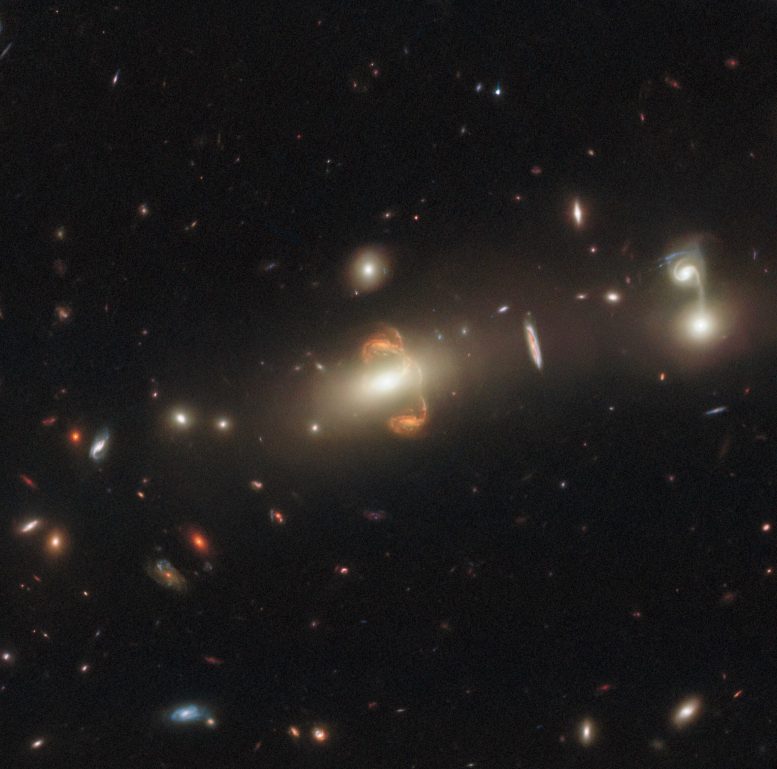
    Gravitationally Lensed Galaxy SGAS J143845+145407
    Hubble Space Telescope observation of a gravitationally lensed galaxy that is identified as SGAS J143845+145407. Credit: ESA/Hubble & NASA, J. Rigby

    Hubble captured the gravitationally lensed galaxy SGAS J143845+145407, where a massive object bends light to produce a mirror image.

    This intriguing observation from the Hubble Space Telescope reveals a gravitationally lensed galaxy with the long-winded identifier SGAS J143845+145407. Gravitational lensing has generated a mirror image of the galaxy at the center of this image, creating a captivating centerpiece.

    Gravitational lensing occurs when a very massive celestial body — such as a galaxy cluster — causes a sufficient curvature of spacetime to bend the course of light around it, as if by a lens. Appropriately, the body causing the light to curve is called a gravitational lens, and the distorted background object is referred to as being “lensed.”

    Sometimes, gravitational lensing can result in multiple images of the original object, as seen with the galaxy in this image, or in the background object appearing as a distorted arc or even a ring. Another significant effect of this lensing distortion is magnification, which allows astronomers to view objects that would otherwise be too far away or too faint to be seen.

    The NASA/ESA Hubble SPace Telescope has a special flair for detecting lensed galaxies. The telescope’s sensitivity and crystal-clear vision allow it to see very faint and distant gravitational lenses that cannot be detected with ground-based telescopes because of the blurring effect of Earth’s atmosphere. In fact, Hubble was the first telescope to resolve details within lensed images of galaxies, and is capable of imaging both their shape and internal structure.

    This particular lensed galaxy image is from a set of Hubble observations that take advantage of gravitational lensing to peer inside galaxies in the early Universe. The lensing reveals details of distant galaxies that would otherwise be unobtainable, and this allows astronomers to determine star formation in early galaxies. This in turn gives scientists a better insight into how the overall evolution of galaxies has unfolded.

    Never miss a breakthrough: Join the SciTechDaily newsletter.
    Follow us on Google and Google News.

    Astronomy Astrophysics European Space Agency Hubble Space Telescope
    Share. Facebook Twitter Pinterest LinkedIn Email Reddit

    Related Articles

    Hubble Captures a Dangerous Dance Over 100 Million Light-Years From Earth

    Hubble Captures the Final Acts of a Monster Star

    Hubble Find Surprises Astronomers: White Dwarfs Can Still Undergo Stable Thermonuclear Activity

    First Evidence of Water Vapor at Jupiter’s Moon Ganymede – May Hold More Water Than All of Earth’s Oceans

    Our Giant Universe: Hubble Spots Massive Galaxy Cluster With a Wealth of Exciting Possibilities

    Tantrums of a Baby Star: Herbig-Haro Objects

    Unexpected Discovery: Hubble Space Telescope Uncovers Concentration of Small Black Holes

    “Unprecedented” – Unusual Planetary Nebula Fades Mere Decades After It Arrived

    Hubble Captures Unprecedented Fading of Stingray Nebula – “This Is Very, Very Dramatic, and Very Weird”

    Leave A Reply Cancel Reply

    • Facebook
    • Twitter
    • Pinterest
    • YouTube

    Don't Miss a Discovery

    Subscribe for the Latest in Science & Tech!

    Trending News

    Common Laxative May Help Reverse Depression-Related Brain Fog

    Younger Generations Are Aging Faster – and It May Be Fueling a Surge in Cancer

    New Discovery Could Unlock Quantum Computers the Size of a Coin

    Shingles Vaccine Linked to 24% Lower Dementia Risk in Older Adults

    Scientists Found a Wordle Trick That Solves 99% of Puzzles

    A Hidden Galaxy Called Shadow Blaster May Explain One of Astronomy’s Biggest Mysteries

    These 3 Common Sleep Habits May Be Aging Your Brain Faster

    Rare Goblin Shark Spotted Alive in Its Natural Habitat for the First Time

    Follow SciTechDaily
    • Facebook
    • Twitter
    • YouTube
    • Pinterest
    • Newsletter
    • RSS
    SciTech News
    • Biology News
    • Chemistry News
    • Earth News
    • Health News
    • Physics News
    • Science News
    • Space News
    • Technology News
    Recent Posts
    • New Fossils Show the Arctic Was an Evolutionary Powerhouse During the Age of Dinosaurs
    • What Happened to Australasia’s Lost Crocodiles? New Research Reveals a Dramatic Extinction Story
    • 520-Million-Year-Old Fossils Solve One of Evolution’s Biggest Mysteries
    • This Extraordinary Desert Mouse Defies Aging – and It Could Change Human Longevity
    • A Simple Blood Test Can Reveal the True Age of Your Brain, Heart, and Other Organs
    Copyright © 1998 - 2026 SciTechDaily. All Rights Reserved.
    • Science News
    • About
    • Contact
    • Editorial Board
    • Privacy Policy
    • Terms of Use

    Type above and press Enter to search. Press Esc to cancel.