
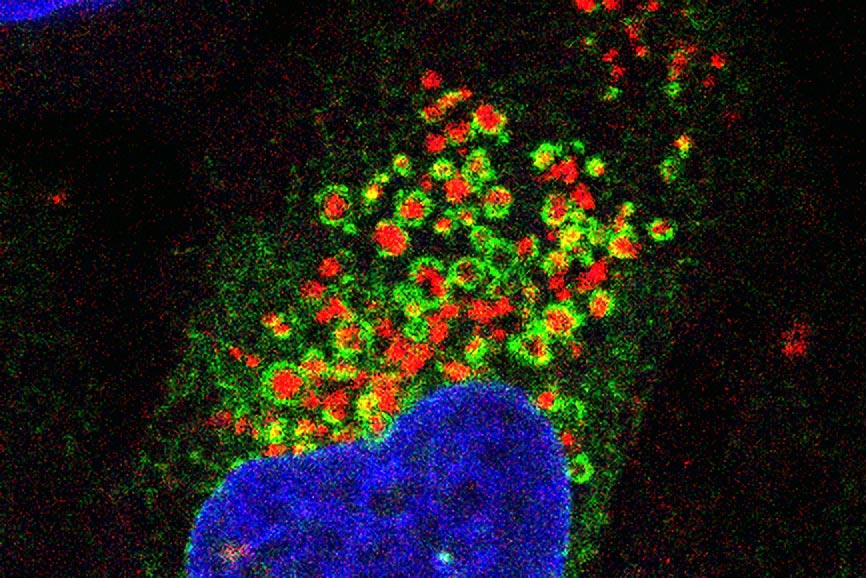
For the first time, researchers describe a pathway by which cells repair damaged lysosomes, structures that contribute to longevity by recycling cellular trash.
The discovery is an important step toward understanding and treating age-related diseases driven by leaky lysosomes. The study, by scientists from the University of Pittsburgh, will be published today (September 7, 2022) in the journal Nature.
“I believe these findings are going to have many implications for normal aging and for age-related diseases.” Toren Finkel, M.D., Ph.D.
“Lysosome damage is a hallmark of aging and many diseases, particularly neurodegenerative disorders such as Alzheimer’s,” said lead author Jay Xiaojun Tan, Ph.D. He is an assistant professor of cell biology at Pitt’s School of Medicine and member of the Aging Institute, a partnership between Pitt and the University of Pittsburgh Medical Center (UPMC). “Our study identifies a series of steps that we believe is a universal mechanism for lysosomal repair, which we named the PITT pathway as a nod to the University of Pittsburgh.”

As the cell’s recycling system, lysosomes contain powerful digestive enzymes that degrade molecular waste. These contents are walled off from damaging other parts of the cell with a membrane that acts like a chain link fence surrounding a hazardous waste facility. Even though breaks can occur in this fence, a healthy cell quickly repairs the damage. To learn more about this repair process, Tan teamed up with senior author Toren Finkel, M.D., Ph.D. He is director of the Aging Institute and distinguished professor of medicine at Pitt’s School of Medicine.
PI4K2A and PtdIns4P in Damage Signaling
First, Tan experimentally damaged lysosomes in lab-grown cells and measured the proteins that arrived on the scene. He discovered that an enzyme called PI4K2A accumulated on damaged lysosomes within minutes and generated high levels of a signaling molecule called PtdIns4P.
“PtdIns4P is like a red flag. It tells the cell, ‘Hey, we have a problem here,’” said Tan. “This alert system then recruits another group of proteins called ORPs.”
ORP Proteins and the Endoplasmic Reticulum’s Role in Repair
ORP proteins function like tethers, Tan explained. One end of the protein binds to the PtdIns4P red flag on the lysosome, and the other end binds to the endoplasmic reticulum, which is the cellular structure involved in synthesis of proteins and lipids.
“The endoplasmic reticulum wraps around the lysosome like a blanket,” added Finkel. “Normally, the endoplasmic reticulum and lysosomes barely touch each other, but once the lysosome was damaged, we found that they were embracing.”
Cholesterol and Lipid Transfer

Through this embrace, cholesterol and a lipid called phosphatidylserine are shuttled to the lysosome, where they help patch up holes in the membrane fence.
Phosphatidylserine also activates a protein called ATG2. It acts like a bridge to transfer other lipids to the lysosome, the final membrane repair step in the newly described PITT — or phosphoinositide-initiated membrane tethering and lipid transport — pathway.
“What’s beautiful about this system is that all of the components of the PITT pathway were known to exist, but they weren’t known to interact in this sequence or for the function of lysosome repair,” said Finkel. “I believe these findings are going to have many implications for normal aging and for age-related diseases.”
The scientists suspect that in healthy people, small breaks in the lysosome membrane are quickly repaired through the PITT pathway. However, if the damage is too extensive or the repair pathway is compromised — due to age or disease — leaky lysosomes accumulate. In Alzheimer’s, leakage of tau fibrils from damaged lysosomes is a key step in the progression of the disease.
When Tan deleted the gene encoding of the first enzyme in the pathway, PI4K2A, he discovered that tau fibril spreading increased dramatically. This suggests that defects in the PITT pathway could contribute to Alzheimer’s disease progression. In future work, the scientists plan to develop mouse models to understand whether the PITT pathway can protect mice from developing Alzheimer’s disease.
Reference: “A phosphoinositide signaling pathway mediates rapid lysosomal repair” by Jay Xiaojun Tan and Toren Finkel, 7 September 2022, Nature.
DOI: 10.1038/s41586-022-05164-4
This research was supported by the National Institutes of Health (P30AG024827, R01HL142663, R01HL142589, U54AG075931 and K01AG075142) and the UPMC Competitive Medical Research Fund.
Never miss a breakthrough: Join the SciTechDaily newsletter.
Follow us on Google and Google News.