
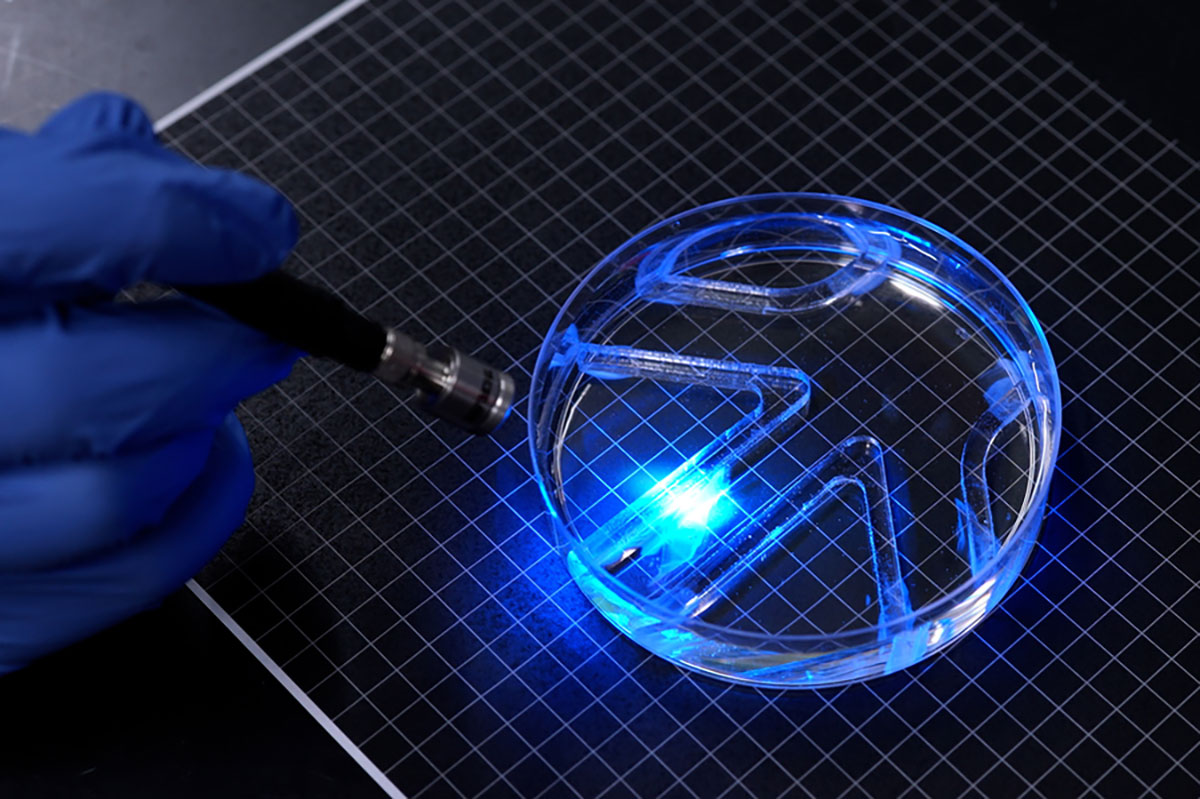
MIT engineers created a paper-thin swimming robot that uses light-controlled living muscle cells to move and steer through water.
Navigating delicate underwater ecosystems requires a gentle physical touch that conventional metal and plastic motors cannot provide.
Engineers trying to build machines soft enough for these environments often turn to living tissue, constructing biohybrid machines powered by chunks of lab-grown skeletal muscle. These biological engines require millions of cells to fabricate, making the resulting swimming robots bulky and expensive to build.
A team of MIT engineers has bypassed the need for thick muscle chunks by designing a swimming robot powered by a layer of living muscle tissue much thinner than a single human hair. Published in the journal Advanced Functional Materials, the flexible device is about the length and width of a stick of gum. Two halves of a paper-thin gel skeleton act as fins, each coated in muscle cells genetically engineered to twitch when exposed to light.
Light turns muscle into steering
“It takes a lot of force to move through water versus air,” says study author Ritu Raman, associate professor of mechanical engineering at MIT. “The robot’s quite strong, given its size.”
Shine light on one fin, and the muscle cells twitch together, bending the gel and pushing against the surrounding water. Flashing light on the opposite fin changes the direction of the force. By varying which side receives light and how often the flashes occur, the researchers can steer the robot and adjust its speed.
In a large petri dish, the robot followed a manually controlled light source and maneuvered through a simple watery maze. At top speed, it traveled about four times its own body length in one minute. Olympic swimmers can cover as much as 65 body lengths per minute, while a cow shark moving leisurely through the ocean travels at roughly the robot’s pace.
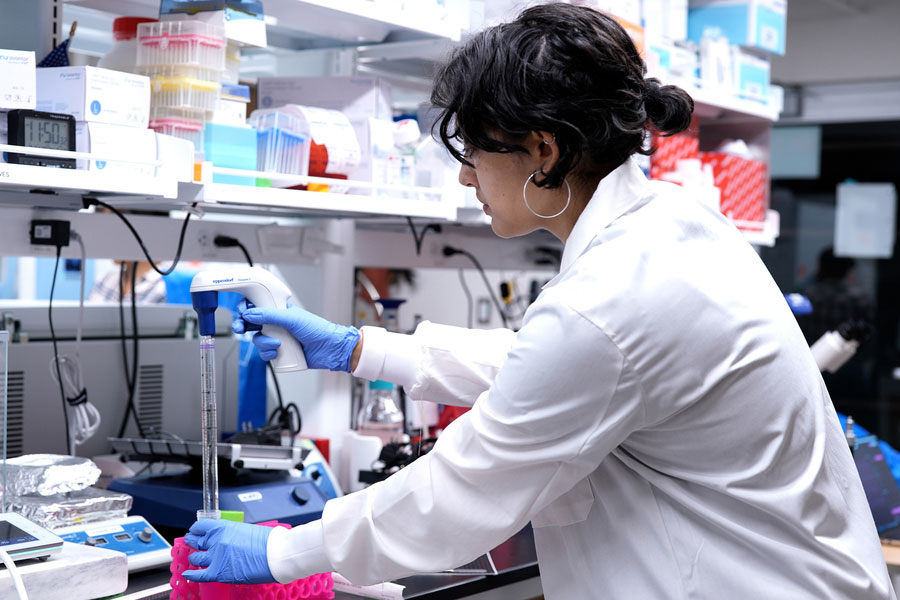
The new design is the first example of a very thin, two-dimensional, muscle-powered robot capable of locomotion. MIT co-authors include first author Maheera Bawa, Arielle Berman, Laura Schwendeman, Ferdows Afghah, and Seanbiron Johnson.
“Currently, biohybrid robots from our group and others’ are built from bulky, 3D chunks of lab-grown skeletal muscle that require millions of cells to fabricate,” says Raman, who notes that thinner, less bulky designs such as the team’s new bot could be cheaper to build and could move more efficiently. “We believe that biohybrid robots powered by living muscle could one day perform delicate jobs like exploring environments too fragile or unpredictable for conventional hardware, because living tissue is soft, responsive to its surroundings, and can heal itself.”
Tiny muscle motions needed more force
Getting such a thin sheet of muscle to move a robot required the researchers to solve a problem left by an earlier experiment.
Last year, Raman’s group built an iris-inspired disk of artificial muscle tissue. They stamped concentric and radial grooves into a gel disk and deposited living muscle cells across its surface. The cells grew along those patterns, forming a thin muscle layer that stretched and squeezed the disk when stimulated with light, much like the iris of an eye changing the size of the pupil.
“People hadn’t seen this muscle architecture engineered from scratch before,” Raman says. “And the cells were moving in multiple directions. But they only moved about 100 microns. From a robotics perspective, their movements were tiny.”
Turning those tiny motions into swimming required the muscle cells to generate more useful force without abandoning the thin architecture. Much of that improvement came from changing the material beneath the cells.
The earlier design used fibrin, an ultrasoft gel that could shrivel under the forces produced by contracting muscle. If the supporting material deformed too easily, some of the muscle’s effort was spent distorting the gel rather than producing larger movements.
Square grooves build stronger muscle
The researchers decided to adjust three properties of the muscle’s supporting skeleton: its composition, its stiffness, and the size and shape of the grooves guiding cell growth.
“For engineering any type of tissue, it’s known that these are knobs you can tune,” Raman says. “And we wanted to optimize all these parameters to support live muscle cells.”
Different groove shapes produced noticeably different muscle arrangements. Some resembled narrow square troughs, while others curved more like long valleys. Muscle cells aligned more effectively inside the square-bottomed grooves. Better alignment encouraged the cells to fuse into fibers, producing stronger and more coordinated muscle tissue.
The team also replaced fibrin with gelatin methacrylate, or GelMA, a material used in tissue engineering. By preparing different GelMA formulations, the researchers could test skeletons with different stiffnesses. Muscle cells grew in better alignment and generated the greatest force on the stiffer gels.
A GelMA film about half a millimeter thick provided enough support for a single muscle layer while remaining light and flexible. During contraction, the cells could stay attached to the film instead of peeling away from its surface.
Repeated stimulation strengthened the tissue further. The researchers put the muscle through a training routine using flashes of light, effectively exercising the cells before asking them to propel the robot.
They then stamped square-bottomed grooves onto both sides of a thin GelMA body and lined the surfaces with muscle cells. As the cells fused into aligned fibers, they formed two independently controlled muscles that acted as the robot’s fins.
“You can think of the robot as having two independent muscles,” Raman says. “If we shine a light on just one, only that muscle moves. If shining on both, they both flap.”
The body design comes next
The robot’s present shape was purposely kept simple so the researchers could first determine whether a single layer of muscle could produce enough force for swimming. With that demonstrated, they can begin changing the body itself to improve performance.
“Our next goal is to optimize the body design to enable faster swimming,” Raman says. “But even at slow swim speeds, one could imagine a muscle-powered swimmer being used for purposes like environmental monitoring in aquatic environments.”
Reference: “2D Skeletal Muscle Thin Film Actuators Enhance Efficiency of Biohybrid Robots” by Maheera Bawa, Arielle Berman, Laura Schwendeman, Ferdows Afghah, Seanbiron Johnson and Ritu Raman, 28 September 2026, Advanced Functional Materials.
DOI: 10.1002/adfm.78065
This research was supported, in part, by the Office of Naval Research.
Never miss a breakthrough: Join the SciTechDaily newsletter.
Follow us on Google and Google News.