

Supersized atoms could help quantum computers run longer with fewer errors after scientists broke three records without the costly cooling these experiments usually require.
Scientists at the University of Stuttgart’s 5th Institute of Physics have set three records for circular Rydberg atoms: their lifetime, their size, and how long they can be held in laser traps. The findings, published in Nature Communications, could help researchers build more capable quantum simulators and, eventually, quantum computers.
Quantum simulators recreate quantum systems that scientists want to investigate. They also provide a way to develop and test techniques for future quantum computers. Rydberg atoms are promising components for both, but their sensitivity to the surrounding environment limits how long researchers can use them.
“One major challenge in developing high-performance quantum simulators was that Rydberg atoms are highly sensitive and remain stable for only a short time. We overcame this challenge and increased the stability of the atoms by a factor of 20,” says Prof. Dr. Tilman Pfau, head of the 5th Institute of Physics.
Why Giant Atoms Matter for Quantum Computing
A Rydberg atom has an electron excited into a state far from its nucleus, making the atom several thousand times larger than an ordinary atom. That expanded size allows neighboring atoms to interact across unusually large distances, a useful property for controlling quantum systems.
Those interactions can span about 5 µm (0.0002 inches), roughly one-tenth the thickness of a human hair. Although tiny by everyday standards, that separation is vast compared with the dimensions of ordinary atoms. Rydberg atoms are therefore valuable for neutral-atom quantum technologies, which use neutral (i.e., uncharged) atoms trapped and controlled with laser light.
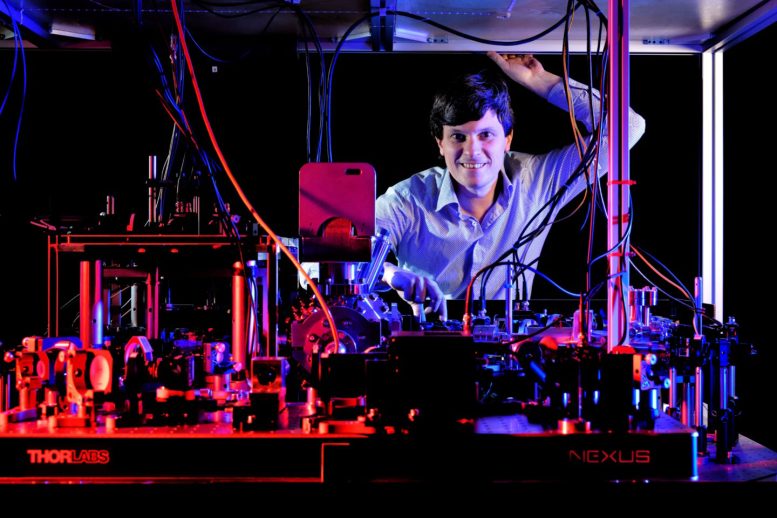
The Stuttgart team worked with circular Rydberg atoms, whose excited electron occupies a circular state around the nucleus. Their electron orbits reached about 1.1 µm (0.000043 inches) in diameter, roughly 10,000 times the size of those in ordinary atoms.
“We set three international records at once: the longest lifetime ever measured for individual Rydberg atoms, the largest controlled circular Rydberg atoms, and the longest storage time for such atoms in optical tweezers,” says Dr. Florian Meinert, group leader at the 5th Institute of Physics.
Two Records Measure Different Kinds Of Stability
The circular state lasted 11 milliseconds, more than 20 times longer than comparable states in free space. Separately, the researchers held the atoms in a laser trap, known as an optical tweezer, for 133 milliseconds. These measurements describe different achievements: how long the excited state survives and how long an atom remains trapped.
“These records open up new possibilities for making quantum simulators more powerful, performing more computations, and controlling quantum systems with greater precision,” says Einius Pultinevicius, a doctoral researcher in Meinert’s team.
“We achieved these record results at room temperature without the costly liquid helium cooling previously required,” says Meinert.
Blocking Microwaves Instead Of Cooling The Atoms
Room temperature may feel simply normal to people, but it creates a disruptive environment for these sensitive atoms. Surrounding surfaces emit thermal radiation, including invisible microwaves that can disturb their excited states. Earlier experiments relied on elaborate cooling systems to reduce this interference.
The team instead adapted a shielding concept from the 1980s. The original approach used metal walls to block troublesome thermal radiation. For this experiment, researchers placed the atoms between two transparent, electrically conductive plates that suppress the interfering microwaves.
“Our results show that extremely long-lived Rydberg atoms are possible even at room temperature. We have refined a well-known concept in physics for use in modern quantum platforms,” says Meinert.
More Time for Quantum Calculations
“These advances could play an important role in the development of quantum simulators and quantum computers,” says Pfau. Neutral atoms held in optical tweezers are among the leading candidates for quantum simulators that can grow to accommodate larger systems.
Longer-lived Rydberg states could help preserve quantum information and allow more precise control over interactions between atoms. Researchers expect that added stability will support longer calculations with fewer errors, although the records themselves are advances in the underlying technology rather than a demonstration of a complete quantum computer.
The University of Stuttgart now has an experimental platform for circular Rydberg atoms that is unique worldwide. The team plans to use it to develop new quantum computers, quantum simulators, and high-precision quantum sensors.
Reference: “Long-lived giant circular Rydberg atoms at room temperature” by Einius Pultinevicius, Aaron Götzelmann, Fabian Thielemann, Christian Hölzl and Florian Meinert, 15 September 2026, Nature Communications.
DOI: 10.1038/s41467-026-77764-x
Never miss a breakthrough: Join the SciTechDaily newsletter.
Follow us on Google and Google News.
4 Comments
Quantum physics loves to throw brute-force cryogenic cooling at every instability problem, treating atomic decay as an unavoidable consequence of operating in a “warm” bulk environment. But the recent world-record breakthrough from the University of Stuttgart’s 5th Institute of Physics—shattering lifetime, size, and storage limits for giant circular Rydberg atoms—proves that decay is a boundary control problem, not an intrinsic material limit.Rather than relying on costly liquid helium, advanced hardware architectures integrate a complete structural defense system: combining an outer NC State perovskite thin-film (delivering extreme thermal insulation at $0.04 \text{ W m}^{-1} \text{ K}^{-1}$ to block environmental noise) with an underlying Rice University ultrathin $RuO_2$ altermagnetic layer grown on a substrate to lock in quantum spin states and boundary impedance.By engineering this dual-material interface to suppress interfering blackbody microwave radiation and thermal bleed, the system locks those giant, 1.1-micrometer-wide electron orbits into stable trajectories lasting 20 times longer than free-space states. Traditional bulk-noise models completely miss what’s actually happening here: stability isn’t a mystical accident; it’s designed at the boundary.When you look at how managing local boundary geometry and dual-material stacks locks down quantum states, a unified picture emerges. Whether it’s tailoring perovskite and altermagnetic layers to stabilize giant atomic orbits, managing superfluid chemical potentials to launch short-lived particles, or steering wave paths through hyperbolic cavities, physical organization is never just about passive bulk properties. State transitions, energy delivery limits, and stability thresholds are entirely governed by boundary geometry and topological stress tolerance.
Giant Atoms Built for Quantum Computing???????
Ask researchers: Do you know about quantum computing, electronic computing, or atomic computing?