
Close Menu
    Facebook X (Twitter) Instagram
    SciTechDaily
    • Biology
    • Chemistry
    • Earth
    • Health
    • Physics
    • Science
    • Space
    • Technology
    Facebook X (Twitter) Pinterest YouTube RSS
    SciTechDaily
    Home»Physics»Quantum Leap: Scientists Slash Atom Superposition Time by 10,000x
    Physics

    Quantum Leap: Scientists Slash Atom Superposition Time by 10,000x

    By University of LiègeApril 22, 20254 Comments5 Mins Read
    Facebook Twitter Pinterest Telegram LinkedIn WhatsApp Email Reddit
    Share
    Facebook Twitter LinkedIn Pinterest Telegram Email Reddit
    Atoms Photons Entanglement Art
    Researchers at the University of Liège have developed a groundbreaking method to rapidly generate quantum superpositions, known as NOON states, using a combination of geometry and quantum control. This innovation drastically reduces preparation time from minutes to milliseconds, opening the door to practical applications in quantum computing and ultra-precise sensors. Credit: SciTechDaily.com

    Researchers have developed a method to quickly create NOON states using ultra-cold atoms. These states, which play an important role in metrology and quantum computing, are now becoming accessible through experiments.

    Creating quantum superpositions of ultra-cold atoms has long been a major challenge, with existing methods proving too slow to be practical in the laboratory. Researchers at the University of Liège have now developed a new approach that combines geometry with “quantum control” to significantly accelerate the process, opening the door to real-world applications in quantum technology.

    Imagine navigating a supermarket with a cart loaded to the brim. The goal is to reach the checkout faster than everyone else without losing items on the tight turns. The key to success is finding the straightest, smoothest path to maintain speed without needing to slow down.

    This is precisely what Simon Dengis, a doctoral researcher at the University of Liège, has accomplished. Not in a supermarket, but in the complex realm of quantum physics.
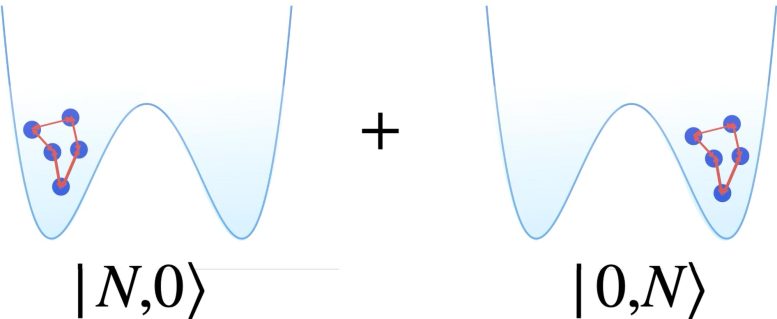
    Visualizing a NOON State in a Double Well Quantum Trap
    A NOON state is a superposed quantum state where N particles are in one state “at the same time” and in another “at the same time”. Here, the particles are trapped in two wells, within a trap formed by lasers. The superimposed state therefore, consists of a state in which all the particles are in the left-hand well, and a state in which they are trapped in the right-hand well. The particles interact with each other and ‘stick’ together when they are in the same site, preventing an isolated particle from leaving the trap. Credit: University of Liège / S. Dengis

    Working with the Quantum Statistical Physics (PQS) group, Dengis developed a protocol for rapidly generating NOON states. “These states, which look like miniature versions of Schrödinger’s famous cat, are quantum superpositions,” he explains. “They are of major interest for technologies such as ultra-precise quantum sensors or quantum computers.”

    The obstacle of time

    The main challenge? Manufacturing these states normally takes far too long. We’re talking tens of minutes or more, which often exceeds the lifetime of the experiment. The cause? An energy bottleneck, a “sharp bend” in the system’s evolution that forces it to slow down.

    Running Waiter
    Counter-diabatic control compensates for the inertia of a system by modifying it in a certain way. In this case, to compensate for the movement of the water caused by the movement of the waiter, the latter can tilt his tray to compensate for the inertia of the glass and prevent it from tipping over. Credit: University of Liège / S.Dengis

    This is where the ULiège team breaks new ground. By combining two powerful concepts, counterdiabatic driving and the optimal geodesic path, they have succeeded in “smoothing the road” for atoms. The result: the system can evolve faster without losing the trajectory of the desired state, just like a driver who anticipates a bend by tilting his tray.

    “This strategy saves a considerable amount of time: in some cases, the process is accelerated by a factor of 10,000, while maintaining 99% fidelity, i.e. near-perfection of the result,” says Peter Schlagheck, director of the laboratory. Where previously it would have taken around ten minutes to create such a state, the researchers have succeeded in considerably reducing this waiting time … to 0.1 seconds!

    Towards practical applications

    With this breakthrough, it is finally possible to produce NOON states with ultra-cold atoms. This opens up prospects in quantum metrology (ultra-sensitive measurements of time, rotation, or gravity) and quantum information technologies. Ultimately, these tools could improve instruments such as quantum gyroscopes or miniature gravity detectors.
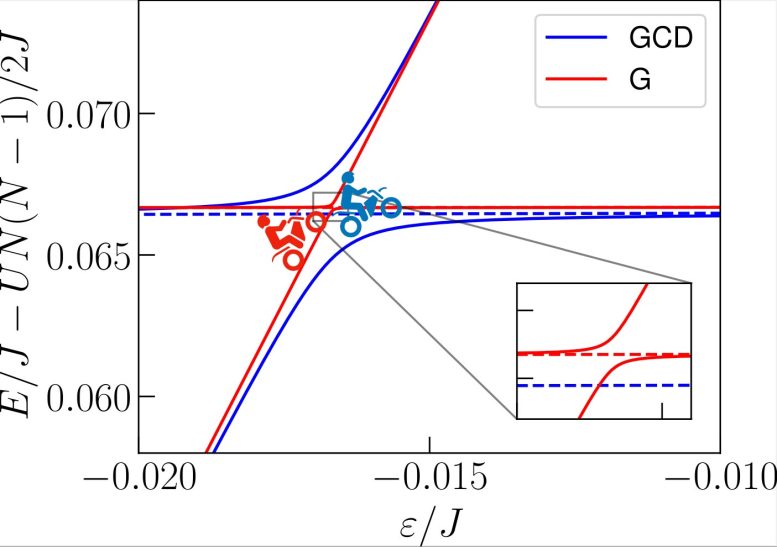
    Energy Level Dynamics Showing Reduced Bottleneck in GCD Protocol
    The proposed protocol (blue, GCD) makes it possible to widen the energy bottleneck (compared with the usual protocol in red, G) and therefore to have to brake less when approaching it. The image can be understood in the context of a motorbike race: the red motorbike will have to brake much more than the blue motorbike because the turn is less “smooth.” The blue bike will therefore arrive at its destination before its opponent. Here, the change in the system’s energies (and therefore its states) is less abrupt, allowing the process to be accelerated drastically. Credit: University of Liège / S.Dengis

    This research shows how theory and experimentation can come together to make concrete advances in quantum physics. By combining mathematical concepts, fundamental physics, and experimental feasibility, ULiège researchers have made a breakthrough that could well transform ideas that were once theoretical into tomorrow’s technologies.

    Quantum superposition and the Noon state

    Quantum superposition is the idea that a quantum system (such as an atom, an electron, or a photon) can exist in several states at the same time, as long as it is not observed. The example most often used to explain this concept is Schrödinger’s cat: a cat is locked in a box. According to quantum mechanics, until the box is opened, the cat is both alive and dead. This simultaneous combination of two states is called superposition.

    It is only by opening the box to observe it that we ‘force’ nature to choose a state: alive or dead. The NOON states are an example of quantum superposition: all the atoms are in both the left-hand well AND the right-hand well. It is only at the moment of measurement that they are found in one or the other.

    Reference: “Accelerated creation of NOON states with ultracold atoms via counterdiabatic driving” by Simon Dengis, Sandro Wimberger and Peter Schlagheck, 10 March 2025, Physical Review A.
    DOI: 10.1103/PhysRevA.111.L031301

    Never miss a breakthrough: Join the SciTechDaily newsletter.
    Follow us on Google and Google News.

    Atoms Quantum Computing Quantum Physics University of Liege
    Share. Facebook Twitter Pinterest LinkedIn Email Reddit

    Related Articles

    Physicists Track Quantum Errors in Real Time

    Physicists Create and Control a Large Quantum Mechanical System Built on Photons

    Quantum Computing Continues To Move Closer to Reality – New Quantum Memory Design

    Physicists Use a Switch to Manipulate Light on Superconducting Chips

    Researchers Make Progress on a Quantum-Computing Proposal

    Geometry of “Super Atoms” May Play a Role in Future Quantum Computer Design

    New System Converts Laser Beam Into Controlled Stream of Single Photons

    Quantum Bits Store Data for Nearly Two Seconds Using Laboratory Grown Diamonds

    Evidence of Elusive Majorana Fermions Raises Possibilities for Quantum Computing

    4 Comments

    1. Bao-hua ZHANG on April 22, 2025 8:54 pm

      Quantum superposition is the idea that a quantum system (such as an atom, an electron, or a photon) can exist in several states at the same time, as long as it is not observed.
      VERY GOOD.

      Ask the researchers:
      1. Is there no superposition state when be observed?
      2. How do you understand the superimposed changes caused by observation?
      3. Is the current quantum theory comprehensive in providing mathematical explanations for superposition?

      Reply
      • Bao-hua ZHANG on April 23, 2025 2:28 am

        According to the topological vortex theory (TVT), the superposition of topological vortices is more diverse and colorful than the so-called quantum superposition states.

        Reply
    2. Tommy Scott on April 23, 2025 8:05 pm

      Nonsense. Superposition is a myth. It doesn’t exist. This is why quantum computers will fail

      Reply
      • Bao-hua ZHANG on April 24, 2025 4:38 pm

        In the so-called academic community where pseudoscience is rampant, you will never make mistakes.

        Reply
    Leave A Reply Cancel Reply

    • Facebook
    • Twitter
    • Pinterest
    • YouTube

    Don't Miss a Discovery

    Subscribe for the Latest in Science & Tech!

    Trending News

    Millions of People Have Osteopenia Without Realizing It – Here’s What You Need To Know

    Researchers Discover Boosting a Single Protein Helps the Brain Fight Alzheimer’s

    World-First Study Reveals Human Hearts Can Regenerate After a Heart Attack

    Why Your Dreams Feel So Real Sometimes and So Strange Other Times

    This Simple Home Device May Boost Brain Power in Adults Over 40

    Enormous Prehistoric Insects Puzzle Scientists

    Scientists Develop Bioengineered Chewing Gum That Could Help Fight Oral Cancer

    After 37 Years, the World’s Longest-Running Soil Warming Experiment Uncovers a Startling Climate Secret

    Follow SciTechDaily
    • Facebook
    • Twitter
    • YouTube
    • Pinterest
    • Newsletter
    • RSS
    SciTech News
    • Biology News
    • Chemistry News
    • Earth News
    • Health News
    • Physics News
    • Science News
    • Space News
    • Technology News
    Recent Posts
    • After 100 Years, Scientists Uncover Hidden Rule Governing Cosmic Rays
    • The Milky Way Has a Hidden Edge and Scientists Finally Mapped It
    • Scientists Stunned by New Organic Molecules Found on Mars
    • Scientists Discover Evolution’s 120-Million-Year-Old “Cheat Sheet”
    • This New “Sound Laser” Could Measure Gravity With Stunning Precision
    Copyright © 1998 - 2026 SciTechDaily. All Rights Reserved.
    • Science News
    • About
    • Contact
    • Editorial Board
    • Privacy Policy
    • Terms of Use

    Type above and press Enter to search. Press Esc to cancel.