
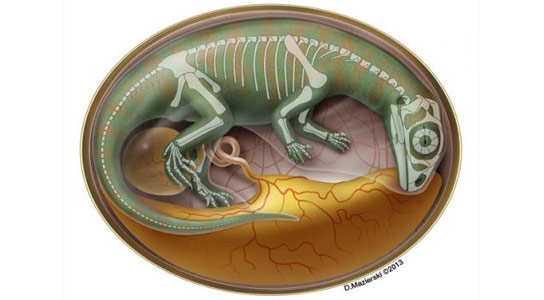
An international team of scientists excavated and analyzed over 200 bones from dinosaurs at different stages of embryonic development from a 190-million-year-old dinosaur bonebed, revealing how dinosaur embryos grew and developed in their eggs.
A 190-million-year-old dinosaur bonebed near the city of Lufeng, in Yunnan, China has revealed for the first time how dinosaur embryos grew and developed in their eggs.
The great age of the embryos is unusual because almost all known dinosaur embryos are from the Cretaceous Period. The Cretaceous ended some 125 million years after the bones at the Lufeng site were buried and fossilized.
Led by University of Toronto Mississauga paleontologist Robert Reisz, an international team of scientists from Canada, Taiwan, the People’s Republic of China, Australia and Germany excavated and analyzed over 200 bones from individuals at different stages of embryonic development.
“We are opening a new window into the lives of dinosaurs,” says Reisz. “This is the first time we’ve been able to track the growth of embryonic dinosaurs as they developed. Our findings will have a major impact on our understanding of the biology of these animals.”
The bones represent about 20 embryonic individuals of the long-necked sauropodomorph Lufengosaurus, the most common dinosaur in the region during the Early Jurassic period. An adult Lufengosaurus was approximately eight meters long.
The disarticulated bones probably came from several nests containing dinosaurs at various embryonic stages, giving Reisz’s team the rare opportunity to study ongoing growth patterns. Dinosaur embryos are more commonly found in single nests or partial nests, which offer only a snapshot of one developmental stage.
To investigate the dinosaurs’ development, the team concentrated on the largest embryonic bone, the femur. This bone showed a consistently rapid growth rate, doubling in length from 12 to 24 mm as the dinosaurs grew inside their eggs. Reisz says this very fast growth may indicate that sauropodomorphs like Lufengosaurus had a short incubation period.
Reisz’s team found that the femurs were being reshaped even as they were in the egg. Examination of the bones’ anatomy and internal structure showed that as they contracted and pulled on the hard bone tissue, the dinosaurs’ muscles played an active role in changing the shape of the developing femur. “This suggests that dinosaurs, like modern birds, moved around inside their eggs,” says Reisz. “It represents the first evidence of such movement in a dinosaur.”
The Taiwanese members of the team also discovered organic material inside the embryonic bones. Using precisely targeted infrared spectroscopy, they conducted chemical analyses of the dinosaur bone and found evidence of what Reisz says may be collagen fibers. Collagen is a protein characteristically found in bone.
“The bones of ancient animals are transformed to rock during the fossilization process,” says Reisz. “To find remnants of proteins in the embryos is really remarkable, particularly since these specimens are over 100 million years older than other fossils containing similar organic material.”
Only about one square meter of the bonebed has been excavated to date, but this small area also yielded pieces of eggshell, the oldest known for any terrestrial vertebrate. Reisz says this is the first time that even fragments of such delicate dinosaur eggshells, less than 100 microns thick, have been found in good condition.
“A find such as the Lufeng bonebed is extraordinarily rare in the fossil record, and is valuable for both its great age and the opportunity it offers to study dinosaur embryology,” says Reisz. “It greatly enhances our knowledge of how these remarkable animals from the beginning of the Age of Dinosaurs grew.”
The research is published in the April 11 issue of the journal Nature.
Reference: “Embryology of Early Jurassic dinosaur from China with evidence of preserved organic remains” by Robert R. Reisz, Timothy D. Huang, Eric M. Roberts, ShinRung Peng, Corwin Sullivan, Koen Stein, Aaron R. H. LeBlanc, DarBin Shieh, RongSeng Chang, ChengCheng Chiang, Chuanwei Yang and Shiming Zhong, 10 April 2013, Nature.
DOI: 10.1038/nature11978
Never miss a breakthrough: Join the SciTechDaily newsletter.
Follow us on Google and Google News.
2 Comments
If I were a scientist say in this I would be fired 190-million-year-old dinosaur is a lye maybe a thousand years what about soft tissue on the bones?
If you really care for https://tutuappx.com/ her and want to give it a shot anyway, first consider the risks and benefits.