
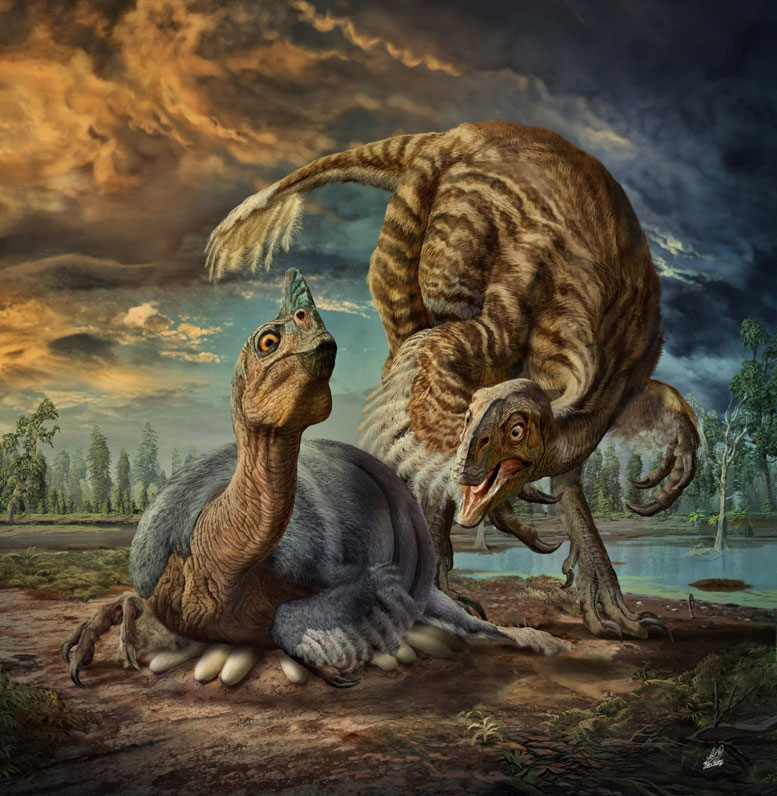
The mystery of the world’s largest dinosaur eggs has been solved, paleontologists have identified the Baby Louie specimen as the embryo of a new species of giant birdlike dinosaur that lived in central-eastern China during the Late Cretaceous period.
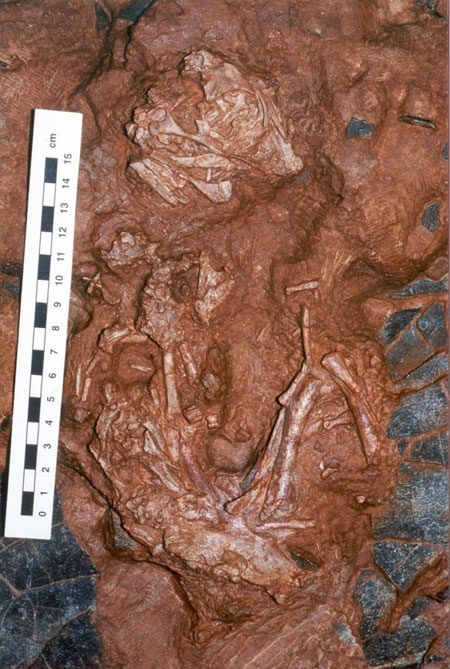
The fossil dinosaur embryo “Baby Louie” and the associated clutch of eggs were first discovered in the early 1990s, but were not formally described at the time. In a paper to be published in Nature Communications, dinosaur paleontologist Darla Zelenitsky from the University of Calgary and co-authors identified the Baby Louie specimen as the embryo of a new species of oviraptorosaur, Beibeilong sinensis, who lived in central-eastern China 90 million years ago during the Late Cretaceous period.
Baby Louie fossil would have grown to gigantic dinosaur
The Baby Louie fossil was discovered in 1993 in a rock formation from the western part of China’s Henan Province. At that time, tens of thousands of dinosaur eggs were being collected by local farmers, then sold and exported to other countries. Many, like Baby Louie, ended up in the United States where it was eventually sold to the Indianapolis Children’s Museum in 2001.
Zelenitsky and her co-authors Philip Currie and Kenneth Carpenter first began examining Baby Louie shortly after it arrived in the United States. They noticed the eggs and embryo skeleton looked similar to those of oviraptorosaurs, a group of meat-eating dinosaurs that superficially look like cassowaries, but the eggs were far too large to have been laid by any known species of such dinosaurs at the time.
“Although the identity of the dinosaur embryo could not be determined due to its state of preservation, I had recognized that the large eggs in the nest belonged to an oviraptorosaur, based on various characteristics of the eggshell. This meant that Baby Louie’s parents must have been truly gigantic, far larger than any known oviraptorosaur species at the time,” says Zelenitsky, who is an assistant professor in the Department of Geoscience. “In the absence of a formal identity, the specimen became known as Baby Louie,” a nickname given by Charlie Magovern, who first exposed the fossil after it came to the United States.
Along with the dinosaur embryo, the Baby Louie fossil contains between six and eight very large eggs. These giant eggs were given their own scientific name, Macroelongatoolithus (meaning large elongated stone eggs). These are the largest-known type of dinosaur eggs, with eggs reaching up to 60 centimeters (24 inches) in length (the eggs associated with Baby Louie reach about 45 centimeters or 18 inches long) that are laid in ring-shaped clutches two to three meters (six to ten feet) in diameter and contain two dozen or more eggs. The Baby Louie specimen was likely a part of one of these large ring-shaped nests.
Eggshell fossil held key to identifying new species
In 2007, a completely unrelated discovery turned up a solution to the mystery behind Baby Louie’s lineage: The first known giant oviraptorosaur, with an estimated body length of eight meters, was unearthed in northern China. At long last, oviraptorosaurs large enough to have been capable of laying eggs as large as Baby Louie’s were known to have existed.
In their article, Zelenitsky and her co-authors compared the bones and discovered that the Baby Louie skeleton belongs to a different kind of giant oviraptorosaur and have given it a brand-new dinosaur name: Beibeilong sinensis, meaning “baby dragon from China.”
“Dinosaur embryos, because they are so small and are only present for a short time interval in the egg, are very rarely preserved as fossils. So discovering a fossilized dinosaur embryo is equivalent to winning the lottery,” Zelenitsky explains. “Baby Louie is the only embryo of a giant oviraptorosaur known in the world.”
Ring-shaped nests of eggs of smaller oviraptorosaur species have been found with the adults sitting in the center of the nest, so an adult Beibeilong probably shared similar behaviors. With their parrot-like skulls, feathers, and two-legged stance, Baby Louie’s parents, weighing in at around 3,000 kilograms (6,600 pounds) — about half as heavy as a Tyrannosaurus rex — are the largest dinosaurs likely to have sat on their nests to brood their clutch of eggs.
Now that the true identity of the Macroelongatoolithus eggs has been resolved, paleontologists can try to determine the geographic distribution of giant oviraptorosaurs. “Despite being large animals, fossilized remains of giant oviraptorosaurs are extremely rare. To date, only three skeletons of these animals have been discovered, all from Asia. Yet, the remains of Macroelongatoolithus eggs are known from dozens of sites in both Asia and North America,” Zelenitsky says.
“The fact that Macroelongatoolithus eggs are so widespread and common compared to their skeletons suggests that giant oviraptorosaurs were probably a more important part of Cretaceous ecosystems than previously thought, based on the rarity of their bones.”
In 2013 Baby Louie was repatriated to the Henan Geological Museum in its home province.
Reference: “Perinate and eggs of a giant caenagnathid dinosaur from the Late Cretaceous of central China” by Hanyong Pu, Darla K. Zelenitsky, Junchang Lü, Philip J. Currie, Kenneth Carpenter, Li Xu, Eva B. Koppelhus, Songhai Jia, Le Xiao, Huali Chuang, Tianran Li, Martin Kundrát and Caizhi Shen, 9 May 2017, Nature Communications.
DOI: 10.1038/ncomms14952
Never miss a breakthrough: Join the SciTechDaily newsletter.
Follow us on Google and Google News.