
These new findings may provide a basis for developing strategies to prevent the further spread of the disease.
According to a recent study conducted by scientists at the University of Miami Rosenstiel School of Marine, Atmospheric, and Earth Science, ships may be contributing to the spread of a deadly coral disease called stony coral tissue loss disease (SCTLD) throughout Florida and the Caribbean.
This disease, which was first detected near Miami in 2014, has now impacted coral reefs in Jamaica, St. Maarten, the U.S. Virgin Islands, and Belize, among other locations. The findings of this study may help researchers to develop testing and treatment methods that can reduce the risk of further disease transmission.
The Role of Ship Ballast Water
Researchers suggest that transport through ship hulls, where the vessel takes on ballast water in one region to keep it stable and releases it at a different port, may have contributed to disease spread.
“Outbreaks in very distant locations suggest that disease transport was aided by means other than just ocean currents, such as through ship ballast water,” said the study’s lead author Michael Studivan, an assistant scientist at the UM Cooperative Institute for Marine and Atmospheric Studies (CIMAS) and NOAA’s Atlantic Oceanographic and Meteorological Laboratory.
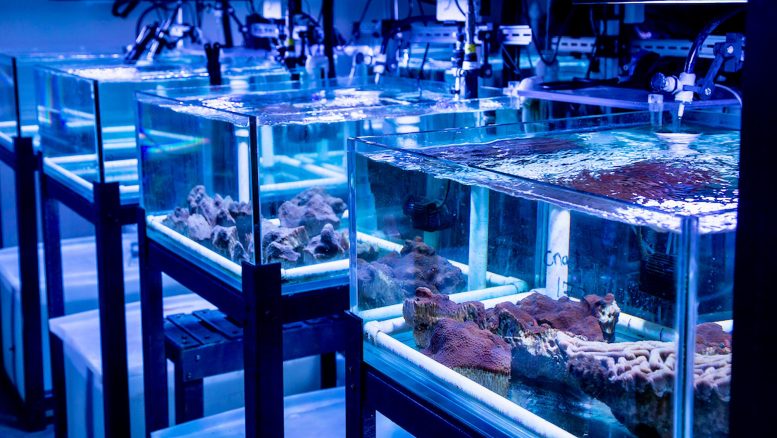
The UM Rosenstiel School researchers conducted two disease transmission experiments in the Experimental Reef Lab at the Rosenstiel School of simulated ship’s ballast water and UV treatment of ballast water to determine whether SCTLD pathogens can be transported in this manner and whether established ballast water treatment approaches like UV can successfully prevent the spread of disease.
The first experiment exposed healthy corals to three types of water: 1) disease-exposed, 2) disease-exposed and UV-treated, and 3) non-disease-exposed water in a flow-through tank system. Over a six-week period, they observed the onset of disease lesions and mortality to determine the number of corals that became diseased, how quickly, and whether UV treatment of disease-exposed water resulted in fewer affected corals. In a second experiment, the researchers held the same types of water in containers to simulate a ship’s ballast tank for one and five days, then exposed the water to healthy corals to determine if the SCTLD pathogens could survive over time and whether they became more or less infectious over time.
The researchers then tested the ballast water generated for both experiments in collaboration with the U.S. Naval Research Laboratory in Key West to quantify the microbial communities and their abundance in untreated and treated ballast water.
Ballast Water Treatment
“The results suggest that ship’s ballast water poses a threat to continued spread and persistence of SCTLD throughout the Caribbean and potentially to reefs in the Pacific, and that established treatment and testing standards may not mitigate the risk of disease spread,” said Studivan.
The Experimental Reef Lab was designed and built by NOAA’s Atlantic Oceanographic and Meteorological Laboratory (AOML) and CIMAS at the Rosenstiel School for conducting research on coral response to changing environmental conditions.
Reference: “Transmission of stony coral tissue loss disease (SCTLD) in simulated ballast water confirms the potential for ship-born spread” by Michael S. Studivan, Michelle Baptist, Vanessa Molina, Scott Riley, Matthew First, Nash Soderberg, Ewelina Rubin, Ashley Rossin, Daniel M. Holstein and Ian C. Enochs, 10 November 2022, Scientific Reports.
DOI: 10.1038/s41598-022-21868-z
The study was funded by the Environmental Protection Agency, the NOAA Coral Reef Conservation Program, the NOAA OAR ‘Omics Program, the Louisiana Board of Regents Research Support Fund Research Competitiveness Subprogram, and the National Science Foundation Ecology and Evolution of Infectious Disease.
Never miss a breakthrough: Join the SciTechDaily newsletter.
Follow us on Google and Google News.
1 Comment
These diseases were observed and studied 35 years ago and now all of a sudden it seems they have just been discovered? Ships bilge water was always suspected of causing the black sea urchin die off 40 years ago. For some reason the current generation of researchers do not read history. https://revistas.ucr.ac.cr/index.php/rbt/article/view/29376