

A common plant seed could be a powerful new tool against microplastics in water.
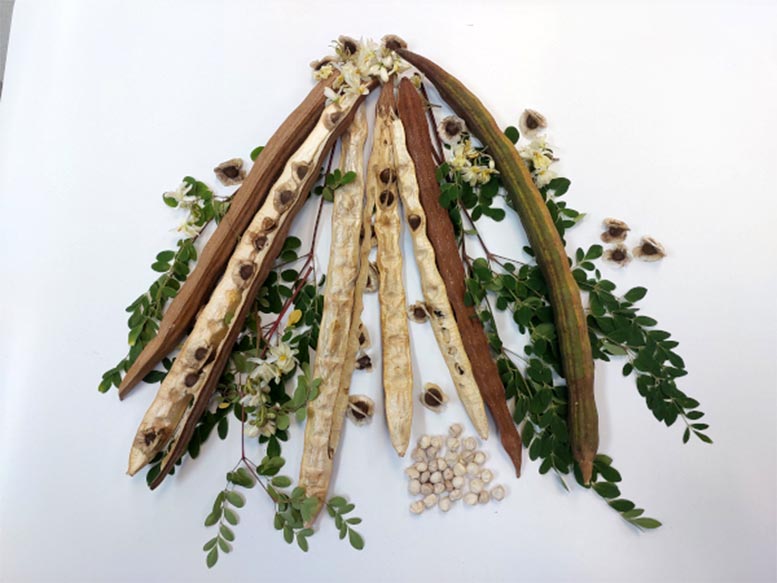
Researchers in Brazil have identified a surprising ally in the fight against microplastic pollution: Moringa oleifera. A study carried out at the Institute of Science and Technology of São Paulo State University (ICT-UNESP) in São José dos Campos found that this plant, also known as moringa or white acacia, can help remove tiny plastic particles from water.
The findings were published in ACS Omega, a journal of the American Chemical Society.
Moringa originates from India and thrives in many tropical regions. Its leaves and seeds are widely consumed due to their nutritional value. Scientists have also been exploring the seeds for years because of their potential use in water purification.
Moringa Seed Extract Matches Chemical Treatments
“We showed that the saline extract from the seeds performs similarly to aluminum sulfate, which is used in treatment plants to coagulate water containing microplastics. In more alkaline waters, it performed even better than the chemical product,” says Gabrielle Batista, the first author of the study. She completed the research during her master’s degree in the Post-Graduate Program in Civil and Environmental Engineering (PPGECA) at the Bauru School of Engineering (FEB) at UNESP.
The research was led by Adriano Gonçalves dos Reis, a professor at ICT-UNESP and in the PPGECA at FEB-UNESP. He also directs the project “Direct and In-Line Filtration for the Removal of Microplastics from Drinking Water,” supported by FAPESP.
“The only drawback found so far regarding aluminum sulfate was the increase in dissolved organic matter, the removal of which could make the process more expensive. However, on a small scale, such as on rural properties and in small communities, the method could be used cost-effectively and efficiently,” says Reis.
How Coagulation Helps Filter Microplastics
The study focused on a process called in-line filtration. In this method, water is first treated with a coagulant, which destabilizes suspended particles, and then passed through a sand filter. This approach works best for water with low turbidity, meaning it is relatively clear and does not require extensive pre-treatment.
Coagulation is a critical step because microplastics and other pollutants carry a negative electrical charge. This causes them to repel each other and prevents them from sticking to filtration materials like sand. Coagulants such as moringa salt extract (which can be made at home) and aluminum sulfate neutralize this charge. Once neutralized, the particles cluster together into larger groups that can be removed more easily during filtration.
Earlier research by the same team showed that moringa seeds are effective throughout a full treatment cycle, including flocculation, sedimentation, and filtration. Luiz Gustavo Rodrigues Godoy, the first author of the study, completed his master’s degree at FEB-UNESP with funding from FAPESP.
Lab Tests With PVC Microplastics
To evaluate the method, researchers added polyvinyl chloride (PVC) microplastics to tap water.
PVC was selected because it is considered one of the most hazardous plastics for human health, with known mutagenic and carcinogenic effects. It is also commonly found on the surfaces of water bodies and can persist even after standard treatment processes.
The team exposed the PVC to ultraviolet radiation to simulate natural aging and replicate the characteristics of real-world microplastics.
The contaminated water was then treated using coagulation and filtration in a Jar Test system, which mimics water treatment on a small scale. The results were compared with water treated using aluminum sulfate.
To measure effectiveness, the researchers used scanning electron microscopy (SEM) to count microplastic particles before and after treatment. They also measured the size of the clusters formed using a high-speed camera and a laser. Both methods produced similar levels of microplastic removal.
Testing Moringa in Real Water Sources
The team is now applying moringa seed extract to water taken directly from the Paraíba do Sul River, which supplies São José dos Campos. So far, the results show that the method is effective under real-world conditions.
“There’s increasing regulatory scrutiny and health concerns regarding the use of aluminum- and iron-based coagulants, as they aren’t biodegradable, leave residual toxicity, and pose a risk of disease. For that reason, the search for sustainable alternatives has intensified,” Reis concludes.
These findings suggest that moringa could offer a more sustainable and accessible option for removing microplastics from drinking water, particularly in smaller communities where cost and simplicity are important factors.
Reference: “Removal of Microplastics from Drinking Water by Moringa oleifera Seed: Comparative Performance with Alum in Direct and in-Line Filtration Systems” by Gabrielle S. Batista, Victoria A. S. Ferreira, Luiz G. R. Godoy, Rodrigo B. Moruzzi, Soroosh Sharifi and Adriano G. dos Reis, 19 January 2026, ACS Omega.
DOI: 10.1021/acsomega.5c11569
Never miss a breakthrough: Join the SciTechDaily newsletter.
Follow us on Google and Google News.
4 Comments
Y’all have done great job..I really enjoyed reading most of the material. Keep up the great work
So once the plant cleans the water, what do you do with the plant that does not release all the captured bad stuff back into the environment?
{o.o}
They use the seed extract to neutralize the negative charge on micro plastics to make it filterable, it’s not actually being filtered by the live plant. Whatever facility uses this process would then separate out the waste product for disposal or hopefully recycling.
Amazing work this could save our planet fish and lives outstanding results.