

Through a series of experiments, researchers evaluated individuals’ ability to recall the location and timing of an object – spatial and temporal memory, respectively – and found both to be massive.
Don’t despair the next time you forget where you placed your keys, parked your car, or set down your glasses. Previous research has shown that if individuals are shown a large number of objects, they are very good at subsequently remembering which objects they have seen. A recent study suggests that people are also shockingly skilled at remembering where and when they saw those objects
In a series of experiments conducted by investigators from Brigham and Women’s Hospital, a member of the Mass General Brigham healthcare system, participants were able to recall the location of over 100 items when shown on a 7-by-7 grid, accurately selecting the right location or a cell adjacent to it. The results, published in Current Biology, demonstrate that people possess “spatial massive memory” (SMM) for the location of objects and “temporal massive memory” (TMM) for the timing of when objects were last seen.
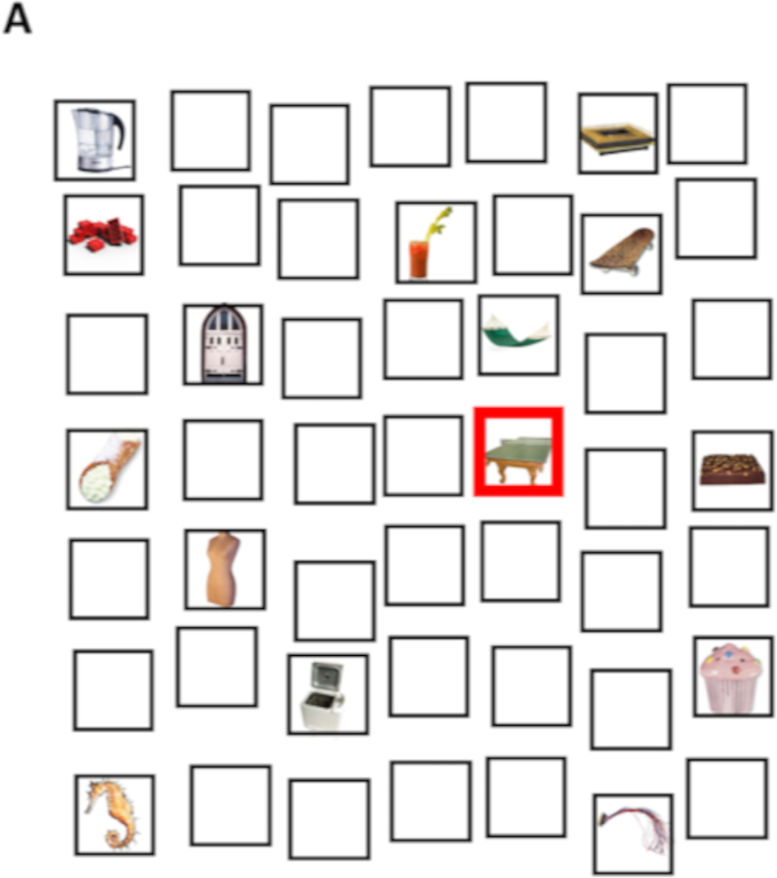
“People often think that their memory is terrible, but our results show that we can recall where and when an object appeared with good, if not perfect, precision for a large number of objects,” said corresponding author Jeremy Wolfe, Ph.D., of the Brigham’s Department of Surgery. “While our spatial and temporal memory for objects may not be as impressive as some birds or squirrels, who have to remember where they hid their food for the winter, our data show that we do have massive memory for objects.”
To conduct their study, Wolfe and colleagues asked participants to remember a number of objects placed on a 7-by-7 grid. Each item was highlighted for two seconds by placing a red square around it. After participants were shown the items, all of the images were removed and the participants were then tested on their ability to recall if they had seen an item before and, if so, where it had been located on the grid.
“In some ways, this is a bit like the game of Memory that many of us played as children, where we turned over a card and then tried to recall the location of a matching card that we had seen before,” said Wolfe. “But unlike in the children’s game, we didn’t just count the exact ‘correct’ answer. We measured how close the participant got to the previously seen image.”
Surprising Accuracy in Location and Timing
Altogether observers saw 300 different objects. Many observers could localize over 100 items to within +/- one cell of the true object location. In a subsequent experiment, participants were shown items one at a time and were asked to click on a timeline, present on the screen, to indicate when they had seen the object. The researchers reported that participants localized 60-80% of old items to within +/-10% of their correct time, markedly better than the 40% that they could have gotten by guessing.
The authors note that further experiments would be needed to define the upper limits of massive memory or to investigate other topics such as possible gender effects on memory.
Wolfe explains that some things slide into our long-term memory far more easily than others—understanding what we can remember most easily, such as pictures of objects and scenes, could help us make the most of our memory.
Enhancing Memory Through Object and Scene Recall
“Since ancient times, people have been using memory tricks related to our ability to remember pictures and scenes to help encode large amounts of information to store in their minds. In that sense, it’s not terribly surprising that, using our methods, we discover that we’re pretty good at remembering where objects are,” said Wolfe. “Our experiments show that spatial and temporal massive memories exist. Future research will define their limits.”
Reference: “Spatial and temporal massive memory in humans” by Jeremy M. Wolfe, Farahnaz A. Wick, Maruti Mishra, Joseph DeGutis, and Wanyi Lyu, 23 January 2023, Current Biology.
DOI: 10.1016/j.cub.2022.12.040
Never miss a breakthrough: Join the SciTechDaily newsletter.
Follow us on Google and Google News.