
Close Menu
    Facebook X (Twitter) Instagram
    SciTechDaily
    • Biology
    • Chemistry
    • Earth
    • Health
    • Physics
    • Science
    • Space
    • Technology
    Facebook X (Twitter) Pinterest YouTube RSS
    SciTechDaily
    Home»Health»Why Are Viral Infections More Severe in Men? Researchers May Have Solved the Mystery
    Health

    Why Are Viral Infections More Severe in Men? Researchers May Have Solved the Mystery

    By University of California - Los Angeles Health SciencesMarch 25, 2023No Comments3 Mins Read
    Facebook Twitter Pinterest Telegram LinkedIn WhatsApp Email Reddit
    Share
    Facebook Twitter LinkedIn Pinterest Telegram Email Reddit
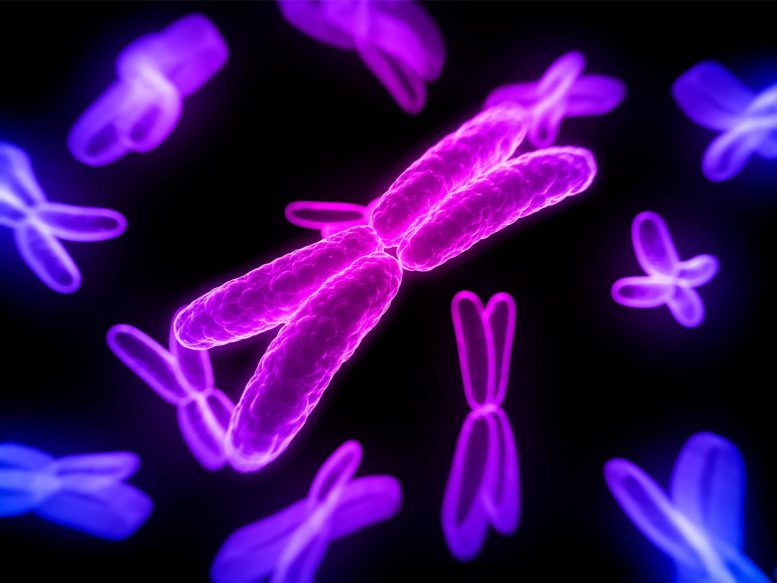
    Glowing X Chromosomes
    A new study suggests that a gene linked to an additional X chromosome may be responsible for the milder symptoms of viral infections observed in females.

    UCLA researchers found that females have higher UTX levels in NK cells, boosting anti-viral defenses despite fewer cells. This discovery highlights the importance of sex-specific approaches in immunotherapy.

    For a long time, it has been known that viral infections can be more severe in males than females, but the question as to why has remained a mystery – until possibly now. The answer may lie in an epigenetic regulator that enhances the function of specific anti-viral immune cells, referred to as natural killer (NK) cells.

    A research team from UCLA has recently published a study in the peer-reviewed journal Nature Immunology. The study revealed that female mice and humans possess an additional copy of a gene called UTX, which is linked to the X chromosome. UTX functions as an epigenetic regulator that enhances the anti-viral function of NK cells while suppressing their numbers.

    “While it is well-known that males have more NK cells compared to females, we did not understand why the increased number of NK cells was not more protective during viral infections. It turns out that females have more UTX in their NK cells than do males, which allows them to fight viral infections more efficiently,” said co-senior author Dr. Maureen Su, professor of microbiology immunology and molecular genetics, and of pediatrics, at the David Geffen School of Medicine at UCLA.

    The researchers noted that this held true whether or not the mice had gonads (ovaries in females; testes in males), indicating that the observed trait was not linked to hormones. Furthermore, female mice with lower UTX expression had more NK cells which were not as capable of controlling viral infection.

    “This implicates UTX as a critical molecular determinant of sex differences in NK cells,” said the study’s lead author Mandy Cheng, graduate student in molecular biology at UCLA.

    The findings suggest that therapies involving immune responses need to move beyond a “one-size-fits-all” approach and toward a precision medicine model, also known as personalized medicine, that tailors treatments that take into account people’s individual differences, such as genetics, environment and other factors that influence health and disease risk, the researchers write.

    “Given the recent excitement with using NK cells in the clinic, we will need to incorporate sex as a biological factor in treatment decisions and immunotherapy design,” said co-senior author Tim O’Sullivan, assistant professor of microbiology, immunology and molecular genetics at the Geffen School.

    Reference: “The X-linked epigenetic regulator UTX controls NK cell-intrinsic sex differences” by Mandy I. Cheng, Joey H. Li, Luke Riggan, Bryan Chen, Rana Yakhshi Tafti, Scott Chin, Feiyang Ma, Matteo Pellegrini, Haley Hrncir, Arthur P. Arnold, Timothy E. O’Sullivan and Maureen A. Su, 16 March 2023, Nature Immunology.
    DOI: 10.1038/s41590-023-01463-8

    The study was funded by the National Institutes of Health, the National Institute of Arthritis and Musculoskeletal and Skin Diseases, UC CRCC, UCLA CFAR, the Department of Defense, Ruth L. Kirschstein National Research Service Awards, the National Organization of Rare Diseases, Whitcome Fellowship from the Molecular Biology Institute at UCLA, and the Warsaw Fellowship from the UCLA Department of Microbiology, Immunology, and Molecular Genetics.

    Never miss a breakthrough: Join the SciTechDaily newsletter.
    Follow us on Google and Google News.

    Chromosomes Genetics Immunology UCLA Virus
    Share. Facebook Twitter Pinterest LinkedIn Email Reddit

    Related Articles

    The Rare Mutation That Makes People Immune to Viruses

    U.S. Army Outbreak Investigation Reveals “Super-Spreader” Potential of Andes Virus

    Development of an Effective COVID-19 Vaccine Through Comprehensive Analysis of Antibody Responses in Patients

    Neural Vulnerability in Huntington’s Disease Tied to Immune Response to Genetic Material

    Scientists Uncover Immune Cells That May Help Those Suffering From Allergies and Asthma

    Evolution of Pandemic Coronavirus Outlines Path From Animals to Humans – Highlights Future Danger

    New Research Points to Treatment for COVID-19 Cytokine Storms, Solution to Global Pandemic

    COVID-19 Treatment May Lie in Pangolin Genetics – May Possess Evolutionary Advantage Against Coronavirus

    UCLA Researchers Show Link Between Diet, Genetics and Obesity

    Leave A Reply Cancel Reply

    • Facebook
    • Twitter
    • Pinterest
    • YouTube

    Don't Miss a Discovery

    Subscribe for the Latest in Science & Tech!

    Trending News

    Scientists May Have Discovered How To Heal Damaged Kidneys

    Interstellar Visitor 3I/ATLAS Is Bursting With an Unexpected Chemical

    Scientists Just Found All 5 Genetic “Letters” of DNA and RNA on an Asteroid

    The 4,000-Year-Old City That Defied History’s Rules on Wealth and Power

    The World’s Biggest Population Fear Has Flipped – and It Could Change Everything

    This “Fake” Pill Improved Memory and Physical Performance in Just 3 Weeks

    Scientists Say Frequent Ejaculation May Improve Sperm Quality and Fertility

    Scientists Have Found “The Heaven Sword” After Years of Looking

    Follow SciTechDaily
    • Facebook
    • Twitter
    • YouTube
    • Pinterest
    • Newsletter
    • RSS
    SciTech News
    • Biology News
    • Chemistry News
    • Earth News
    • Health News
    • Physics News
    • Science News
    • Space News
    • Technology News
    Recent Posts
    • Critically Endangered Monkey Defies the Odds With New Baby After Surgery
    • 17-Million-Year-Old Ape Fossil in Egypt Could Change What We Know About Human Origins
    • NASA’s Orbiting Quantum Lab Pushes Deeper Into the Unknown
    • NASA’s James Webb Discovers Bizarre Salt Clouds on the Pink Planet
    • Mysterious Signals Keep Coming From Space. Scientists May Finally Know Why
    Copyright © 1998 - 2026 SciTechDaily. All Rights Reserved.
    • Science News
    • About
    • Contact
    • Editorial Board
    • Privacy Policy
    • Terms of Use

    Type above and press Enter to search. Press Esc to cancel.