
Close Menu
    Facebook X (Twitter) Instagram
    SciTechDaily
    • Biology
    • Chemistry
    • Earth
    • Health
    • Physics
    • Science
    • Space
    • Technology
    Facebook X (Twitter) Pinterest YouTube RSS
    SciTechDaily
    Home»Space»Eye and Brain Study, Fluid Physics Research on Space Station After Cosmonaut Spacewalk
    Space

    Eye and Brain Study, Fluid Physics Research on Space Station After Cosmonaut Spacewalk

    By NASAApril 19, 2023No Comments3 Mins Read
    Facebook Twitter Pinterest Telegram LinkedIn WhatsApp Email Reddit
    Share
    Facebook Twitter LinkedIn Pinterest Telegram Email Reddit
    Cosmonaut Helmet Camera During Spacewalk
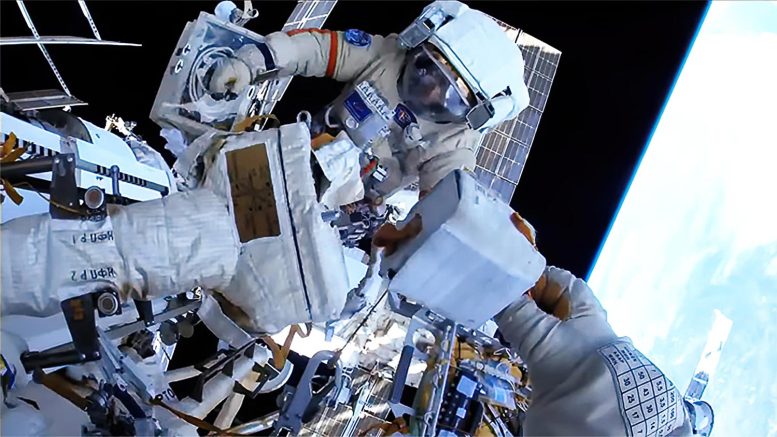
    Cosmonaut Sergey Prokopyev’s helmet camera captures Earth views and cosmonaut Dmitri Petelin at work during the April 18 Russian spacewalk to install a radiator on the Nauka science module. Credit: NASA TV

    On Wednesday, the Expedition 69 astronauts conducted science experiments aboard the International Space Station. NASA astronauts studied the effect of weightlessness on astronauts’ eyes and brains, while UAE Flight Engineer and NASA Flight Engineer set up hardware for a fluid physics study. They also spent the afternoon practicing robotic maneuvers for an upcoming spacewalk on April 28. Overnight, two of the astronauts installed a radiator on the Nauka science module, completing the third spacewalk of the year.

    Human research and fluid physics were the main science experiments taking place aboard the International Space Station (ISS) on Wednesday, April 19, for four Expedition 69 astronauts. The three cosmonauts aboard the orbital outpost slept in following an overnight spacewalk to move and install hardware.

    The latest space biology experiment taking place on the station explores how living long-term in weightlessness affects an astronaut’s eyes and brain. The lack of gravity causes blood and cerebrospinal fluid to shift toward the head creating ocular and cranial pressure. NASA astronauts Stephen Bowen and Woody Hoburg studied that phenomena Wednesday morning and ways to offset the space-caused symptoms by collecting their blood pressure measurements and scanning their chests with the Ultrasound 2 device for the ISAFE investigation.

    Afterward, Bowen peered at biological samples inside the Confocal Microscope testing its operations using fluorescence imaging techniques. Hoburg joined UAE (United Arab Emirates) Flight Engineer Sultan Alneyadi setting up hardware to kick off the CapiSorb Visible Systems fluid physics study. That experiment investigates the potential of using a liquid-based carbon dioxide removal system to promote more efficient space-based solutions and advanced Earth-bound applications.

    The three astronauts, together with NASA Flight Engineer Frank Rubio, also spent a portion of Wednesday afternoon reviewing procedures and practicing robotic maneuvers for a spacewalk planned for April 28. Bowen and Alneyadi are scheduled to spend about six-and-a-half hours in the vacuum of space upgrading the orbital outpost’s power generation system. Space station managers will discuss the upcoming spacewalk live on NASA TV’s app and the agency’s website at 2 p.m. EDT on Monday.

    The third spacewalk of the year was completed overnight after Commander Sergey Prokopyev and Flight Engineer Dmitri Petelin installed a radiator on the Nauka science module. The duo wrapped up the seven-hour and 55-minute logistics spacewalk at 5:35 a.m. on Wednesday, with assistance from Roscosmos Flight Engineer Andrey Fedyaev who operated the European robotic arm (ERA) with the radiator in its grip.

    The trio from Roscosmos will have a long sleep period before returning to a normal shift on Thursday. Prokopyev and Petelin will then spend the day cleaning their Orlan spacesuits and stowing their spacewalking tools in the Poisk module. Fedyaev will return the ERA to its stowage position on Nauka and then power it down.

    Never miss a breakthrough: Join the SciTechDaily newsletter.
    Follow us on Google and Google News.

    Astronaut Cosmonauts International Space Station NASA
    Share. Facebook Twitter Pinterest LinkedIn Email Reddit

    Related Articles

    Astronaut and Cosmonauts Fly Soyuz Crew Ship to New Docking Port on Space Station

    Leaky Soyuz Spaceship Departs Space Station and Lands in Kazakhstan

    Engineers Assessing Soyuz Spacecraft Leak – Spacewalk Cancelled

    Russian Spacewalk Ends Early After Battery Power Issue on Spacesuit

    International Space Station Crew Changes Command to Russian Cosmonaut

    Cosmonauts Set Up Robotic Arm’s First Motion During Spacewalk Outside ISS

    Russian Cosmonauts Exit International Space Station To Activate New Robotic Arm

    Russian Cosmonauts Complete Spacewalk To Set Up 37-Foot-Long Robotic Arm

    Russian Soyuz Space Station Crew Launch Set for Friday Following Tuesday’s Successful Spacewalk

    Leave A Reply Cancel Reply

    • Facebook
    • Twitter
    • Pinterest
    • YouTube

    Don't Miss a Discovery

    Subscribe for the Latest in Science & Tech!

    Trending News

    Long COVID Brain Scans Reveal Damage to Dopamine Neurons

    Scientists Warn a Silent Oxygen Crisis Is Spreading Through Earth’s Waters

    James Webb Telescope Discovers Hidden Giant Planet in Famous Star System

    Scientists Build the First 3D Cloak That Makes Objects Invisible To Heat

    Common Food Additive Linked To Gut Inflammation

    Black Hole Collisions May Follow a Surprisingly Simple Rule

    The Eye Has a Hidden Cleanup System and Scientists Just Discovered It

    The Truth About Vikings Is More Complicated Than Museums Admit

    Follow SciTechDaily
    • Facebook
    • Twitter
    • YouTube
    • Pinterest
    • Newsletter
    • RSS
    SciTech News
    • Biology News
    • Chemistry News
    • Earth News
    • Health News
    • Physics News
    • Science News
    • Space News
    • Technology News
    Recent Posts
    • The Lost “Golden Age” of Human Language
    • Scientists Say Love Follows Mathematical Patterns
    • Long-Term Money Problems May Accelerate Brain Aging
    • The Surprising Brain Chemistry That Turns Ants Into Caregivers
    • “Zombie Cells” Reveal a Hidden Weakness That Could Help Fight Aging
    Copyright © 1998 - 2026 SciTechDaily. All Rights Reserved.
    • Science News
    • About
    • Contact
    • Editorial Board
    • Privacy Policy
    • Terms of Use

    Type above and press Enter to search. Press Esc to cancel.