
Close Menu
    Facebook X (Twitter) Instagram
    SciTechDaily
    • Biology
    • Chemistry
    • Earth
    • Health
    • Physics
    • Science
    • Space
    • Technology
    Facebook X (Twitter) Pinterest YouTube RSS
    SciTechDaily
    Home»Space»Hubble Views Star Formation within the Chamaeleon Cloud
    Space

    Hubble Views Star Formation within the Chamaeleon Cloud

    By Hubble Space TelescopeFebruary 3, 2014No Comments2 Mins Read
    Facebook Twitter Pinterest Telegram LinkedIn WhatsApp Email Reddit
    Share
    Facebook Twitter LinkedIn Pinterest Telegram Email Reddit


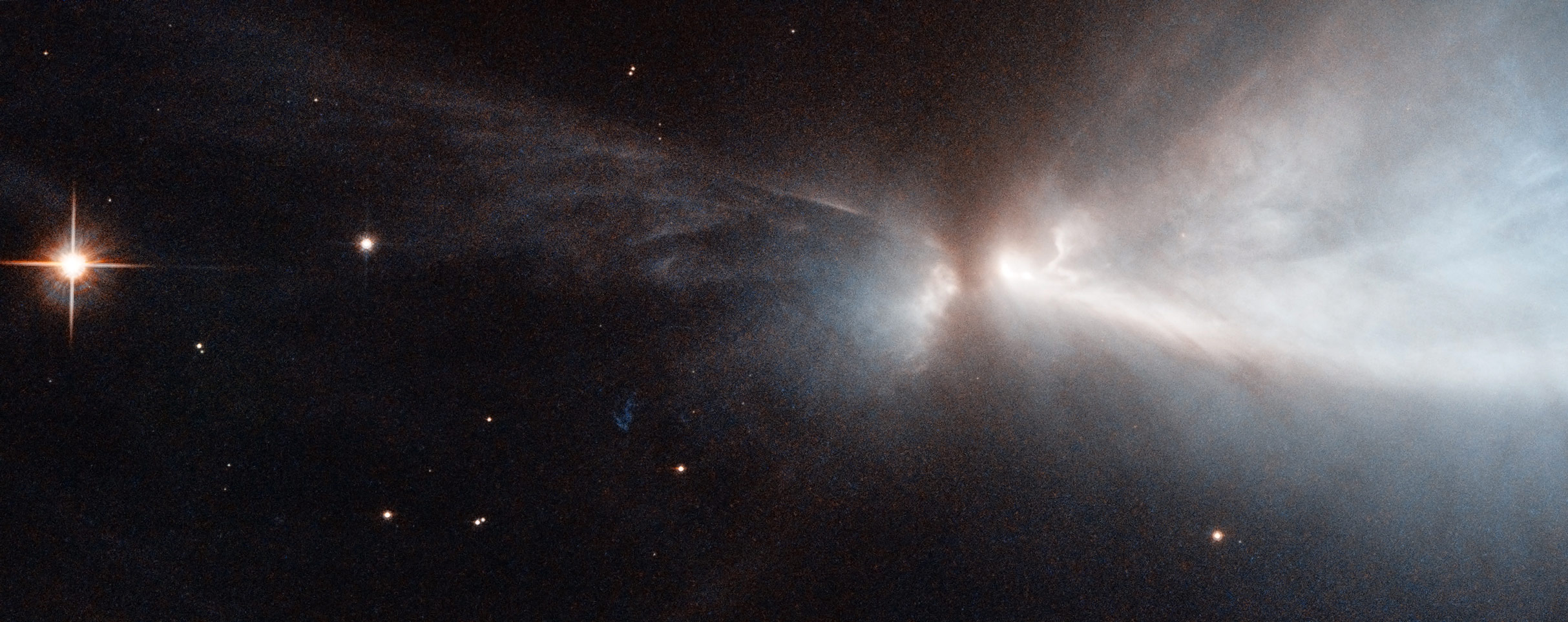
    Hubble Reveals Star Formation within the Chamaeleon Cloud
    Hubble reveals star formation within the Chamaeleon Cloud. Credit: NASA & ESA. Acknowledgments: Kevin Luhman (Pennsylvania State University), and Judy Schmidt

    This newly released Hubble image reveals star formation within the Chamaeleon cloud.

    This striking new image, captured by the NASA/ESA Hubble Space Telescope, reveals a star in the process of forming within the Chamaeleon cloud. This young star is throwing off narrow streams of gas from its poles — creating this ethereal object known as HH 909A. These speedy outflows collide with the slower surrounding gas, lighting up the region.

    When new stars form, they gather material hungrily from the space around them. A young star will continue to feed its huge appetite until it becomes massive enough to trigger nuclear fusion reactions in its core, which light the star up brightly.

    Before this happens, new stars undergo a phase during which they violently throw bursts of material out into space. This material is ejected as narrow jets that streak away into space at breakneck speeds of hundreds of kilometers per second, colliding with nearby gas and dust and lighting up the region. The resulting narrow, patchy regions of faintly glowing nebulosity are known as Herbig-Haro objects. They are very short-lived structures, and can be seen to visibly change and evolve over a matter of years — just the blink of an eye on astronomical timescales.

    These structures are very common within star-forming regions like the Orion Nebula, or the Chameleon I molecular cloud — home to the subject of this image. The Chameleon cloud is located in the southern constellation of Chameleon, just over 500 light-years from Earth. Astronomers have found numerous Herbig-Haro objects embedded in this stellar nursery, most of them emanating from stars with masses similar to that of the Sun. A few are thought to be tied to less massive objects such as brown dwarfs, which are “failed” stars that did not hit the critical mass to spark reactions in their centers.

    A version of this image was entered into the Hubble’s Hidden Treasures image processing competition by contestant Judy Schmidt.


    Never miss a breakthrough: Join the SciTechDaily newsletter.
    Follow us on Google and Google News.

    Astronomy Hubble Space Telescope Star Formation
    Share. Facebook Twitter Pinterest LinkedIn Email Reddit

    Related Articles

    Hubble Space Telescope Reveals Monster Stars in Star Cluster R136

    Hubble Views Turbulent Birthing Ground Orion B Molecular Cloud Complex

    Hubble Image of the Week: Starburst Galaxy Messier 94

    ESO and Hubble Reveal Fast-Moving, Wave-Like Features in the Debris Disk Around AU Microscopii

    New Phoenix Cluster Observations Provide A Fresh Perspective

    Hubble Video Gives 3D Perspective of Gum 29 and Westerlund 2

    New Observations Reveal How Star Formation Shuts Down in Elliptical Galaxies

    Hubble Completes Largest Survey of Dusty Debris Disks around Other Stars

    Hubble Image of the Day: The Sharpest View of the Orion Nebula

    Leave A Reply Cancel Reply

    • Facebook
    • Twitter
    • Pinterest
    • YouTube

    Don't Miss a Discovery

    Subscribe for the Latest in Science & Tech!

    Trending News

    125-Million-Year-Old Crocodile Fossil Reveals Astonishing New Secrets

    Scientists Discover an “Impossible” Way Muscle Filaments Can Grow

    A Star’s Spin Could Solve a Longstanding Black Hole Mystery

    NASA Finds Earth Microbes Could Hide in the Moon’s Deep Shadows

    New Study: Intermittent Fasting Lowers Blood Sugar in Type 1 Diabetes

    Alzheimer’s Brain Changes May Begin 7 Years Earlier Than Scientists Thought

    This New Molecule Could Transform How We Recover Gold From Electronic Waste

    A Billion Years Before the Grand Canyon, a Giant Cliff May Have Stretched Across America

    Follow SciTechDaily
    • Facebook
    • Twitter
    • YouTube
    • Pinterest
    • Newsletter
    • RSS
    SciTech News
    • Biology News
    • Chemistry News
    • Earth News
    • Health News
    • Physics News
    • Science News
    • Space News
    • Technology News
    Recent Posts
    • How Insects Conquered Land Was Stranger Than Scientists Thought
    • A 250-Year-Old Heat Mystery Leads to a Surprising Discovery About Human Sweat
    • Thousands of Giant Whales Are Suddenly Flooding Into an Arctic “Feeding Frenzy”
    • AI Searched 150 Million Materials – and Found Two Promising Candidates for Future Electronics
    • A Major Quantum Computing Problem May Finally Have an Answer: Can We Trust the Results?
    Copyright © 1998 - 2026 SciTechDaily. All Rights Reserved.
    • Science News
    • About
    • Contact
    • Editorial Board
    • Privacy Policy
    • Terms of Use

    Type above and press Enter to search. Press Esc to cancel.