
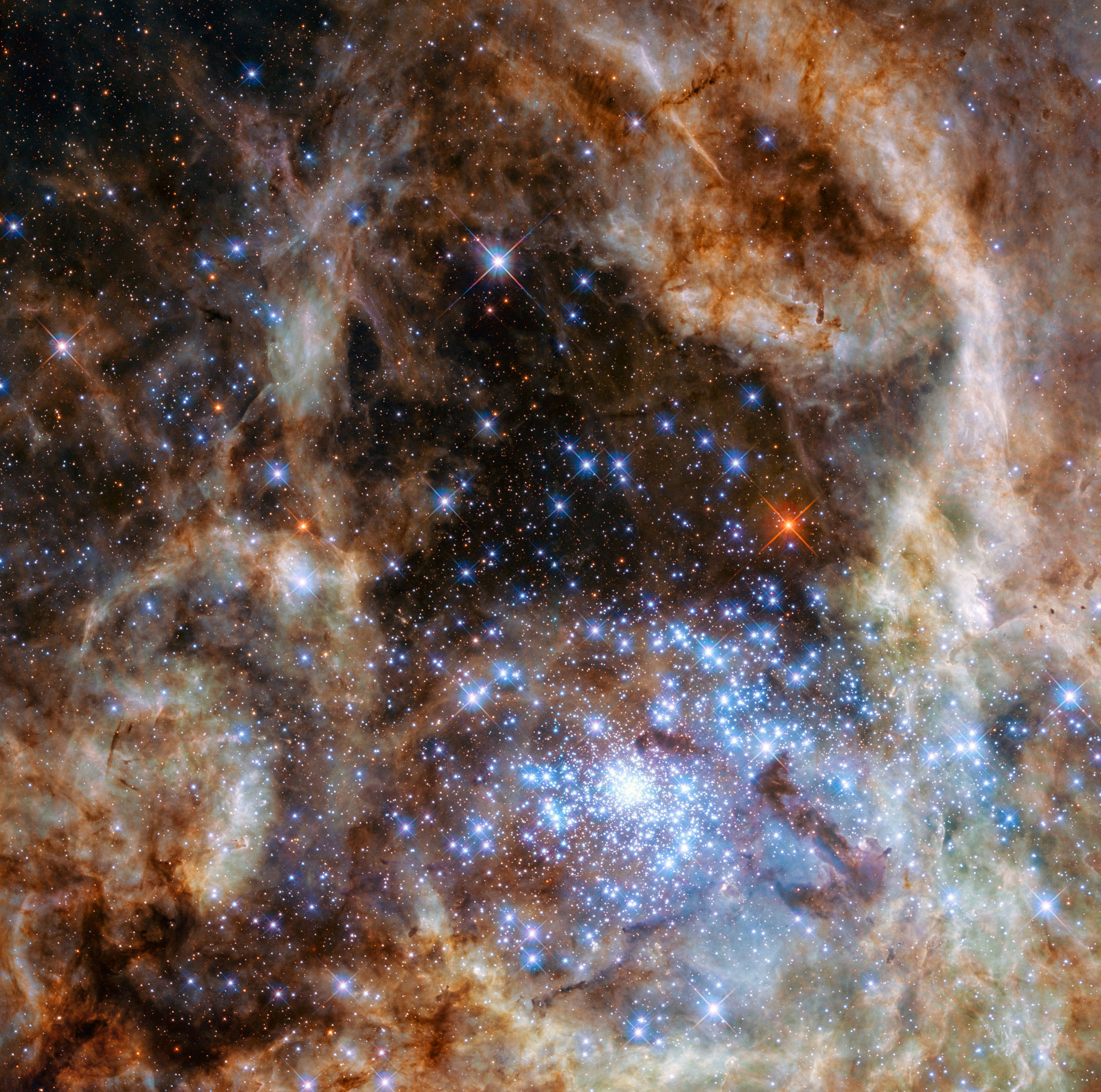
Using the unique ultraviolet capabilities of the NASA/ESA Hubble Space Telescope, a team of astronomers has identified nine monster stars with masses over 100 times the mass of the sun in the star cluster R136. This makes it the largest sample of very massive stars identified to date.
The results, which will be published in the monthly notices of the Royal Astronomical Society, raise many new questions about the formation of massive stars.
An international team of scientists using the NASA/ESA Hubble Space Telescope has combined images taken with the Wide Field Camera 3 (WFC3) with the unprecedented ultraviolet spatial resolution of the Space Telescope Imaging Spectrograph (STIS) to successfully dissect the young star cluster R136 in ultraviolet light for the first time.
R136 is only a few light-years across and is located in the Tarantula Nebula within the Large Magellanic Cloud, about 170,000 light-years away. The young cluster hosts many extremely massive, hot, and luminous stars whose energy is mostly radiated in the ultraviolet range of its light spectrum. This is why the scientists probed the ultraviolet emission of the cluster.
As well as finding dozens of stars exceeding 50 solar masses, this new study was able to reveal a total number of nine very massive stars in the cluster, all more than 100 times more massive than the sun. However, the current record holder R136a1 does keep its place as the most massive star known in the universe, at more than 250 solar masses. The detected stars are not only extremely massive, but also extremely bright. Together these nine stars outshine the sun by a factor of 30 million.
The scientists were also able to investigate outflows from these behemoths, which are most readily studied in the ultraviolet. They eject up to an Earth mass of material per month at a speed approaching one percent of the speed of light, resulting in extreme weight loss throughout their brief lives.
“The ability to distinguish ultraviolet light from such an exceptionally crowded region into its component parts, resolving the signatures of individual stars, was only made possible with the instruments aboard Hubble,” explains Paul Crowther from the University of Sheffield, U.K., and lead author of the study. “Together with my colleagues, I would like to acknowledge the invaluable work done by astronauts during Hubble’s last servicing mission: they restored STIS and put their own lives at risk for the sake of future science!”
In 2010 Crowther and his collaborators showed the existence of four stars within R136, each with over 150 times the mass of the sun. At that time the extreme properties of these stars came as a surprise as they exceeded the upper-mass limit for stars that was generally accepted at that time. Now, this new census has shown that there are five more stars with more than 100 solar masses in R136. The results gathered from R136 and from other clusters also raise many new questions about the formation of massive stars as the origin of these behemoths remains unclear.
Saida Caballero-Nieves, a co-author of the study, explains, “There have been suggestions that these monsters result from the merger of less extreme stars in close binary systems. From what we know about the frequency of massive mergers, this scenario can’t account for all the really massive stars that we see in R136, so it would appear that such stars can originate from the star formation process.”
In order to find answers about the origin of these stars the team will continue to analyze the gathered datasets. An analysis of new optical STIS observations from Hubble will also allow them to search for close binary systems in R136. Since very massive stars burn out relatively quickly and can become black holes when they die, such binary pairs could produce massive black hole binaries that would ultimately merge, producing gravitational waves.
“Once again, our work demonstrates that, despite being in orbit for over 25 years, there are some areas of science for which Hubble is still uniquely capable,” concludes Crowther.
Reference: “The R136 star cluster dissected with Hubble Space Telescope/STIS. I. Far-ultraviolet spectroscopic census and the origin of HeII 1640 in young star clusters” by Paul A. Crowther, S.M. Caballero-Nieves, K.A. Bostroem, J. Maiz Apellaniz, F.R.N. Schneider, N.R. Walborn, C.R. Angus, I. Brott, A. Bonanos, A. de Koter, S.E. de Mink, C.J. Evans, G. Grafener, A. Herrero, I.D. Howarth, N. Langer, D.J. Lennon, J. Puls, H. Sana and J.S. Vink, 5 February 2016, MNRAS.
DOI: 10.1093/mnras/stw273
arXiv:1603.04994
Never miss a breakthrough: Join the SciTechDaily newsletter.
Follow us on Google and Google News.