
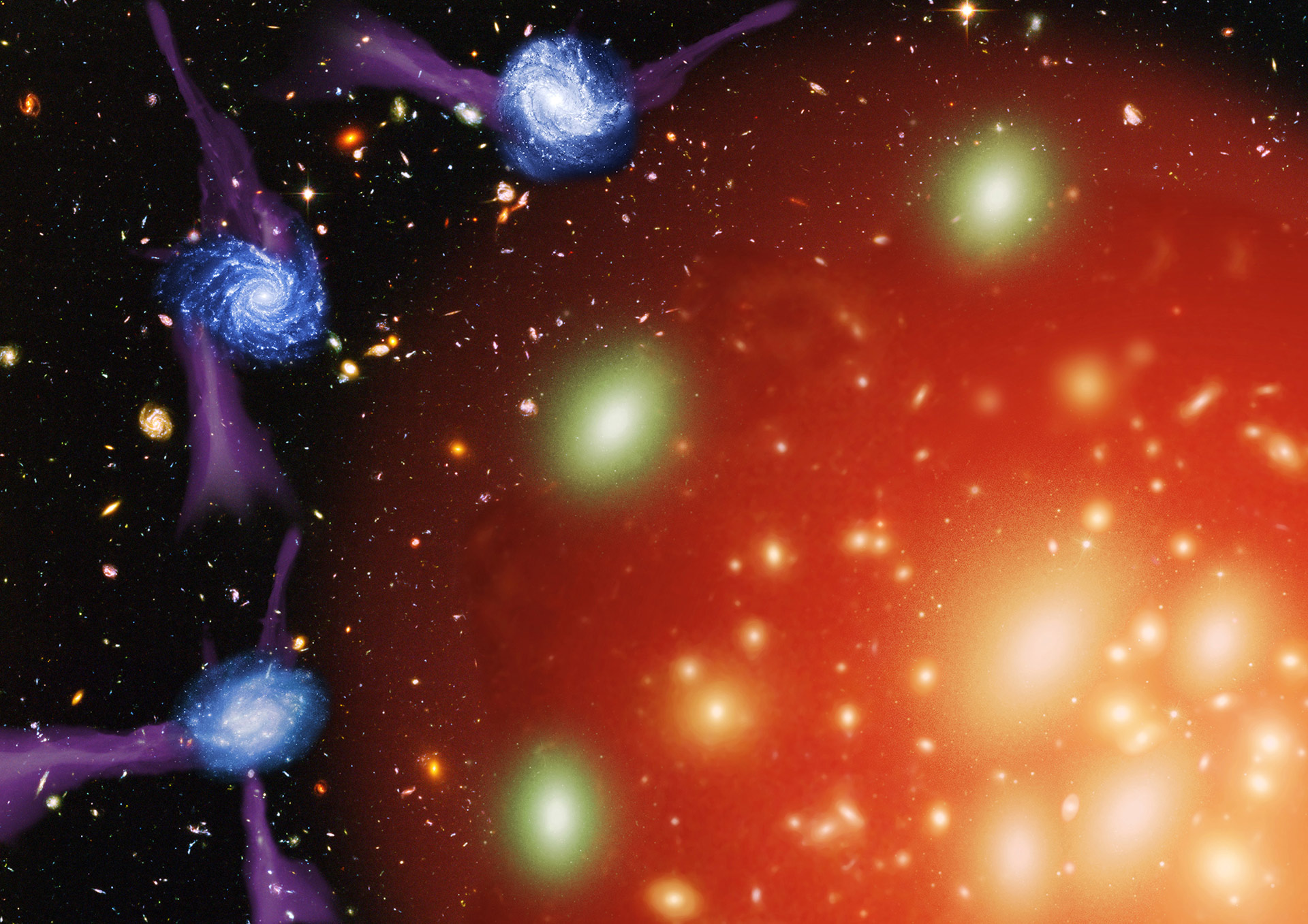
Using data from the Sloan Digital Sky Survey, astronomers from the University of Cambridge detail why certain galaxies can no longer produce stars.
As murder mysteries go, it’s a big one: how do galaxies die and what kills them? A new study, published today in the journal Nature, has found that the primary cause of galactic death is strangulation, which occurs after galaxies are cut off from the raw materials needed to make new stars.
Researchers from the University of Cambridge and the Royal Observatory Edinburgh have found that levels of metals contained in dead galaxies provide key ‘fingerprints’, making it possible to determine the cause of death.
There are two types of galaxies in the Universe: roughly half are ‘alive’ galaxies which produce stars, and the other half are ‘dead’ ones which don’t. Alive galaxies such as our own Milky Way are rich in the cold gas – mostly hydrogen – needed to produce new stars, while dead galaxies have very low supplies. What had been unknown was what’s responsible for killing the dead ones.
Astronomers have come up with two main hypotheses for galactic death: either the cold gas needed to produce new stars is suddenly ‘sucked’ out of the galaxies by internal or external forces, or the supply of incoming cold gas is somehow stopped, slowly strangling the galaxy to death over a prolonged period of time.
In order to get to the bottom of this mystery, the team used data from the Sloan Digital Sky Survey to analyze metal levels in more than 26,000 average-sized galaxies located in our corner of the universe.
“Metals are a powerful tracer of the history of star formation: the more stars that are formed by a galaxy, the more metal content you’ll see,” said Dr Yingjie Peng of Cambridge’s Cavendish Laboratory and Kavli Institute of Cosmology, and the paper’s lead author. “So looking at levels of metals in dead galaxies should be able to tell us how they died.”
If galaxies are killed by outflows suddenly pulling the cold gas out of the galaxies, then the metal content of a dead galaxy should be the same as just before it died, as star formation would abruptly stop.
In the case of death by strangulation, however, the metal content of the galaxy would keep rising and eventually stop, as star formation could continue until the existing cold gas gets completely used up.
While it is not possible to analyze individual galaxies due to the massive timescales involved, by statistically investigating the difference of metal content of alive and dead galaxies, the researchers were able to determine the cause of death for most galaxies of average size.
“We found that for a given stellar mass, the metal content of a dead galaxy is significantly higher than a star-forming galaxy of similar mass,” said Professor Roberto Maiolino, co-author of the new study. “This isn’t what we’d expect to see in the case of sudden gas removal, but it is consistent with the strangulation scenario.”
The researchers were then able to independently test their results by looking at the stellar age difference between star-forming and dead galaxies, independent of metal levels, and found an average age difference of four billion years – this is in agreement with the time it would take for a star-forming galaxy to be strangled to death, as inferred from the metallicity analysis.
“This is the first conclusive evidence that galaxies are being strangled to death,” said Peng. “What’s next though, is figuring out what’s causing it. In essence, we know the cause of death, but we don’t yet know who the murderer is, although there are a few suspects.”
Reference: “Strangulation as the primary mechanism for shutting down star formation in galaxies” by Y. Peng, R. Maiolino and R. Cochrane, 14 May 2015, Nature.
DOI: 10.1038/nature14439
arXiv: 1505.03143
Never miss a breakthrough: Join the SciTechDaily newsletter.
Follow us on Google and Google News.
1 Comment
Fascinating. We thoroughly enjoyed this article. As grammar nerds however I do find “killing the dead ones” to be a double negative of a sort.