
Close Menu
    Facebook X (Twitter) Instagram
    SciTechDaily
    • Biology
    • Chemistry
    • Earth
    • Health
    • Physics
    • Science
    • Space
    • Technology
    Facebook X (Twitter) Pinterest YouTube RSS
    SciTechDaily
    Home»Space»Hubble Image of the Week – A Cosmic Kaleidoscope
    Space

    Hubble Image of the Week – A Cosmic Kaleidoscope

    By SciTechDailyMarch 21, 2016No Comments2 Mins Read
    Facebook Twitter Pinterest Telegram LinkedIn WhatsApp Email Reddit
    Share
    Facebook Twitter LinkedIn Pinterest Telegram Email Reddit
    Hubble Image of the Week A Cosmic Kaleidoscope
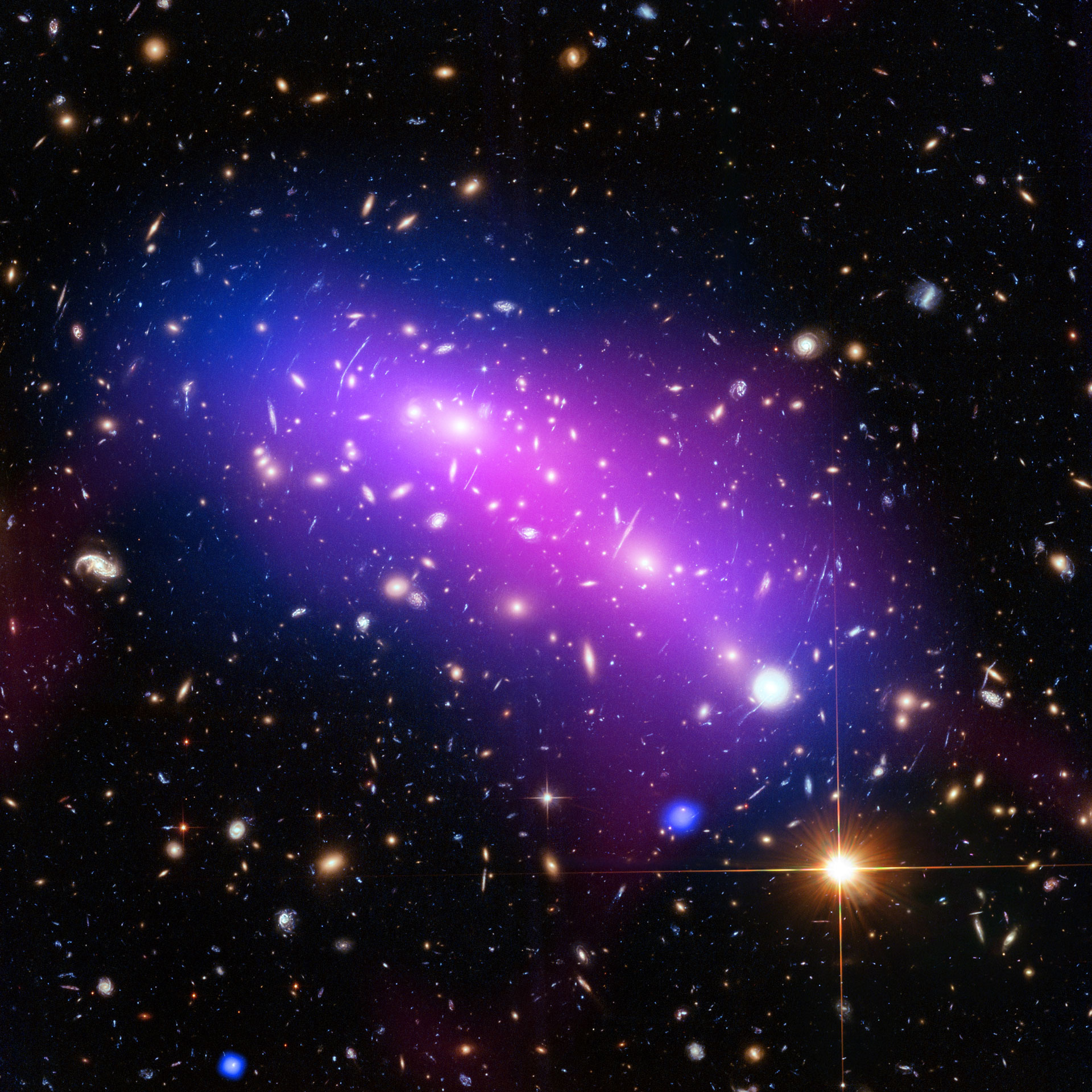
    MACS J0416 is located about 4.3 billion light-years from Earth, in the constellation of Eridanus. Credit: NASA, ESA, CXC, NRAO/AUI/NSF, STScI, and G. Ogrean (Stanford University), Acknowledgment: NASA, ESA, and J. Lotz (STScI), and the HFF team

    This newly released Hubble image shows MACS J0416, which is located about 4.3 billion light-years from Earth.

    At first glance, this cosmic kaleidoscope of purple, blue, and pink offers a strikingly beautiful — and serene — snapshot of the cosmos. However, this multi-colored haze actually marks the site of two colliding galaxy clusters, forming a single object known as MACS J0416.1-2403 (or MACS J0416 for short).

    MACS J0416 is located about 4.3 billion light-years from Earth, in the constellation of Eridanus. This new image of the cluster combines data from three different telescopes: the NASA/ESA Hubble Space Telescope (showing the galaxies and stars), the NASA Chandra X-ray Observatory (diffuse emission in blue), and the NRAO Jansky Very Large Array (diffuse emission in pink). Each telescope shows a different element of the cluster, allowing astronomers to study MACS J0416 in detail.

    As with all galaxy clusters, MACS J0416 contains a significant amount of dark matter, which leaves a detectable imprint in visible light by distorting the images of background galaxies. In this image, this dark matter appears to align well with the blue-hued hot gas, suggesting that the two clusters have not yet collided; if the clusters had already smashed into one another, the dark matter and gas would have separated. MACS J0416 also contains other features — such as a compact core of hot gas — that would likely have been disrupted had a collision already occurred.

    Together with five other galaxy clusters, MACS J0416 is playing a leading role in the Hubble Frontier Fields program, for which this data was obtained. Owing to its huge mass, the cluster is in fact bending the light of background objects, acting as a magnifying lens. Astronomers can use this phenomenon to find galaxies that existed only hundreds of million years after the Big Bang.

    Never miss a breakthrough: Join the SciTechDaily newsletter.
    Follow us on Google and Google News.

    Astronomy Hubble Space Telescope NASA Stanford University
    Share. Facebook Twitter Pinterest LinkedIn Email Reddit

    Related Articles

    A Star’s Unexpected Heatwave: FU Orionis Challenges Astrophysics Models

    NASA’s Hubble Reveals How the LMC Defied Galactic Destruction

    Legendary Star’s Smooth Disk Mystifies Astronomers, Challenges Planet Formation Theories

    Cosmic Horror Unveiled: NASA Reveals “Blood-Soaked Eyes” Staring From Deep Space [Video]

    Spanning 248 Billion Miles: Stunning Hubble Timelapse Captures a Star’s Violent Eruptions

    Jupiter’s Great Red Spot Enigma: Unexplained Oscillations Baffle Astronomers

    Unlocking Uranus: NASA’s Dual Observations Pave the Way to Discovering New Worlds

    Astronomers Baffled by Black Hole Jets Igniting Star Explosions

    The Big Bang’s Dark Legacy Revealed by Hubble: Unexpected Black Holes

    Leave A Reply Cancel Reply

    • Facebook
    • Twitter
    • Pinterest
    • YouTube

    Don't Miss a Discovery

    Subscribe for the Latest in Science & Tech!

    Trending News

    Mezcal “Worm” in a Bottle Mystery: DNA Testing Reveals a Surprise

    New Research Reveals That Your Morning Coffee Activates an Ancient Longevity Switch

    This Is What Makes You Irresistible to Mosquitoes

    Shockingly Powerful Giant Octopuses Ruled the Seas 100 Million Years Ago

    Scientists Stunned by New Organic Molecules Found on Mars

    Rewriting Dinosaur Evolution: Scientists Unearth Remarkable 150-Million-Year-Old Stegosaur Skull

    Omega-3 Supplements Linked to Cognitive Decline in Surprising New Study

    First-of-Its-Kind Discovery: Homer’s Iliad Found Embedded in a 1,600-Year-Old Egyptian Mummy

    Follow SciTechDaily
    • Facebook
    • Twitter
    • YouTube
    • Pinterest
    • Newsletter
    • RSS
    SciTech News
    • Biology News
    • Chemistry News
    • Earth News
    • Health News
    • Physics News
    • Science News
    • Space News
    • Technology News
    Recent Posts
    • Scientists Just Discovered the Hidden Trick That Keeps Your Cells Alive
    • This Simple Movement Could Be Secretly Cleaning Your Brain
    • Male Birth Control Breakthrough: Scientists Find Way To Turn Sperm Production Off and Back On
    • A Common Vitamin Could Hold the Key to Treating Fatty Liver Disease
    • New Research Shows Vitamin B12 May Hold the Key to Healthy Aging
    Copyright © 1998 - 2026 SciTechDaily. All Rights Reserved.
    • Science News
    • About
    • Contact
    • Editorial Board
    • Privacy Policy
    • Terms of Use

    Type above and press Enter to search. Press Esc to cancel.