

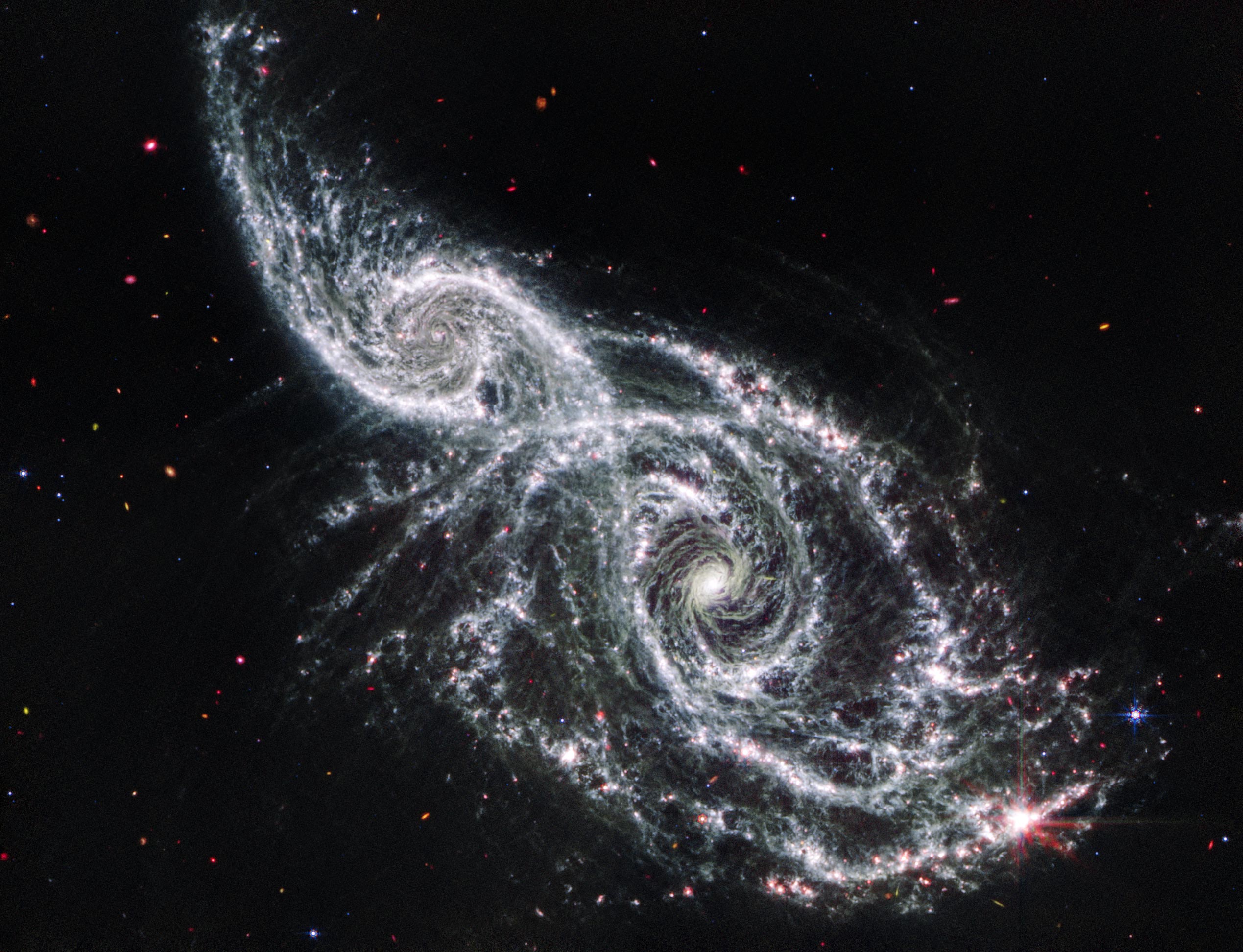
By teaming up, NASA’s Webb and Hubb;e space telescopes have delivered the highest resolution image of IC 2163 and NGC 2207 to date in a combination of mid-infrared, visible, and ultraviolet light.
This ghastly galactic “countenance” recalls mythological human-hunters like the Algonquian wendigo — an emaciated figure with ashen flesh and glowing eyes that grows larger and larger as it feasts, and is never satiated.
But this image, captured by the James Webb and Hubble space telescopes, isn’t a case of galactic cannibalism — at least, not yet.
The smaller galaxy to the left, IC 2163, has “slithered” behind the larger one at right, NGC 2207, millions of years ago. Though we can’t wait around for millions of years to see what may happen next, researchers can use this crisp combination of mid-infrared light from Webb, and ultraviolet and visible light from Hubble to learn more about the pair, and improve models that may preview the galaxies’ upcoming “thrills.”
This video tours a pair of spiral galaxies, IC 2163 at left and NGC 2207 at right, which reside 114 million light-years from Earth. The journey begins and ends on a new image that combines mid-infrared, visible, and ultraviolet light from the James Webb and Hubble space telescopes, and includes brief fades to Webb’s mid-infrared image and Hubble’s visible and ultraviolet light image. Watch as these spellbinding observations are pulled apart, and then presented again as a combined observation. The tour features star formation in chilling detail, blood-red shock fronts, and traces of ancient supernova explosions that “echo” through the cosmic landscape. Credit: NASA, ESA, CSA, STScI, Danielle Kirshenblat (STScI)
‘Blood-Soaked’ Eyes: NASA’s Webb and Hubble Examine Galaxy Pair
Take a close look at these galaxies. They appear almost lifelike, as if blood is coursing through the top of a bare face. Their intense, eye-like cores seem to stare out into the vast cosmic darkness, giving them a haunting, powerful presence.
Fortunately, this eerie appearance is just an illusion.
These galaxies have only brushed past each other so far. The smaller spiral on the left, known as IC 2163, slowly “crept” behind the larger spiral galaxy on the right, NGC 2207, in an encounter millions of years ago.
The pair’s unusual, macabre colors come from a blend of mid-infrared light captured by NASA’s James Webb Space Telescope and visible and ultraviolet light from the Hubble Space Telescope.
Evidence of Cosmic Collisions
Signs of their close encounter can be seen in the shock fronts—bright, red-tinted lines that may reveal areas where material from the galaxies collided. These regions, including features that look like “eyelids,” give the galaxies their bulging, vein-like arms.
Their initial pass likely altered their graceful spiral arms, drawing out tidal extensions in different places. For example, the faint, small spiral arms stretching between IC 2163’s core and its left side are likely a result of this interaction. Other wispy tendrils seem to stretch between the galaxies’ cores, while another extension flows from the top of the larger galaxy, forming a translucent, thin arm that nearly disappears off-screen.
Stellar Nurseries: Birth of New Stars
Both galaxies have high star formation rates, like innumerable individual hearts fluttering all across their arms. Each year, the galaxies produce the equivalent of two dozen new stars that are the size of the Sun. Our Milky Way galaxy only forms the equivalent of two or three new Sun-like stars per year. Both galaxies have also hosted seven known supernovae in recent decades, a high number compared to an average of one every 50 years in the Milky Way. Each supernova may have cleared space in their arms, rearranging gas and dust that later cooled, and allowed many new stars to form.
To spot the star-forming “action sequences,” look for the bright blue areas captured by Hubble in ultraviolet light, and pink and white regions detailed mainly by Webb’s mid-infrared data. Larger areas of stars are known as super star clusters. Look for examples of these in the top-most spiral arm that wraps above the larger galaxy and points left. Other bright regions in the galaxies are mini starbursts — locations where many stars form in quick succession. Additionally, the top and bottom “eyelid” of IC 2163, the smaller galaxy on the left, is filled with newer star formation and burns brightly.

In Hubble’s image, the star-filled spiral arms glow brightly in blue, and the galaxies’ cores in orange. Both galaxies are covered in dark brown dust lanes, which obscures the view of IC 2163’s core at left.
In Webb’s image, cold dust takes center stage, casting the galaxies’ arms in white. Areas where stars are still deeply embedded in the dust appear pink. Other pink regions may be objects that lie well behind these galaxies, including active supermassive black holes known as quasars.
Turn your eye toward the bottom right of the Webb image. The largest, brightest pink region that glimmers with eight prominent diffraction spikes is a mini starburst — a location where many stars are forming in quick succession. The same region in the Hubble image appears as a bright blue cluster of stars.
The lace-like holes in the white spiral arms of Webb’s images are often where supernovae exploded long ago. In the same regions, Hubble shows these areas are now populated with newer stars.
The black areas to upper right and lower left of the Hubble image do not contain any data. Credit: NASA, ESA, CSA, STScI
The Future of Galactic Evolution
What’s next for these spirals? Over many millions of years, the galaxies may swing by one another repeatedly. It’s possible that their cores and arms will meld, leaving behind completely reshaped arms, and an even brighter, cyclops-like “eye” at the core. Star formation will also slow down once their stores of gas and dust deplete, and the scene will calm.
Want to “pull apart” these images? Examine the galaxies’ skeleton-like appearance in Webb’s mid-infrared image, and compare the Hubble and Webb images side by side (both images above).

The image shows a scale bar, compass arrows, and color key for reference.
The scale bar is labeled in light-years along the top, which is the distance that light travels in one Earth-year. (It takes three years for light to travel a distance equal to the length of the scale bar.) One light-year is equal to about 5.88 trillion miles or 9.46 trillion kilometers.
The scale bar is also labeled in arcminutes, which is a measure of angular distance on the sky. One arcsecond is equal an angular measurement of 1/3600 of one degree. There are 60 arcminutes in a degree and 60 arcseconds in an arcminute. (The full Moon has an angular diameter of about 30 arcminutes.) The actual size of an object that covers one arcsecond on the sky depends on its distance from the telescope.
The north and east compass arrows show the orientation of the image on the sky. Note that the relationship between north and east on the sky (as seen from below) is flipped relative to direction arrows on a map of the ground (as seen from above).
This image shows invisible ultraviolet, visible, and mid-infrared wavelengths of light that have been translated into visible-light colors. The color key shows which WFPC2 and MIRI filters were used when collecting the light. The color of each filter name is the visible-light color used to represent the infrared light that passes through that filter.
Credit: NASA, ESA, CSA, STScI
The James Webb Space Telescope (JWST) is the world’s leading space observatory, designed to explore the vast mysteries of our universe. With advanced capabilities, JWST is uncovering details about our solar system, studying distant exoplanets orbiting other stars, and investigating the origins and structures of the cosmos to deepen our understanding of our place within it. An international collaboration, JWST is led by NASA in partnership with the European Space Agency (ESA) and the Canadian Space Agency (CSA), combining efforts to push the boundaries of astronomical discovery.
The Hubble Space Telescope has been a pioneering force in astronomy for over 30 years, providing groundbreaking discoveries that transform our understanding of the universe. This telescope is a product of international collaboration between NASA and the European Space Agency (ESA), with NASA’s Goddard Space Flight Center managing its operations. Lockheed Martin Space supports mission functions from Goddard, while scientific operations are conducted by the Space Telescope Science Institute in Baltimore, operated by the Association of Universities for Research in Astronomy. Through Hubble’s powerful observations, our view of space continues to expand in remarkable ways.
Never miss a breakthrough: Join the SciTechDaily newsletter.
Follow us on Google and Google News.
7 Comments
It is most exciting happenings through these two intelligent & powerful telescopes invented by most intelligent, dedicated scientists from NASA & ESA. The greatest fact is that these two noble organisations are transferring these wonderful cosmic drama is made known to all interested groups of human beings in pictures & beautiful commentary to all scientific communities & general public on the globe . I wish these groups will expose more adventurous details in the times to come !!
Thank you ! .
In Indian mythology the Cosmos is called VYOMA in Sanskrit. The whole Cosmos is referred to Lord Shiva as VYOMA KESHA meaning the Lord has spread his long hairs grown on his head throughout in all directions in space & time.
Are Astronomers increasingly leaning toward ghoulish descriptions, or is it the media that insists on making the science into a non stop horror flick? Maybe they’re trying to avoid the nerd label.
It practically goes without saying that they wouldn’t be compared to eyes if they weren’t quite so similar in morphology and size. One side of the binary seems most relaxed, in a pause, going by the relative arm spacing there. The other side appears to be the more active of the pair, appearing as if it’s being swung around by its partner, with arms simultaneously both frayed out and compressed inward as a result. Three critical, practically equidistant, crossing points completing a flattened “w” pattern in-between the pair appear to be set up by an equal-spacing tendency in the concentric waviness expressed by the arms.
There are several even-spaced vertical luminous filaments ending at the “nose” area of the pairing and their spacings are practically the same as the average distance of the arms at their closest to the cores of each galaxy. That is a nice agreement with the notion that core gravity flow coherence brings out a “roll” effect, an ultra-gradual vector field rotation in a radiated gravity carrier effect. Here’s hoping such disrespect for GR may somehow avoid the noxious attention of the AI propaganda argue-bot Larsson.
When I say gravitational redshift is at odds with objects falling relatively fastest near the surface of the planet, moving faster at sea level, it may seem a lot like saying dS space needs replacement with AdS space logic, but basically it’s just saying that “c” depends on gravity and is only constant at e.g. sea level, and it’s suggesting the observed red-shift of gravity is just photons getting redder, a secret that apparently needs constant public attention as if it’s quite natural to see. All indications are that GR redshift has nothing to do with the spacing of gravitationally-altered photons, nothing to do with time-bending at all in other words. An increase in spacing of red-shifted photons is an aspect of velocity-based red-shift covered by Albert’s SR. It’s easy to confuse the two kinds of shift, the imaginary-looking gravity-based one and the real-looking velocity-based one (when it comes to real, easily observed things like falling), but no one with a conscious brain, which notably leaves out “The Heck,” character for example, is trying to equate SR frequency shift with GR frequency shift, being that one is an acceleration effect, the other is a velocity effect.
I’ll leave it at noting there is a whole lot of very equal-looking galactic-scale gravity luminous matter peak spacing evident in the picture, and anyone who wants to ignore that, especially after it has been pointed out in simple terms, is basically biased against fixing obvious problems with keeping dark matter as a GR-inspired “placeholder.”
By teaming up, NASA’s Webb and Hubb;e space telescopes have delivered the highest resolution image of IC 2163 and NGC 2207 to date in a combination of mid-infrared, visible, and ultraviolet light.
Is it just me or is that semi-colon out of place. Perhaps the letter “L” would be best served in its place.
Spell check deceived you.