
Credit: Science: NASA, ESA, CSA, Rogier Windhorst (ASU), William Keel (University of Alabama), Stuart Wyithe (University of Melbourne), JWST PEARLS Team, Image Processing: Alyssa Pagan (STScI)
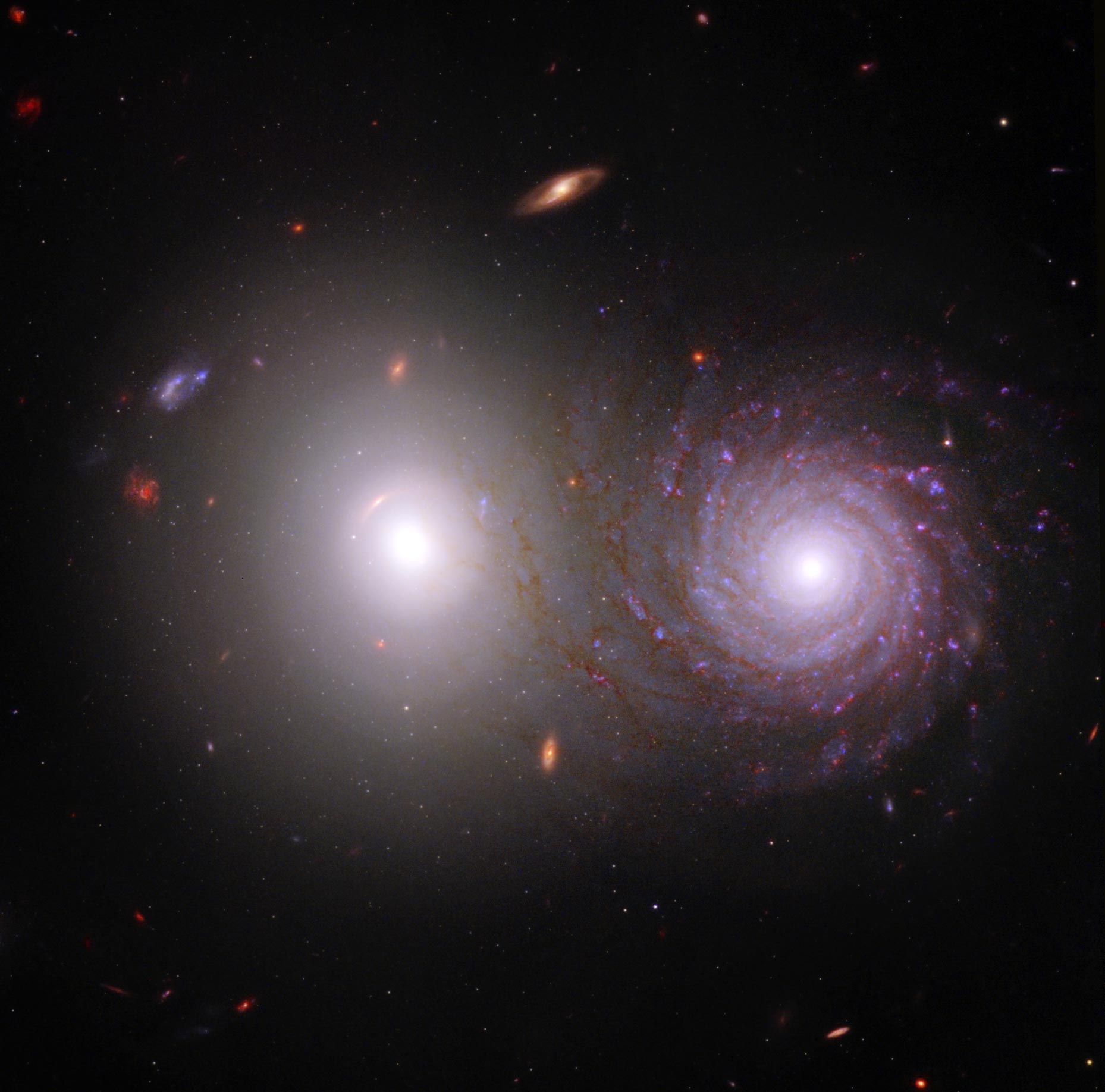
Combined data from Webb and Hubble telescopes revealed intricate details of the VV 191 galaxy pair, including dusty spiral arms and a gravitationally lensed distant galaxy, helping astronomers study dust, dark matter, and distant galaxies.
“We got more than we bargained for by combining data from NASA’s James Webb Space Telescope and NASA’s Hubble Space Telescope!” New data from Webb allowed astronomers to trace the light that was emitted by the bright white elliptical galaxy, at left, through the winding spiral galaxy at right – and identify the effects of interstellar dust in the spiral galaxy. This image of galaxy pair, known as VV 191, includes near-infrared light from Webb, and ultraviolet and visible light from Hubble.
With Webb’s near-infrared data we can see the galaxy’s longer, extremely dusty spiral arms in far more detail. It gives the arms an appearance of overlapping with the central bulge of the bright white elliptical galaxy on the left. While the two foreground galaxies are relatively close astronomically speaking, they are not actively interacting.
VV 191 is the latest addition to a small number of galaxies that helps researchers directly compare the properties of galactic dust. This target was selected from nearly 2,000 superimposed galaxy pairs identified by Galaxy Zoo citizen science volunteers.
Because dust changes the brightness and colors that appear in images of the galaxies, it is important to understand where dust is present in them. Since dust grains are partially responsible for the formation of new stars and planets, astronomers are always striving to identify their presence for further investigations.
Credit: Science: NASA, ESA, CSA, Rogier Windhorst (ASU), William Keel (University of Alabama), Stuart Wyithe JWST PEARLS Team, Image Processing: Alyssa Pagan (STScI)
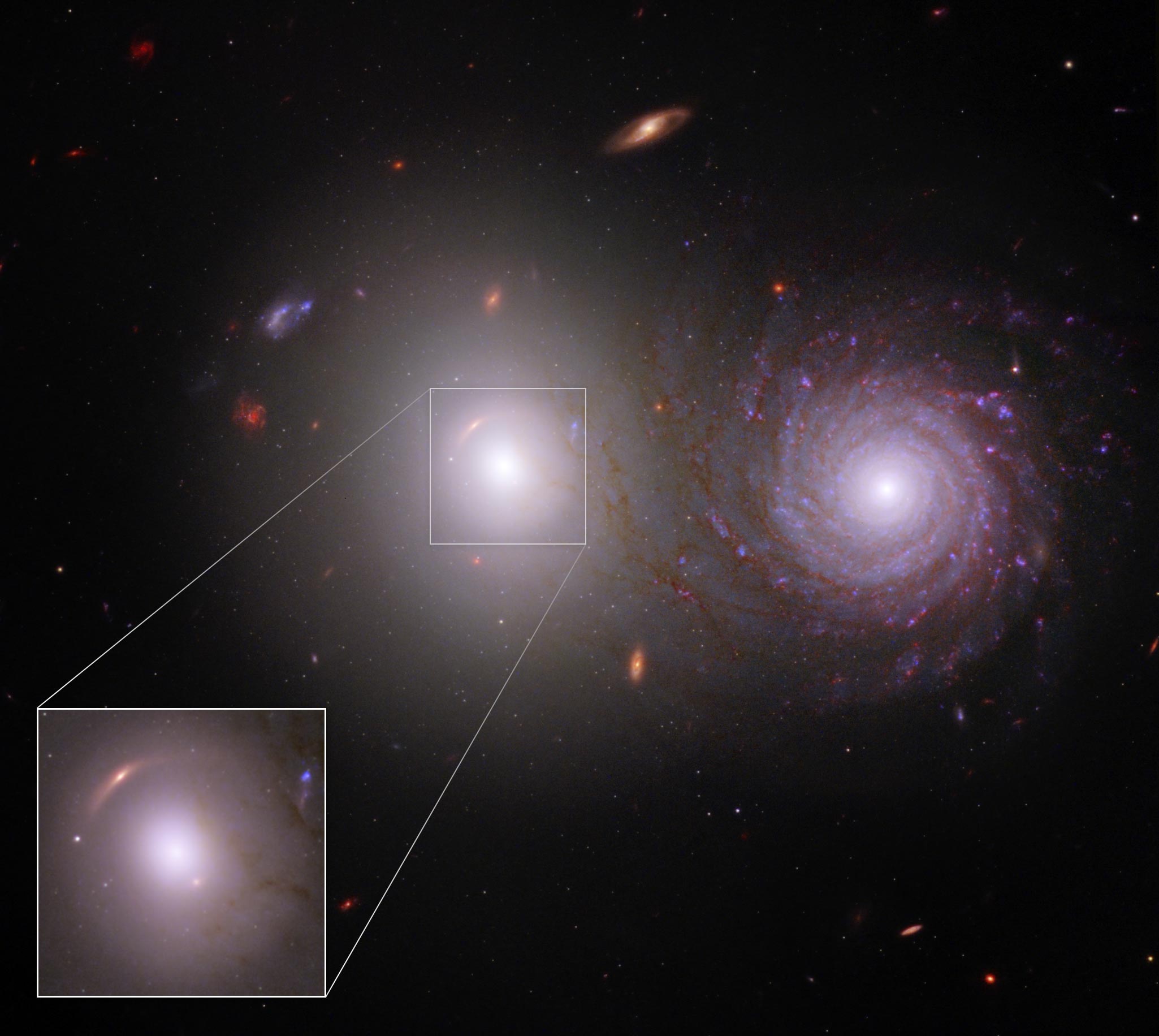
The image also holds a second discovery that’s easier to overlook. Carefully examine the white elliptical galaxy at left. A faint red arc appears in the inset at 10 o’clock. This arc is a very distant galaxy whose light is bent by the gravity of the elliptical foreground galaxy – and its appearance is duplicated. The stretched red arc is warped where it reappears – as a dot – at 4 o’clock. Because these images of the lensed galaxy are so faint and so red that they went unrecognized in Hubble data. However, they are unmistakable in Webb’s near-infrared image. Simulations of gravitationally lensed galaxies like this help astronomers reconstruct how much mass is in individual stars, as well as how much dark matter is in the core of this galaxy.
As with many images from the James Webb Space Telescope, this image of VV 191 shows additional galaxies deeper and deeper in the background. Two patchy spirals to the upper left of the elliptical galaxy have similar apparent sizes, but show up in very different colors. One is likely very dusty and the other very far away, but astronomers will need to obtain data known as spectra to determine which is which.
References:
“Webb’s PEARLS: dust attenuation and gravitational lensing in the backlit-galaxy system VV 191” by William C. Keel, Rogier A. Windhorst, Rolf A. Jansen, Seth H. Cohen, Benne Holwerda, Sarah T. Bradford, Clayton D. Robertson, Giovanni Ferrami, Stuart Wyithe, Haojing Yan, Christopher J. Conselice, Simon P. Driver, Norman A. Grogin, Christopher N.A. Willmer, Anton M. Koekemoer, Brenda L. Frye, Nimish P. Hathi, Russell E. Ryan Jr., Nor Pirzkal, Madeline A. Marshall, Dan Coe, Jose M. Diego, Thomas J. Broadhurst, Michael J. Rutkowski, Lifan Wang, S.P. Willner, Andreea Petric, Cheng Cheng and Adi Zitrin, 20 March 2023, The Astronomical Journal.
DOI: 10.3847/1538-3881/acbdff
arXiv:2208.14475
“Webb’s PEARLS: Prime Extragalactic Areas for Reionization and Lensing Science: Project Overview and First Results” by Rogier A. Windhorst, Seth H. Cohen, Rolf A. Jansen, Jake Summers, Scott Tompkins, Christopher J. Conselice, Simon P. Driver, Haojing Yan, Dan Coe, Brenda Frye, Norman Grogin, Anton Koekemoer, Madeline A. Marshall, Nor Pirzkal, Aaron Robotham, Russell E. Ryan Jr., Christopher N. A. Willmer, Timothy Carleton, Jose M. Diego, William C. Keel, Rosalia O’Brien, Paolo Porto, Caleb Redshaw, Sydney Scheller, Andi Swirbul, Stephen M. Wilkins, S. P. Willner, Adi Zitrin, Nathan J. Adams, Duncan Austin, Richard G. Arendt, John F. Beacom, Rachana A. Bhatawdekar, Larry D. Bradley, Thomas J. Broadhurst, Cheng Cheng, Francesca Civano, Liang Dai, Herve Dole, Jordan C. J. D’Silva, Kenneth J. Duncan, Giovanni G. Fazio, Giovanni Ferrami, Leonardo Ferreira, Steven L. Finkelstein, Lukas J. Furtak, Alex Griffiths, Heidi B. Hammel, Kevin C. Harrington, Nimish P. Hathi, Benne W. Holwerda, Jia-Sheng Huang, Minhee Hyun, Myungshin Im, Bhavin A. Joshi, Patrick S. Kamieneski, Patrick Kelly, Rebecca L. Larson, Juno Li, Jeremy Lim, Zhiyuan Ma, Peter Maksym, Giorgio Manzoni, Ashish Kumar Meena, Stefanie N. Milam, Mario Nonino, Massimo Pascale, Justin D. R. Pierel, Andreea Petric, Maria del Carmen Polletta, Huub J. A. Rottgering, Michael J. Rutkowski, Ian Smail, Amber N. Straughn, Louis-Gregory Strolger, James A. A. Trussler, Lifan Wang, Brian Welch, J. Stuart B. Wyithe, Min Yun, Erik Zackrisson, Jiashuo Zhang and Xiurui Zhao, 14 December 2022, The Astronomical Journal.
DOI: 10.3847/1538-3881/aca163
arXiv:2209.04119
Webb interdisciplinary scientist Rogier Windhorst of Arizona State University and his team obtained the data used in this image from early results of the Prime Extragalactic Areas for Reionization and Lensing Science (PEARLS) JWST Guaranteed Time Observation (GTO) programs, GTO 1176 and 2738. Additional data from Hubble’s STARSMOG snapshot program (SNAP 13695) and GO 15106, were added. Jake Summers, also of Arizona State, performed the pipeline data reduction. The dust analysis was led by William Keel of the University of Alabama, while the Hubble data acquisition was led by Benne Holwerda of the University of Louisville in Kentucky. The detailed gravitational-lensing analysis was conducted by Giovanni Ferrami and Stuart Wyithe, both of the University of Melbourne, Australia and ASTRO 3D, Australia.
Never miss a breakthrough: Join the SciTechDaily newsletter.
Follow us on Google and Google News.