
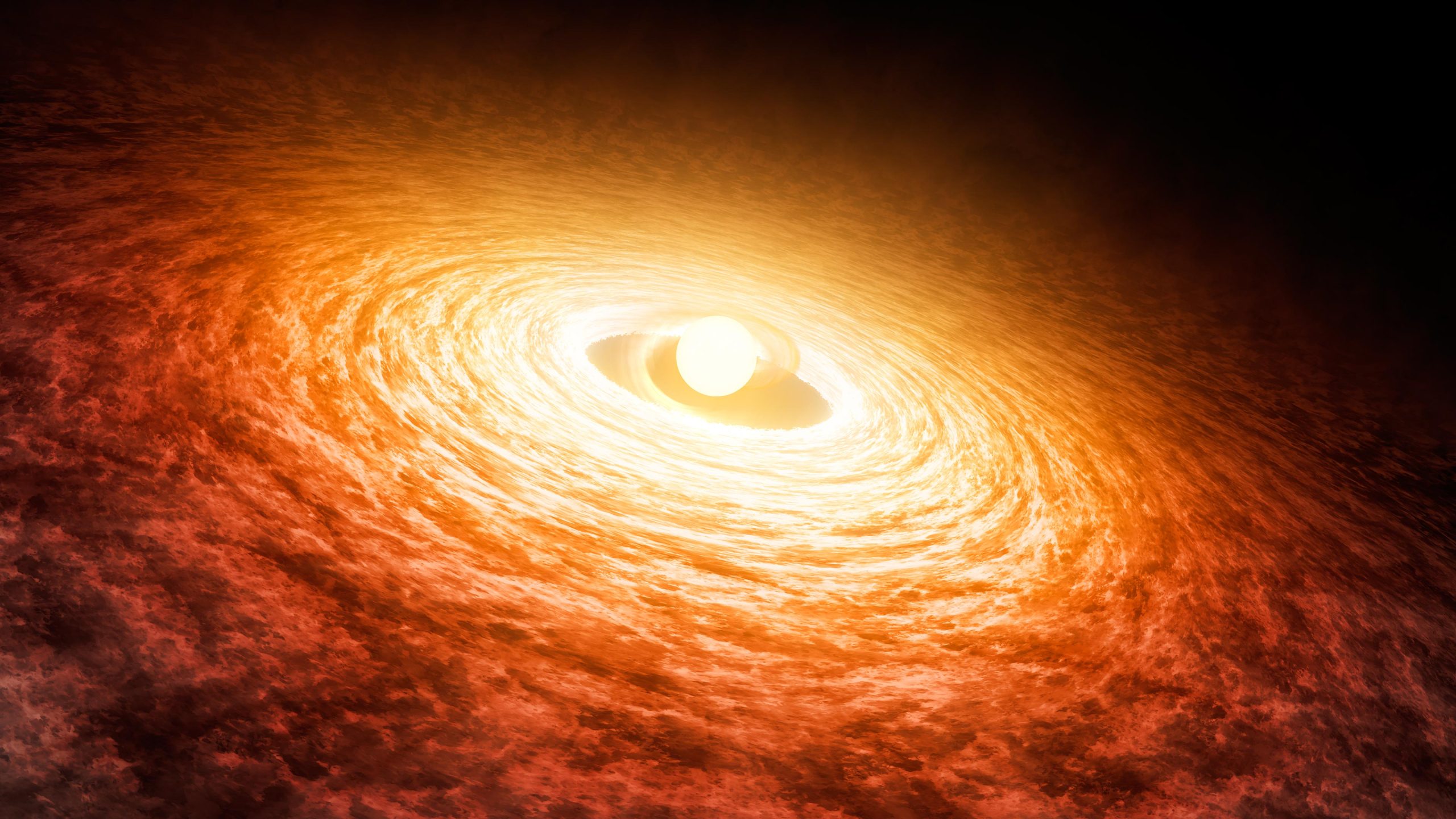
Ultraviolet light reveals new information about the FU Orionis’ mechanisms.
In 1936, the young star FU Orionis (FU Ori) dramatically brightened, becoming significantly more luminous. Since then, its brightness has gradually faded. Initially thought to be an isolated case, FU Ori is now recognized as part of a rare group of young, turbulent stars called FU Ori objects, known for their sudden and extreme increases in brightness.
To uncover what drives these dramatic outbursts, a team of astronomers used NASA’s Hubble Space Telescope to study FU Ori in ultraviolet light. Their observations revealed surprising and groundbreaking details about the interaction between the star’s surface and its surrounding accretion disk.
Hubble Space Telescope Finds Sizzling Details About Young Star FU Orionis
In 1936, astronomers observed a mysterious event in the constellation Orion: the young star FU Orionis (FU Ori) suddenly became 100 times brighter in just a few months. At its peak, FU Ori shone with 100 times the luminosity of our Sun. Unlike an exploding star, however, its brightness has only gradually faded over the decades.
Recently, a team of astronomers used NASA’s Hubble Space Telescope to investigate FU Ori in ultraviolet light. They aimed to better understand the interaction between the star’s surface and its accretion disk—a structure that has been funneling gas onto the star for nearly 90 years. Their findings revealed that the inner edge of the disk, where it contacts the star, is extraordinarily hot, defying current theoretical models.
These observations were made using Hubble’s COS (Cosmic Origins Spectrograph) and STIS (Space Telescope Imaging Spectrograph) instruments, providing the first far-ultraviolet and new near-ultraviolet spectral data of FU Ori.
“We were hoping to validate the hottest part of the accretion disk model, to determine its maximum temperature, by measuring closer to the inner edge of the accretion disk than ever before,” said Lynne Hillenbrand of Caltech in Pasadena, California, and a co-author of the paper. “I think there was some hope that we would see something extra, like the interface between the star and its disk, but we were certainly not expecting it. The fact we saw so much extra — it was much brighter in the ultraviolet than we predicted — that was the big surprise.”
Exploring Stellar Accretion Mechanisms
Originally deemed to be a unique case among stars, FU Ori exemplifies a class of young, eruptive stars that undergo dramatic changes in brightness. These objects are a subset of classical T Tauri stars, which are newly forming stars that are building up by accreting material from their disk and the surrounding nebula. In classical T Tauri stars, the disk does not touch the star directly because it is restricted by the outward pressure of the star’s magnetic field.
The accretion disks around FU Ori objects, however, are susceptible to instabilities due to their enormous mass relative to the central star, interactions with a binary companion, or infalling material. Such instability means the mass accretion rate can change dramatically. The increased pace disrupts the delicate balance between the stellar magnetic field and the inner edge of the disk, leading to material moving closer in and eventually touching the star’s surface.
The enhanced infall rate and proximity of the accretion disk to the star make FU Ori objects much brighter than a typical T Tauri star. In fact, during an outburst, the star itself is outshined by the disk. Furthermore, the disk material is orbiting rapidly as it approaches the star, much faster than the rotation rate of the stellar surface. This means that there should be a region where the disk impacts the star and the material slows down and heats up significantly.
“The Hubble data indicates a much hotter impact region than models have previously predicted,” said Adolfo Carvalho of Caltech and lead author of the study. “In FU Ori, the temperature is 16,000 kelvins [nearly three times our Sun’s surface temperature]. That sizzling temperature is almost twice the amount prior models have calculated. It challenges and encourages us to think of how such a jump in temperature can be explained.”
To address the significant difference in temperature between past models and the recent Hubble observations, the team offers a revised interpretation of the geometry within FU Ori’s inner region: The accretion disk’s material approaches the star and once it reaches the stellar surface, a hot shock is produced, which emits a lot of ultraviolet light.
Planet Survival Around FU Ori
Understanding the mechanisms of FU Ori’s rapid accretion process relates more broadly to ideas of planet formation and survival.
“Our revised model based on the Hubble data is not strictly bad news for planet evolution, it’s sort of a mixed bag,” explained Carvalho. “If the planet is far out in the disk as it’s forming, outbursts from an FU Ori object should influence what kind of chemicals the planet will ultimately inherit. But if a forming planet is very close to the star, then it’s a slightly different story. Within a couple outbursts, any planets that are forming very close to the star can rapidly move inward and eventually merge with it. You could lose, or at least completely fry, rocky planets forming close to such a star.”
Additional work with the Hubble UV observations is in progress. The team is carefully analyzing the various spectral emission lines from multiple elements present in the COS spectrum. This should provide further clues on FU Ori’s environment, such as the kinematics of inflowing and outflowing gas within the inner region.
“A lot of these young stars are spectroscopically very rich at far ultraviolet wavelengths,” reflected Hillenbrand. “A combination of Hubble, its size and wavelength coverage, as well as FU Ori’s fortunate circumstances, let us see further down into the engine of this fascinating star-type than ever before.”
These findings were published in The Astrophysical Journal Letters.
Reference: “A Far-ultraviolet-detected Accretion Shock at the Star–Disk Boundary of FU Ori” by Adolfo S. Carvalho, Lynne A. Hillenbrand, Kevin France and Gregory J. Herczeg, 23 September 2024, The Astrophysical Journal Letters.
DOI: 10.3847/2041-8213/ad74eb
The observations were taken as part of General Observer program 17176.
The Hubble Space Telescope has been operating for over three decades and continues to make ground-breaking discoveries that shape our fundamental understanding of the universe. Hubble is a project of international cooperation between NASA and ESA (European Space Agency). NASA’s Goddard Space Flight Center in Greenbelt, Maryland, manages the telescope and mission operations. Lockheed Martin Space, based in Denver, also supports mission operations at Goddard. The Space Telescope Science Institute in Baltimore, which is operated by the Association of Universities for Research in Astronomy, conducts Hubble science operations for NASA.
Never miss a breakthrough: Join the SciTechDaily newsletter.
Follow us on Google and Google News.
1 Comment
FU, indeed. Lol