

Encounter Blew Away Most of Smaller Galaxy’s Gaseous Halo
In a dramatic tale of survival captured by the Hubble Space Telescope, one of our closest galactic neighbors, the Large Magellanic Cloud (LMC), has plunged through the Milky Way’s vast gaseous halo and emerged intact. However, this dwarf galaxy paid a steep price, losing most of its own halo of gas during the encounter.
Astronomers were astonished to discover that the LMC’s remaining halo is extraordinarily small—about 10 times smaller than those of other galaxies of similar mass. Yet, despite the loss, the LMC has retained enough gas to continue forming new stars. A smaller, less massive galaxy likely wouldn’t have survived such a collision.
This groundbreaking measurement of the LMC’s halo, achieved for the first time, was only possible thanks to Hubble’s unique capabilities.
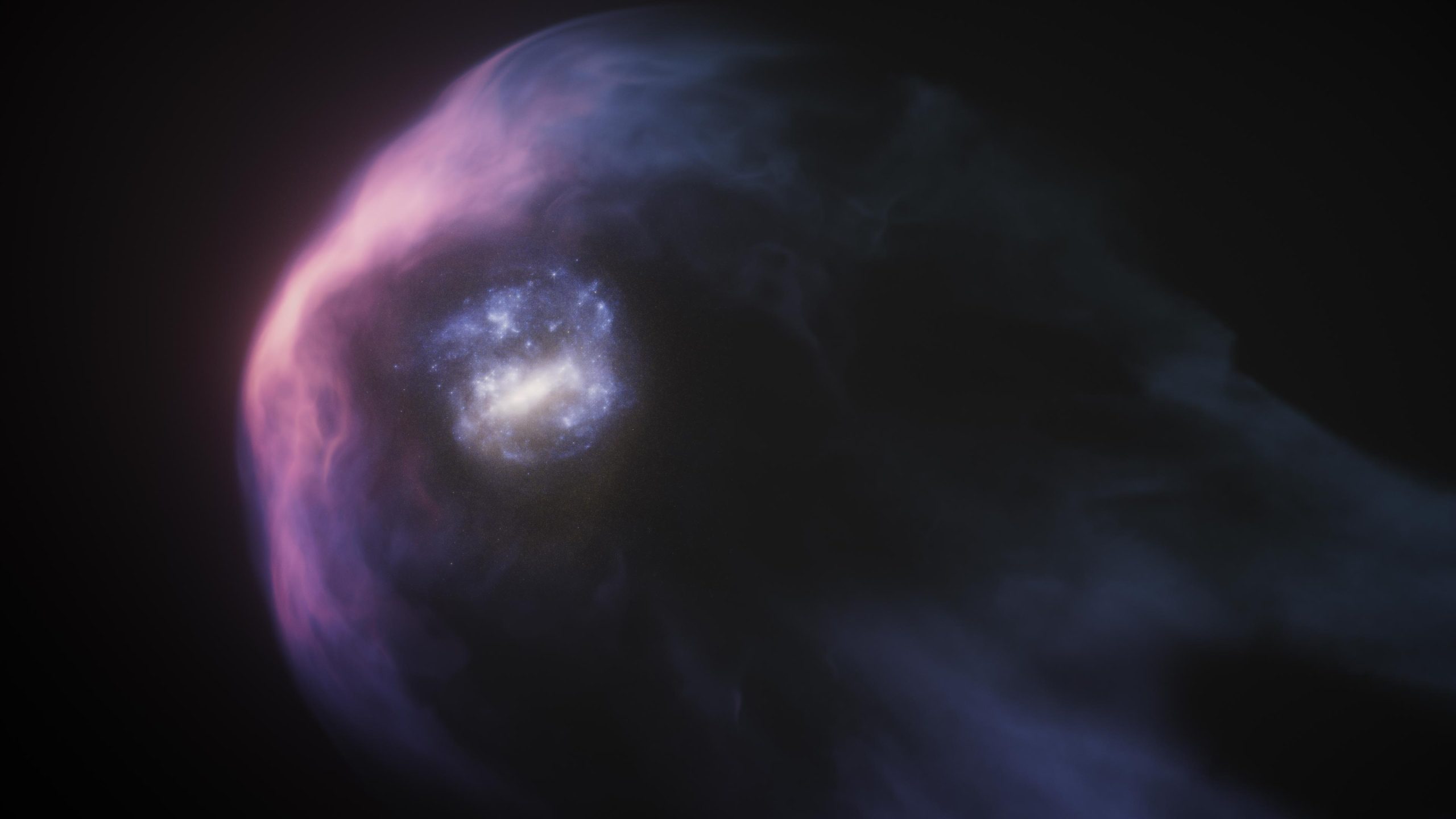
Hubble Space Telescope Sees Aftermath of Galaxy’s Scrape With Milky Way
A remarkable story of survival is unfolding at the edge of our galaxy, captured by NASA’s Hubble Space Telescope.
The Large Magellanic Cloud (LMC), one of the Milky Way’s closest galactic neighbors, is a dwarf galaxy prominently visible in the southern night sky. Its apparent size is 20 times larger than that of the full Moon.
Scientists theorize that the LMC isn’t in a stable orbit around the Milky Way but is instead passing through. Researchers believe it recently completed its closest approach to our much larger galaxy, an event that stripped away most of the spherical halo of gas surrounding the LMC.
Unveiling the Compact Halo
For the first time, astronomers have measured the size of the LMC’s halo, a feat made possible by Hubble. According to a new study set for publication in The Astrophysical Journal Letters, the halo is surprisingly small—only about 50,000 light-years across. This is roughly 10 times smaller than the halos of other galaxies of similar mass, offering a clear testament to the LMC’s dramatic encounter with the Milky Way.
“The LMC is a survivor,” said Andrew Fox of AURA/STScI for the European Space Agency in Baltimore, who was principal investigator on the observations. “Even though it’s lost a lot of its gas, it’s got enough left to keep forming new stars. So new star-forming regions can still be created. A smaller galaxy wouldn’t have lasted – there would be no gas left, just a collection of aging red stars.”
Though quite a bit worse for wear, the LMC still retains a compact, stubby halo of gas – something that it wouldn’t have been able to hold onto gravitationally had it been less massive. The LMC is 10 percent the mass of the Milky Way, making it heftier than most dwarf galaxies.
“Because of the Milky Way’s own giant halo, the LMC’s gas is getting truncated, or quenched,” explained STScI’s Sapna Mishra, the lead author on the paper chronicling this discovery. “But even with this catastrophic interaction with the Milky Way, the LMC is able to retain 10 percent of its halo because of its high mass.”

The Milky Way’s Influence
Most of the LMC’s halo was blown away due to a phenomenon called ram-pressure stripping. The dense environment of the Milky Way pushes back against the incoming LMC and creates a wake of gas trailing the dwarf galaxy – like the tail of a comet.
“I like to think of the Milky Way as this giant hairdryer, and it’s blowing gas off the LMC as it comes into us,” said Fox. “The Milky Way is pushing back so forcefully that the ram pressure has stripped off most of the original mass of the LMC’s halo. There’s only a little bit left, and it’s this small, compact leftover that we’re seeing now.”
As the ram pressure pushes away much of the LMC’s halo, the gas slows down and eventually will rain into the Milky Way. But because the LMC has just gotten past its closest approach to the Milky Way and is moving outward into deep space again, scientists do not expect the whole halo will be lost.
Hubble’s Unique Role
To conduct this study, the research team analyzed ultraviolet observations from the Mikulski Archive for Space Telescopes at STScI. Most ultraviolet light is blocked by the Earth’s atmosphere, so it cannot be observed with ground-based telescopes. Hubble is the only current space telescope tuned to detect these wavelengths of light, so this study was only possible with Hubble.
The team surveyed the halo by using the background light of 28 bright quasars. The brightest type of active galactic nucleus, quasars are believed to be powered by supermassive black holes. Shining like lighthouse beacons, they allow scientists to “see” the intervening halo gas indirectly through the absorption of the background light. Quasars reside throughout the universe at extreme distances from our galaxy.
The scientists used data from Hubble’s Cosmic Origins Spectrograph (COS) to detect the presence of the halo’s gas by the way it absorbs certain colors of light from background quasars. A spectrograph breaks light into its component wavelengths to reveal clues to the object’s state, temperature, speed, quantity, distance, and composition. With COS, they measured the velocity of the gas around the LMC, which allowed them to determine the size of the halo.
Because of its mass and proximity to the Milky Way, the LMC is a unique astrophysics laboratory. Seeing the LMC’s interplay with our galaxy helps scientists understand what happened in the early universe, when galaxies were closer together. It also shows just how messy and complicated the process of galaxy interaction is.
Future Research Directions
The team will next study the front side of the LMC’s halo, an area that has not yet been explored.
“In this new program, we are going to probe five sightlines in the region where the LMC’s halo and the Milky Way’s halo are colliding,” said co-author Scott Lucchini of the Center for Astrophysics | Harvard & Smithsonian. “This is the location where the halos are compressed, like two balloons pushing against each other.”
Reference: “The Truncated Circumgalactic Medium of the Large Magellanic Cloud” by Sapna Mishra, Andrew J. Fox, Dhanesh Krishnarao, Scott Lucchini, Elena D’Onghia, Frances H. Cashman, Kathleen A. Barger, Nicolas Lehner and Jason Tumlinson, Accepted, The Astrophysical Journal Letters.
arXiv:2410.11960
The Hubble Space Telescope, a collaboration between NASA and the European Space Agency (ESA), has been revolutionizing our understanding of the universe for over three decades. Launched in 1990, it continues to deliver groundbreaking discoveries, from unveiling the age of the universe to capturing stunning images of distant galaxies, nebulae, and exoplanets.
Managed by NASA’s Goddard Space Flight Center in Greenbelt, Maryland, with mission operations supported by Lockheed Martin Space in Denver, Colorado, Hubble’s scientific operations are conducted by the Space Telescope Science Institute (STScI) in Baltimore, Maryland. The STScI, operated by the Association of Universities for Research in Astronomy, ensures that Hubble remains at the forefront of astronomical research, delivering invaluable insights into the cosmos.
Never miss a breakthrough: Join the SciTechDaily newsletter.
Follow us on Google and Google News.
2 Comments
If one were to analogize this event to a symbolic interaction between two conscious organisms, for sci-fi’s sake, for instance, that could be an enjoyable exercise.
Hello sir namaste god bless all family members.aber Leute sturion family members.aber viel Leute studieren und professor werden.das god aus gabe.jede Menachemn geborn eigne Leben.manchmal laute kinder loss family,kinder nehmen.aber sturion die ganze welt.alls horen.das Leben.schone gruss Rajveer Singh sun of karnail singh batth village kotala bet po chhourian district Ludhiana Punjab India.das brief international uno all kindergarten studieren.sorry sir iam kriminal.thanks for alls