
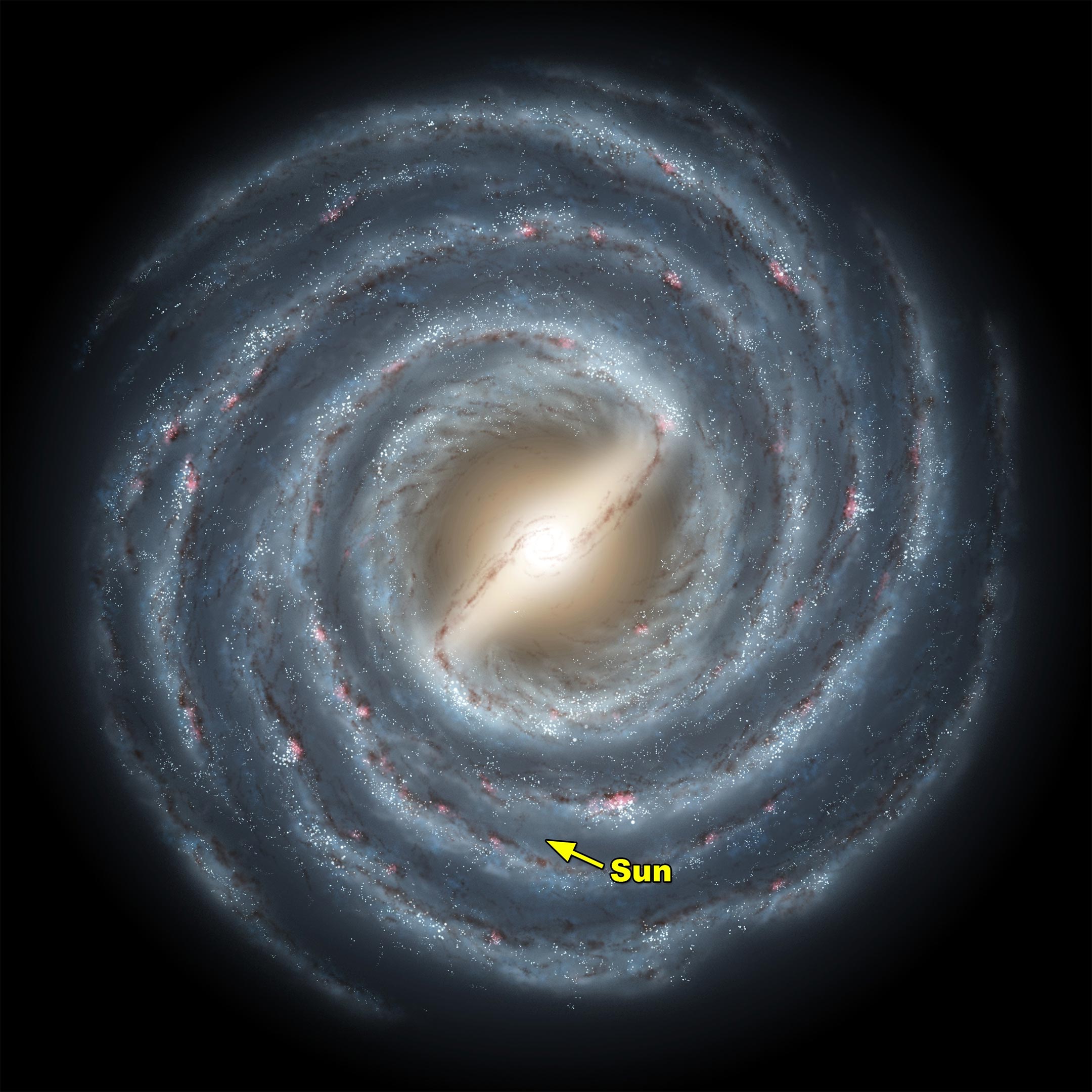
New research shows a section of the outer Milky Way is more clumpy, less well-organized than previously thought.
When you go outside at night in a rural location with dark skies, you can look up and see a band of stars crossing the sky. That band is our Milky Way galaxy, which we see edge-on since we’re inside of it. If we could travel faster than light and climb above the plane of our galaxy, we would see a flat disk with spiral arms wrapping around the core. But what shape, exactly, would those spiral arms have? Stuck here with no bird’s-eye view, we have to apply other methods to measure the galaxy’s shape.
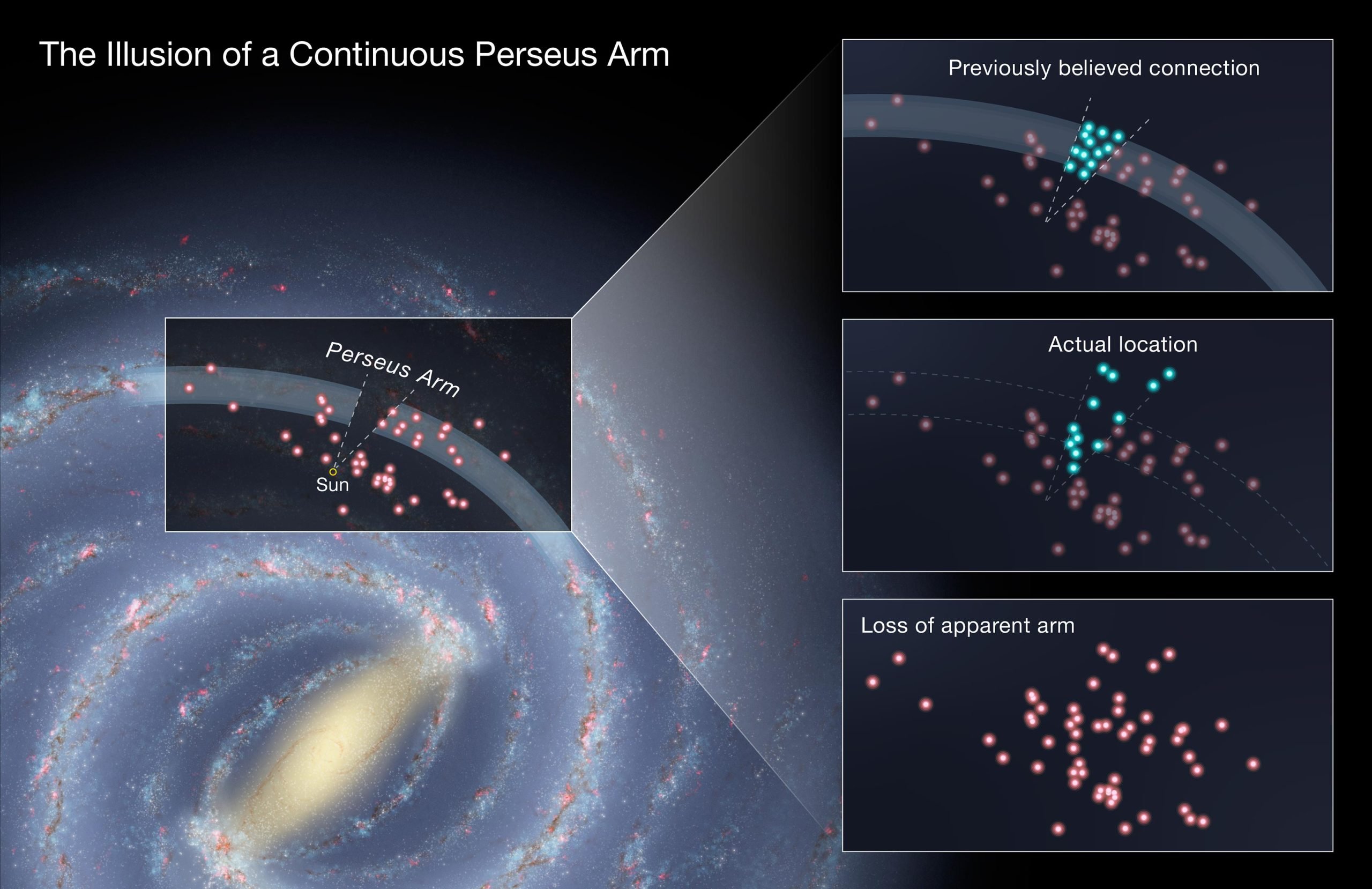
Moving outward from Earth’s location, astronomers have constructed a model of the neighboring spiral arm, known as the Perseus arm. Previous work suggested that the Perseus arm possesses a narrow and distinct shape. However new research shows that at least a portion of the Perseus arm may be illusory, without any well-defined structure. The illusion is a result of complexities first predicted by W. Burton in 1971.
Our Milky Way May Be More Fluffy, Less Wiry
Our Milky Way has long been known to be a spiral galaxy, shaped much like a fried egg with a bulbous central bulge and a thin, flat disk of stars. For decades, astronomers have struggled to map the Milky Way’s disk and its associated spiral arms. As the old saying goes, you can’t see the forest for the trees, and if you’re in the middle of the forest, how can you map its groves without a bird’s-eye view?
Previous work has suggested that the Milky Way is what’s known as a “grand design” spiral, with long, narrow, well-defined spiral arms. However, new research finds that at least one portion of the outer Milky Way (beyond the Sun’s location) is much more clumpy and chaotic.
“We have long had a picture of the galaxy in our minds, based on a combination of measurements and inference,” said Josh Peek of the Space Telescope Science Institute (STScI) in Baltimore, Maryland. “This work calls that picture into question. We don’t see evidence that pieces we’ve been connecting up are actually connected.”
Distances are Key
When mapping our galaxy, the biggest challenge is finding the distance to any given star, star cluster, or gas clump. The gold standard is to use parallax measurements of naturally occurring radio sources called masers, some of which are found in high-mass star-forming regions. However, this technique inevitably leaves gaps.
To fill those gaps, astronomers switch from examining star-forming regions to gas clouds, and more specifically, the motions of those gas clouds. In an ideal situation, the line-of-sight motion we measure for a gas cloud is directly related to its distance due to the overall rotation of the Milky Way. As a result, by measuring gas velocities, we can determine distances and hence the underlying structure of the galaxy.
The question then becomes, what about a non-ideal situation? While the motion of any given gas cloud might be dominated by its rotation around the galactic center, it undoubtedly has some additional, more random motions as well. Can those extra motions throw off our maps?
Chunky and Lumpy
To investigate this question, Peek and his colleagues examined not the gas, but the dust. In general within our galaxy, gas and dust are closely associated, so if you can map one, you also map the other.
3D dust maps can be created by examining the colors of large collections of stars spread across the sky. The more dust that is between the star and our telescope, the redder the star will appear compared to its natural color.

Peek and his team examined a region of space known as the Perseus spiral arm, which is beyond our Sun in the Milky Way’s disk. They compared the distances measured via dust reddening to those determined by the velocity relationship. They found that many of the clouds do not, in fact, lie at the distance of the Perseus arm, but instead stretch along a distance of some 10,000 light-years.
“We don’t have long, skinny spiral arms after all, at least in this section of the galaxy. There are chunks and lumps that don’t look like anything,” explained Peek. “It’s a good possibility that the outer disk of the Milky Way resembles the nearby galaxy Messier 83, with shorter, chopped-up pieces of arms.”
Revising Our Map
While this latest research focused on the outer Milky Way, Hubble Fellow Catherine Zucker, a member of Peek’s team at STScI, is planning to extend that work to the inner Milky Way. The region interior to the Sun’s orbit is where the spiral arms that are most actively forming stars reside.
Zucker plans to create 3D dust maps using existing large-scale infrared surveys to measure the reddening of some 1 to 2 billion stars. By linking those new dust maps with existing gas velocity surveys, astronomers can refine our map of the inner Milky Way much as they have already done with the outer galaxy.
“Previous 3D dust mapping efforts have largely relied on data at wavelengths visible to the human eye. No one has used deep infrared data to create a 3D dust map,” said Zucker. “We may find that this region, like the Perseus arm, is more chaotic and less well defined.”
Even more insights may come from the upcoming Nancy Grace Roman Space Telescope and Vera Rubin Observatory. The Roman Space Telescope will have the capability to map the entire galactic plane in a few hundred hours. Also, its infrared measurements will cut through the dust.
“We could see clear to the other side of the galaxy for the first time. If a survey like this is selected for Roman, it would be stunning,” said Peek.
Rubin, on the other hand, will be able to make deep observations of faint objects at a variety of optical wavelengths. By combining Roman’s infrared view of the sky with Rubin’s deep, multi-wavelength optical data, we may finally map our own cosmic “forest.”
This work is accepted for publication in The Astrophysical Journal.
The Space Telescope Science Institute is expanding the frontiers of space astronomy by hosting the science operations center of the Hubble Space Telescope, the science and mission operations centers for the James Webb Space Telescope, and the science operations center for the Nancy Grace Roman Space Telescope. STScI also houses the Barbara A. Mikulski Archive for Space Telescopes (MAST) which is a NASA-funded project to support and provide to the astronomical community a variety of astronomical data archives, and is the data repository for the Hubble, Webb, Roman, Kepler, K2, TESS missions and more. STScI is operated for NASA by the Association of Universities for Research in Astronomy in Washington, D.C.
Never miss a breakthrough: Join the SciTechDaily newsletter.
Follow us on Google and Google News.
4 Comments
Science is a business and is not necessarily science or scientific. Before scientists go looking far away they can get rid of their stupidity called Einstein’s 4 D space time physics and take into account Earth’s motion visual effects
Yoyo Joe, science is discovering. Space or medicine,robotics, chemistry. Just believe your dim comment of Einstein is less informed,u may not need to know.*👽 {et} u know that one?joe* in fact there over 13 dimensions 🧐😱🛸if not more=+=,but u don’t know do u?#👽😎Joe ^*^as if Joe checked for readers to return his thoughts 🤔 no o no a discontented
Hey! I learned that in science class, in 1977!
Don’t change it, or I’ll be WRONG!
(Seriously. How many folks see a guy smoking a joint in the Space JPG, above?)
Science is wonderful. It doesn’t make pronouncements of truth, but instead is a ongoing process to refine what we think we know into a more accurate understanding of reality as it really is. Finding out the galaxy isn’t as organized as we thought is an excellent example of this refinement process. What will we either discover or correct next?