
Oldest infant burial in Europe reveals deep roots of gender recognition.
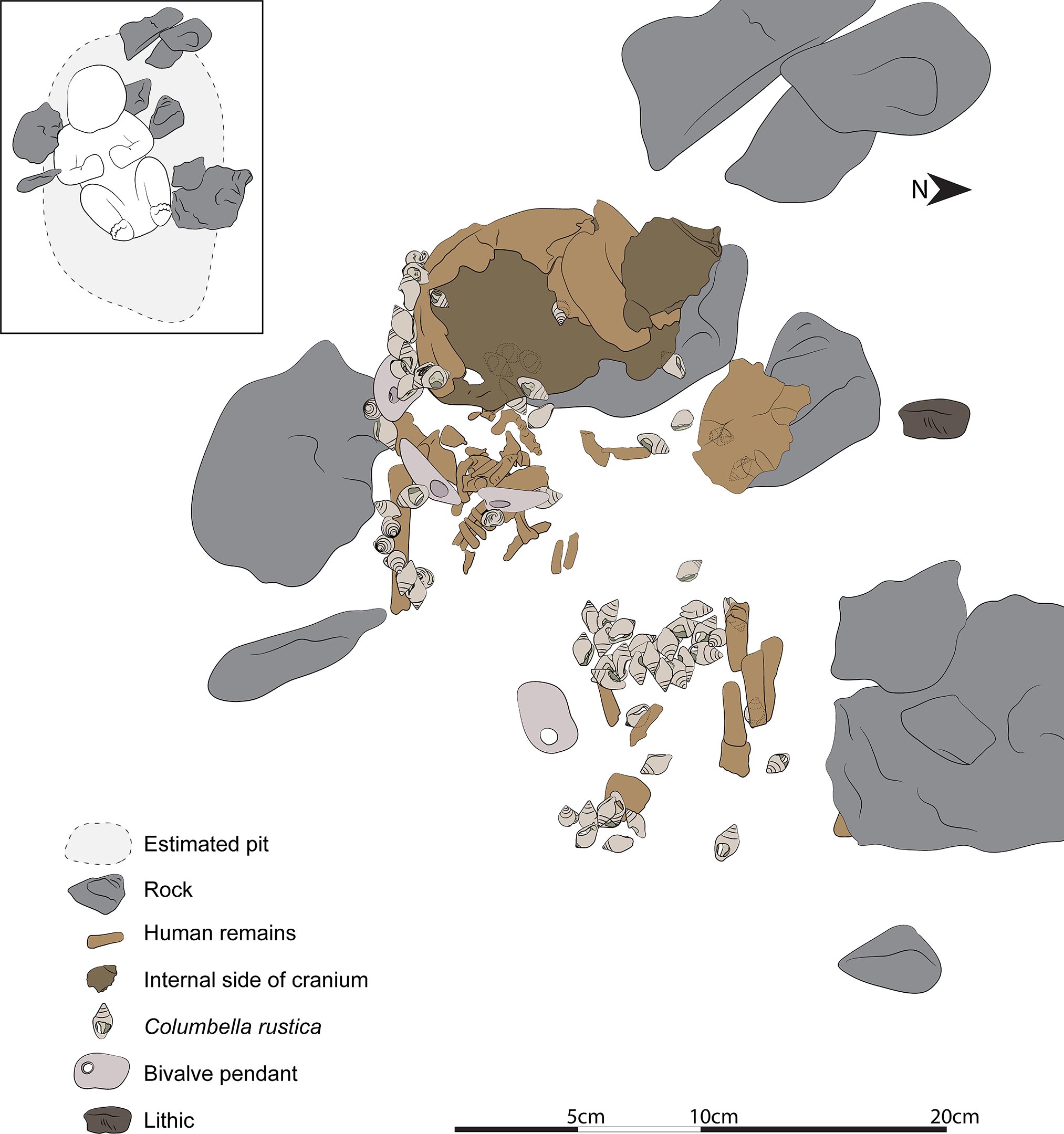
Working in a cave in Liguria, Italy, an international team of researchers uncovered the oldest documented burial of an infant girl in the European archaeological record. The richly decorated 10,000-year-old burial included over 60 pierced shell beads, four pendants, and an eagle-owl talon alongside the remains. The discovery offers insight into the early Mesolithic period, from which few recorded burials are known, and the seemingly egalitarian funerary treatment of an infant female.
“The evolution and development of how early humans buried their dead as revealed in the archaeological record has enormous cultural significance,” says Jamie Hodgkins, PhD, paleoanthropologist and associate professor of anthropology at the University of Colorado Denver.
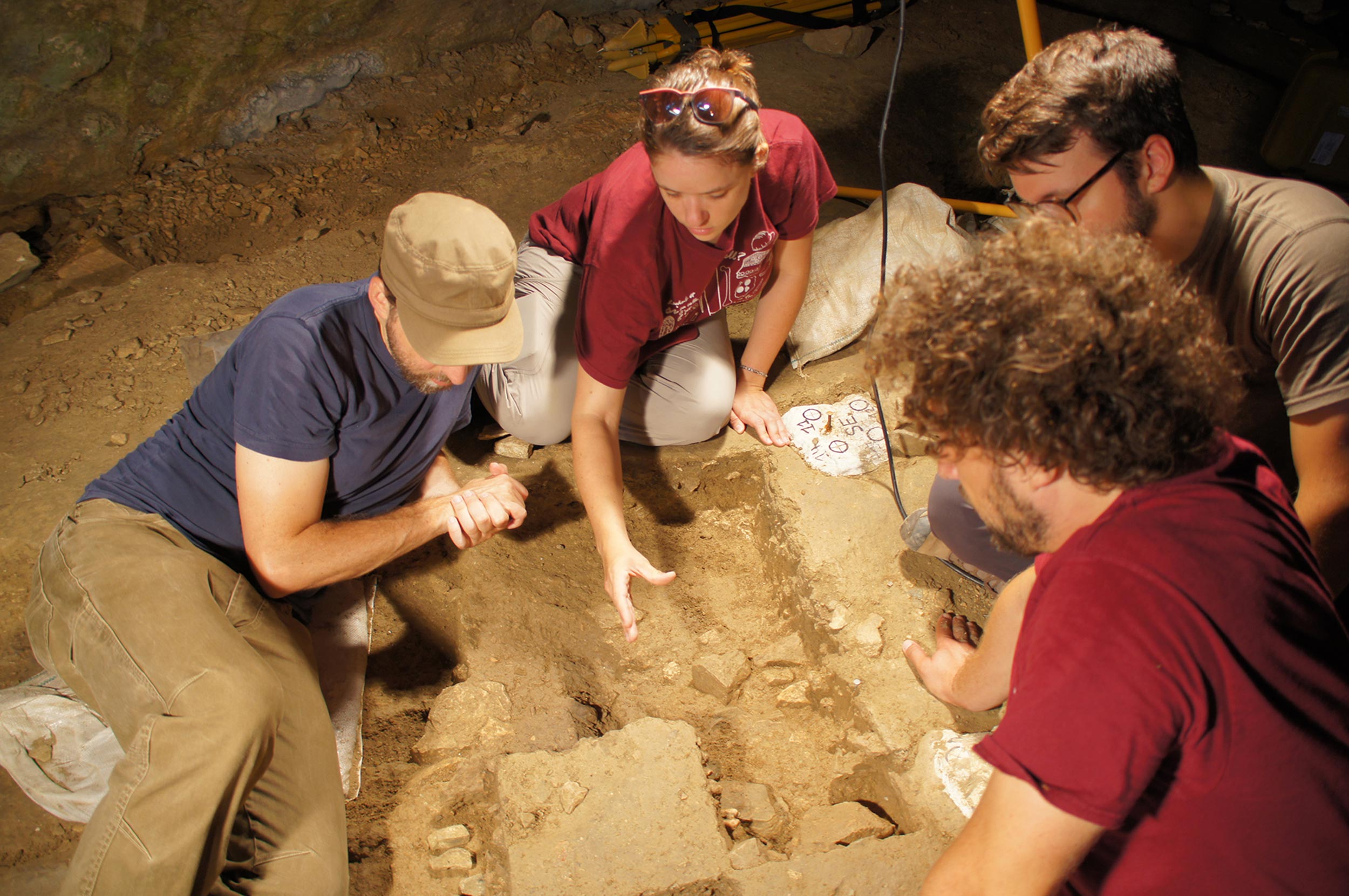
The crew first discovered the burial in 2017 and fully excavated the delicate remains in July 2018. Hodgkins worked alongside her husband Caley Orr, PhD, paleoanthropologist and anatomist at the University of Colorado School of Medicine. Their team of project codirectors included Italian collaborators Fabio Negrino, University of Genoa, and Stefano Benazzi, University of Bologna, as well as researchers from the University of Montreal, Washington University, University of Ferrara, University of Tubingen, and the Institute of Human Origins at Arizona State University.
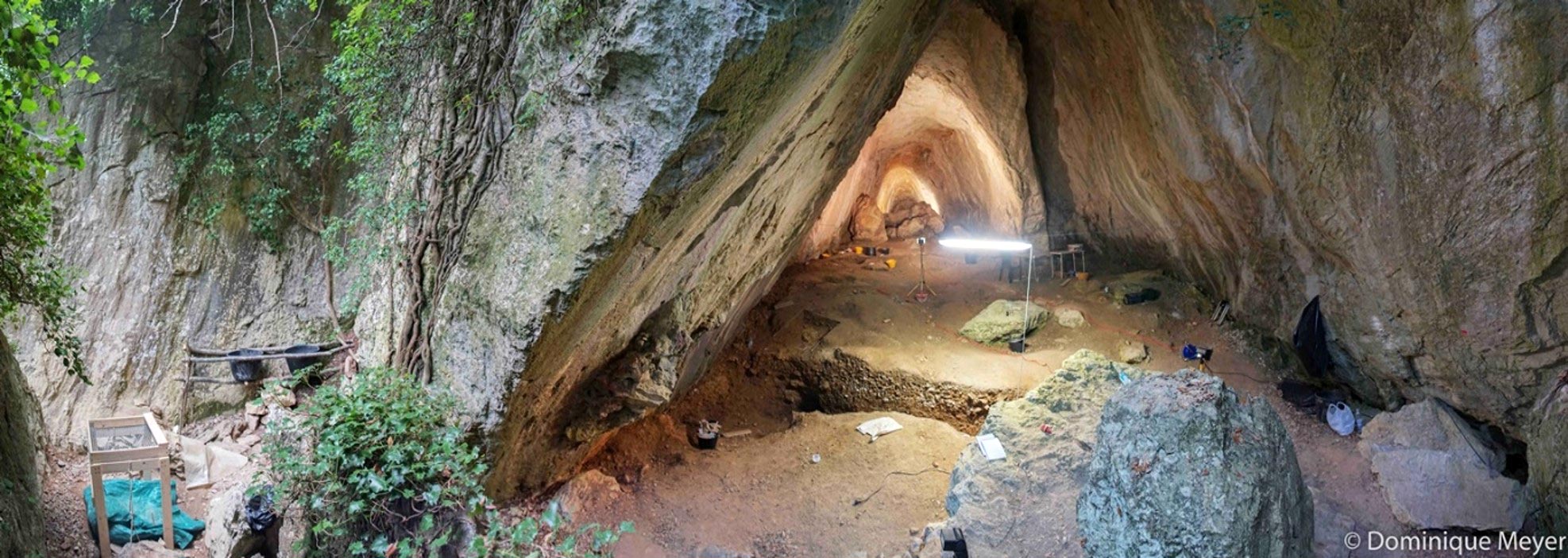
Arma Veirana, a cave in the Ligurian pre-Alps of northwestern Italy, is a popular spot for local families to visit. Looters also discovered the site, and their digging exposed the late Pleistocene tools that drew researchers to the area.
The team spent its first two excavation seasons near the mouth of the cave, exposing stratigraphic layers that contained tools over 50,000 years old typically associated with Neandertals in Europe (Mousterian tools). They also found the remains of ancient meals such as the cut-marked bones of wild boars and elk, and bits of charred fat. To better understand the stratigraphy of the cave as it related to the artifacts, the team needed to expose potential Upper Paleolithic deposits that could have been the source of the more recently made stone tools they found eroding down the cave floor.
As the team explored the further reaches of the cave, they began to unearth pierced shell beads. Hodgkins was going through the beads back in the lab and knew the team was onto something. A few days later, using dental tools and a small paint brush, the researchers exposed parts of a cranial vault and articulated lines of pierced shell beads.
In a series of analyses coordinated with multiple institutions and numerous experts, the team uncovered several details about the ancient burial. Radiocarbon dating determined that the child, who the team nicknamed “Neve,” lived 10,000 years ago, and amelogenin protein analysis and ancient DNA revealed that the infant was a female belonging to a lineage of European women known as the U5b2b haplogroup.
Why Neve’s Burial Fills a Key Gap
“There’s a decent record of human burials before around 14,000 years ago,” said Hodgkins. “But the latest Upper Paleolithic period and earliest part of the Mesolithic are more poorly known when it comes to funerary practices. Infant burials are especially rare, so Neve adds important information to help fill this gap.”
“The Mesolithic is particularly interesting,” said Orr. “It followed the end of the final Ice Age and represents the last period in Europe when hunting and gathering was the primary way of making a living. So it’s a really important time period for understanding human prehistory.”
Teeth Reveal Infant Stress and Maternal Diet
Detailed virtual histology of the infant’s teeth showed that she died 40–50 days after birth, and that she experienced stress that briefly halted the growth of her teeth 47 days and 28 days before she was born. Carbon and nitrogen analyses of the teeth revealed that the baby’s mother had been nourishing the infant in her womb on a land-based diet.
An analysis of the ornaments adorning the infant demonstrated the care invested in each piece and showed that many of the ornaments exhibited wear that proves they were passed down to the child from group members.
Along with the burial of a similarly aged female from Upward Sun River in Alaska, Hodgkins said the funerary treatment of Neve suggests that the recognition of infant females as full persons has deep origins in a common ancestral culture that was shared by peoples who migrated into Europe and those who migrated to North America. Or it may have arisen in parallel in populations across the planet.
Mortuary practices offer a window into the worldviews and social structure of past societies. Child funerary treatment provides important insights into who was considered a person and afforded the attributes of an individual self, moral agency, and eligibility for group membership. Neve shows that even the youngest females were recognized as full persons in her society.
And because archaeology has historically been viewed through a male lens, Hodgkins worries there are many stories we’ve missed.
DNA Reveals Hidden Stories of Women in Prehistory
“Right now, we have the oldest identified female infant burial in Europe,” said Hodgkins. “I hope that quickly becomes untrue. Archaeological reports have tended to focus on male stories and roles, and in doing so have left many people out of the narrative. Protein and DNA analyses are allowing us to better understand the diversity of human personhood and status in the past. Without DNA analysis, this highly decorated infant burial could possibly have been assumed male.”
In Western society, archaeologists have historically assumed that figureheads and warriors were male. But DNA analyses have proven the existence of female Viking warriors, nonbinary leaders, and powerful Bronze Age female rulers. Finding a burial like Neve’s is a reason to look more critically at archaeology’s past, said Hodgkins.
“This is about increasing our knowledge of women, but also acknowledging that we as archaeologists can’t understand the past through a singular lens. We need as diverse a perspective as possible because humans are complex.”
For more on this research, see Evolution of Personhood: Earliest Adorned Female Infant Burial in Europe Reveals Significant Insights.
Reference: “An infant burial from Arma Veirana in northwestern Italy provides insights into funerary practices and female personhood in early Mesolithic Europe” by Jamie Hodgkins, Caley M. Orr, Claudine Gravel-Miguel, Julien Riel-Salvatore, Christopher E. Miller, Luca Bondioli, Alessia Nava, Federico Lugli, Sahra Talamo, Mateja Hajdinjak, Emanuela Cristiani, Matteo Romandini, Dominique Meyer, Danylo Drohobytsky, Falko Kuester, Geneviève Pothier-Bouchard, Michael Buckley, Lucia Mancini, Fabio Baruffaldi, Sara Silvestrini, Simona Arrighi, Hannah M. Keller, Rocío Belén Griggs, Marco Peresani, David S. Strait, Stefano Benazzi and Fabio Negrino, 14 December 2021, Scientific Reports.
DOI: 10.1038/s41598-021-02804-z
The research, excavation, and analysis were made possible with funding from The Wenner-Gren Foundation, Leakey Foundation, National Geographic Society Waitt Program, Hyde Family Foundation, Social Sciences and Humanities Research Council (SSHRC), the European Union’s Horizon 2020 Research and Innovation Program, and the Max Planck Society.
Never miss a breakthrough: Join the SciTechDaily newsletter.
Follow us on Google and Google News.
1 Comment
… a question!
If the Humans have babies with the Neanderthals, could there be a chance that one of those combination had cancer more likely occur and then that way we would carry the Neanderthals genes only or more likely from one side…