
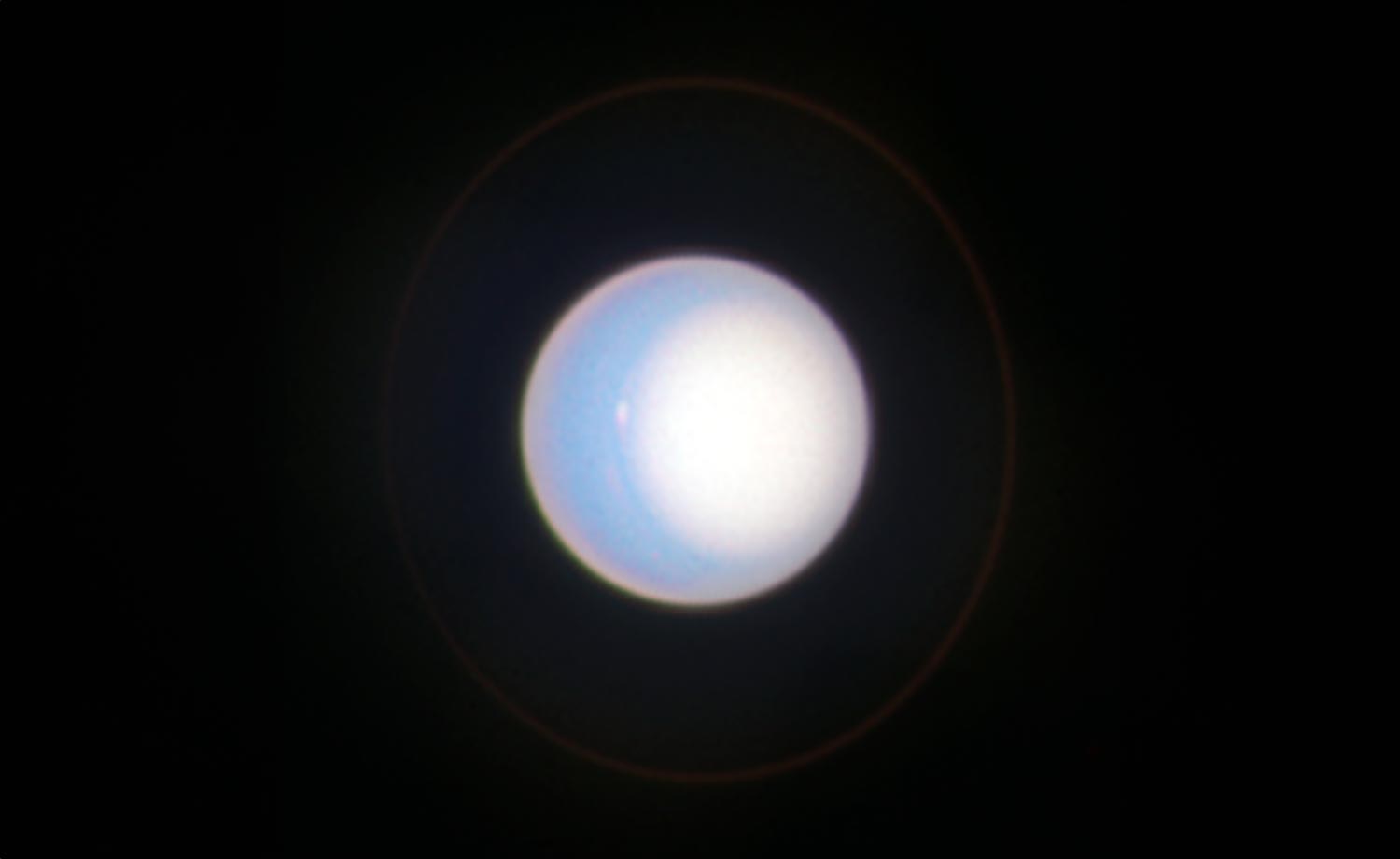
Using the dual perspectives of Hubble and New Horizons, scientists have gained new insights into Uranus’ atmospheric properties and brightness, informing future exoplanet studies.
Uranus has been described as mysterious, strange, and fairly unknown to those of us here on Earth. However, in astronomy, these terms are pretty relative. Compared to the remote, dark stretches of the early universe or oddball exoplanets dozens of light-years from our solar system, researchers actually know a lot about Uranus.
NASA’s Hubble Space Telescope is among the observatories that can view the planet in high resolution, showing up-close details of the planet’s atmospheric features.
Astronomers have now taken advantage of this viewpoint in a new way. They viewed Uranus in high resolution with Hubble, and at the same time, with the New Horizons spacecraft from 6.5 billion miles away, where the planet appears as just a splotch. This combined perspective can help teach them more about what to expect while imaging planets around other stars — Hubble provides context for what the atmosphere is actually doing when it was observed with New Horizons.

NASA’s Hubble and New Horizons Team Up for a Simultaneous Look at Uranus
NASA’s Hubble Space Telescope and New Horizons spacecraft recently focused simultaneously on Uranus, enabling scientists to directly compare observations of the planet from two distinct vantage points. These insights will guide future studies of similar planets in other star systems.
By using Uranus as a stand-in for distant exoplanets, astronomers leveraged high-resolution images from Hubble alongside broader views from New Horizons. This dual perspective enhances our understanding of what to anticipate when imaging exoplanets with next-generation telescopes.
Unveiling New Insights in Exoplanet Observation
“While we expected Uranus to appear differently in each filter of the observations, we found that Uranus was actually dimmer than predicted in the New Horizons data taken from a different viewpoint,” said lead author Samantha Hasler of the Massachusetts Institute of Technology in Cambridge and New Horizons science team collaborator.
Direct imaging of exoplanets is a key technique for learning about their potential habitability, and offers new clues to the origin and formation of our own solar system. Astronomers use both direct imaging and spectroscopy to collect light from the observed planet and compare its brightness at different wavelengths. However, imaging exoplanets is a notoriously difficult process because they’re so far away. Their images are mere pinpoints and so are not as detailed as the close-up views that we have of worlds orbiting our Sun. Researchers can also only directly image exoplanets at “partial phases,” when only a portion of the planet is illuminated by their star as seen from Earth.

Comparing Distant Views: Hubble vs. New Horizons
Uranus was an ideal target as a test for understanding future distant observations of exoplanets by other telescopes for a few reasons. First, many known exoplanets are also gas giants similar in nature. Also, at the time of the observations, New Horizons was on the far side of Uranus, 6.5 billion miles away, allowing its twilight crescent to be studied—something that cannot be done from Earth. At that distance, the New Horizons view of the planet was just several pixels in its color camera, called the Multispectral Visible Imaging Camera.
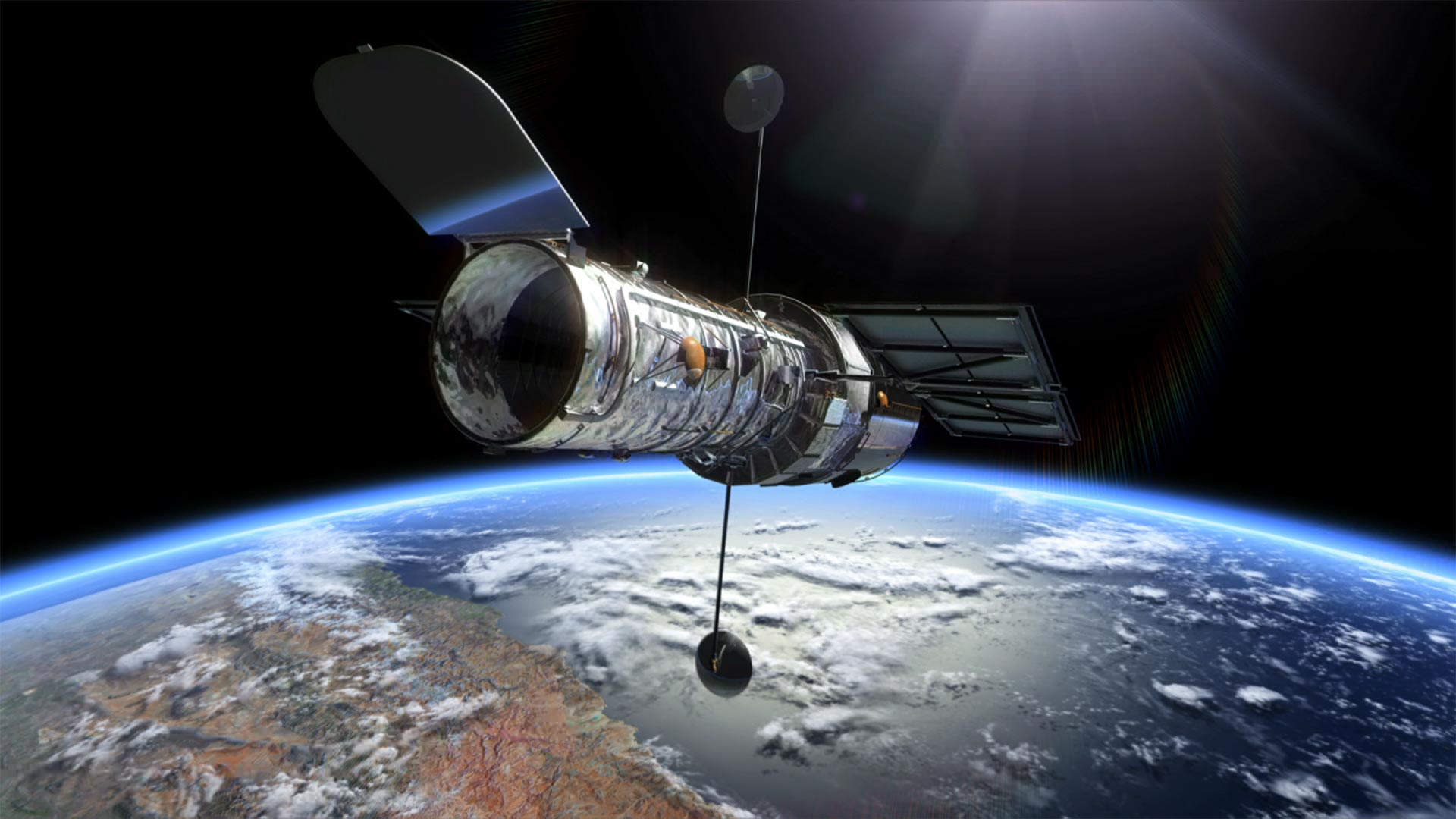
On the other hand, Hubble, with its high resolution, and in its low-Earth orbit 1.7 billion miles away from Uranus, was able to see atmospheric features such as clouds and storms on the day side of the gaseous world.
“Uranus appears as just a small dot on the New Horizons observations, similar to the dots seen of directly-imaged exoplanets from observatories like Webb or ground-based observatories,” added Hasler. “Hubble provides context for what the atmosphere is doing when it was observed with New Horizons.”
Reflective Properties and Future Missions
The gas giant planets in our solar system have dynamic and variable atmospheres with changing cloud cover. How common is this among exoplanets? By knowing the details of what the clouds on Uranus looked like from Hubble, researchers are able to verify what is interpreted from the New Horizons data. In the case of Uranus, both Hubble and New Horizons saw that the brightness did not vary as the planet rotated, which indicates that the cloud features were not changing with the planet’s rotation.
However, the importance of the detection by New Horizons has to do with how the planet reflects light at a different phase than what Hubble, or other observatories on or near Earth, can see. New Horizons showed that exoplanets may be dimmer than predicted at partial and high phase angles, and that the atmosphere reflects light differently at partial phase.

Pioneering the Future of Exoplanet Research
NASA has two major upcoming observatories in the works to advance studies of exoplanet atmospheres and potential habitability.
“These landmark New Horizons studies of Uranus from a vantage point unobservable by any other means add to the mission’s treasure trove of new scientific knowledge, and have, like many other datasets obtained in the mission, yielded surprising new insights into the worlds of our solar system,” added New Horizons principal investigator Alan Stern of the Southwest Research Institute.
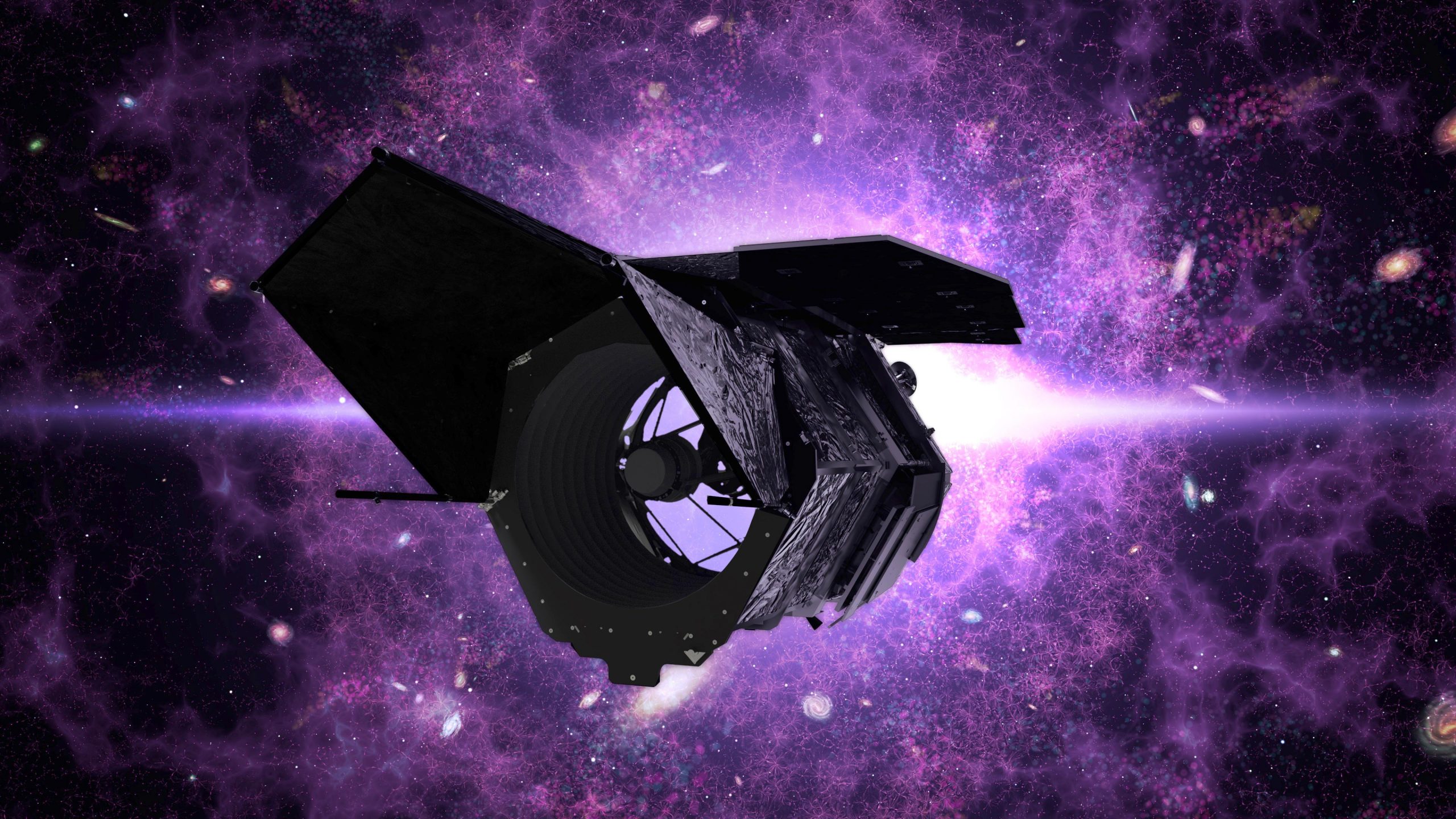
NASA’s upcoming Nancy Grace Roman Space Telescope, set to launch by 2027, will use a coronagraph to block out a star’s light to directly see gas giant exoplanets. NASA’s Habitable Worlds Observatory, in an early planning phase, will be the first telescope designed specifically to search for atmospheric biosignatures on Earth-sized, rocky planets orbiting other stars.
“Studying how known benchmarks like Uranus appear in distant imaging can help us have more robust expectations when preparing for these future missions,” concluded Hasler. “And that will be critical to our success.”
Launched in January 2006, New Horizons made the historic flyby of Pluto and its moons in July 2015, before giving humankind its first close-up look at one of these planetary building block and Kuiper Belt object, Arrokoth, in January 2019. New Horizons is now in its second extended mission, studying distant Kuiper Belt objects, characterizing the outer heliosphere of the Sun, and making important astrophysical observations from its unmatched vantage point in distant regions of the solar system.
The Uranus results are being presented this week at the 56th annual meeting of the American Astronomical Society Division for Planetary Sciences, in Boise, Idaho.
The Hubble Space Telescope, a collaboration between NASA and the European Space Agency (ESA), has been revolutionizing our understanding of the universe for over three decades. Launched in 1990, Hubble orbits Earth, capturing high-resolution images and data that have led to groundbreaking discoveries, from the expansion of the universe to the existence of dark energy.
Managed by NASA’s Goddard Space Flight Center in Maryland, with support from Lockheed Martin Space, Hubble’s mission operations are a testament to international cooperation. The Space Telescope Science Institute in Baltimore, Maryland, operated by the Association of Universities for Research in Astronomy, conducts scientific operations, ensuring that Hubble continues to play a critical role in advancing astronomy. Despite its age, Hubble remains one of the most important and reliable tools for exploring deep space, with its discoveries shaping our fundamental understanding of the cosmos.
New Horizons is a pioneering spacecraft developed and operated by the Johns Hopkins Applied Physics Laboratory (APL) in Laurel, Maryland, under NASA’s New Frontiers program. Launched in 2006, it is best known for its historic flyby of Pluto in 2015, offering humanity its first close-up view of the dwarf planet. Since then, New Horizons has continued its journey through the outer solar system, exploring Kuiper Belt objects and providing critical data about these distant worlds.
The mission is directed by the Southwest Research Institute, with Principal Investigator Alan Stern leading the science team, overseeing payload operations and encounter science planning. Managed by NASA’s Marshall Space Flight Center in Huntsville, Alabama, New Horizons has significantly expanded our understanding of the outer solar system, opening new doors to astrophysical research and planetary exploration.
Never miss a breakthrough: Join the SciTechDaily newsletter.
Follow us on Google and Google News.
2 Comments
“Another one bites the dust”! SHOOTOUT!
Unlocking Uranus should only be done with a mutual consent.