

Uranus Findings Can Aid the Study of Exoplanets
Now more than 30 years into its mission, the Hubble Space Telescope has proven to be a powerful tool for studying the distant and mysterious ice giant Uranus. By observing the planet repeatedly over a span of 20 years, astronomers were able to track long-term seasonal changes in its atmosphere. These observations have provided new insights into how Uranus’ atmosphere behaves – information that could also help scientists better understand exoplanets with similar size and composition.

20-Year Hubble Study of Uranus Yields New Atmospheric Insights
Uranus, a distant ice giant that orbits the Sun while tipped dramatically on its side, is one of the Solar System’s most unusual and least understood planets. Now, after a groundbreaking 20-year study, scientists using NASA’s Hubble Space Telescope have uncovered new details about its atmospheric composition and behavior. This long-term research was made possible by Hubble’s sharp resolution, advanced spectroscopic tools, and remarkable longevity.
The findings offer fresh insight into how Uranus’ atmosphere functions and reacts to changes in sunlight over time. These extended observations are helping scientists better understand the planet’s weather patterns and atmospheric dynamics – and may even provide clues about similar-sized exoplanets orbiting distant stars.
From Voyager’s Snapshot to Hubble’s Time-Lapse
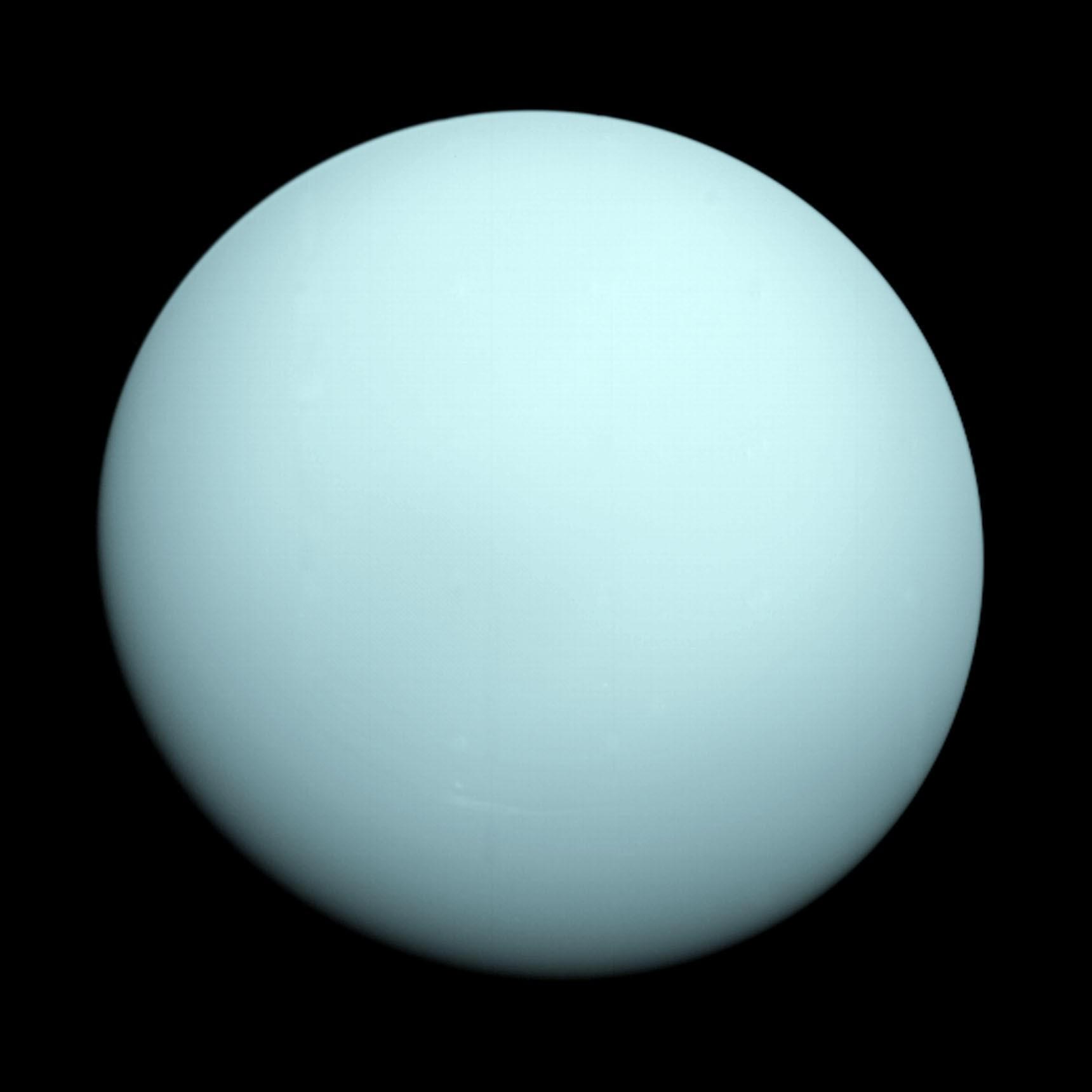
When NASA’s Voyager 2 spacecraft flew past Uranus in 1986, it captured the first close-up image of the planet – a smooth, blue-green orb that appeared relatively featureless. In contrast, Hubble has been able to observe Uranus over two decades, from 2002 to 2022, revealing seasonal changes and a far more complex atmosphere. Led by Erich Karkoschka (University of Arizona) and Larry Sromovsky and Pat Fry (University of Wisconsin), the research team used Hubble’s Space Telescope Imaging Spectrograph (STIS) to build a detailed picture of the planet’s shifting atmospheric layers.
Uranus’ atmosphere is primarily composed of hydrogen and helium, with small amounts of methane and traces of water and ammonia. Methane plays a key role in the planet’s appearance, giving Uranus its pale blue hue by absorbing red light from the Sun.
Shifting Polar Patterns and Seasonal Changes
The Hubble team observed Uranus four times in the 20-year period: in 2002, 2012, 2015, and 2022. They found that, unlike conditions on the gas giants Saturn and Jupiter, methane is not uniformly distributed across Uranus. Instead, it is strongly depleted near the poles. This depletion remained relatively constant over the two decades. However, the aerosol and haze structure changed dramatically, brightening significantly in the northern polar region as the planet approaches its northern summer solstice in 2030.
Uranus takes a little over 84 Earth years to complete a single orbit of the Sun. So, over two decades, the Hubble team has only seen mostly northern spring as the Sun moves from shining directly over Uranus’ equator toward shining almost directly over its north pole in 2030. Hubble observations suggest complex atmospheric circulation patterns on Uranus during this period. The data that are most sensitive to the methane distribution indicate a downwelling in the polar regions and upwelling in other regions.
Tracking Two Decades of Change
The team analyzed their results in several ways. The image columns show the change of Uranus for the four years that STIS observed Uranus across a 20-year period. Over that span of time, the researchers watched the seasons of Uranus as the south polar region (left) darkened going into winter shadow while the north polar region (right) brightened as it began to come into a more direct view as northern summer approaches.
The top row, in visible light, shows how the color of Uranus appears to the human eye as seen through even an amateur telescope.
In the second row, the false-color image of the planet is assembled from visible and near-infrared light observations. The color and brightness correspond to the amounts of methane and aerosols. Both of these quantities could not be distinguished before Hubble’s STIS was first aimed at Uranus in 2002. Generally, green areas indicate less methane than blue areas, and red areas show no methane. The red areas are at the limb, where the stratosphere of Uranus is almost completely devoid of methane.
The two bottom rows show the latitude structure of aerosols and methane inferred from 1,000 different wavelengths (colors) from visible to near infrared. In the third row, bright areas indicate cloudier conditions, while the dark areas represent clearer conditions. In the fourth row, bright areas indicate depleted methane, while dark areas show the full amount of methane.
Polar Extremes: Aerosols vs. Methane
At middle and low latitudes, aerosols and methane depletion have their own latitudinal structure that mostly did not change much over the two decades of observation. However, in the polar regions, aerosols and methane depletion behave very differently.
In the third row, the aerosols near the north pole display a dramatic increase, showing up as very dark during early northern spring, turning very bright in recent years. Aerosols also seem to disappear at the left limb as the solar radiation disappeared. This is evidence that solar radiation changes the aerosol haze in the atmosphere of Uranus. On the other hand, methane depletion seems to stay quite high in both polar regions throughout the observing period.
What’s Next for Uranus Watching?
Astronomers will continue to observe Uranus as the planet approaches northern summer.
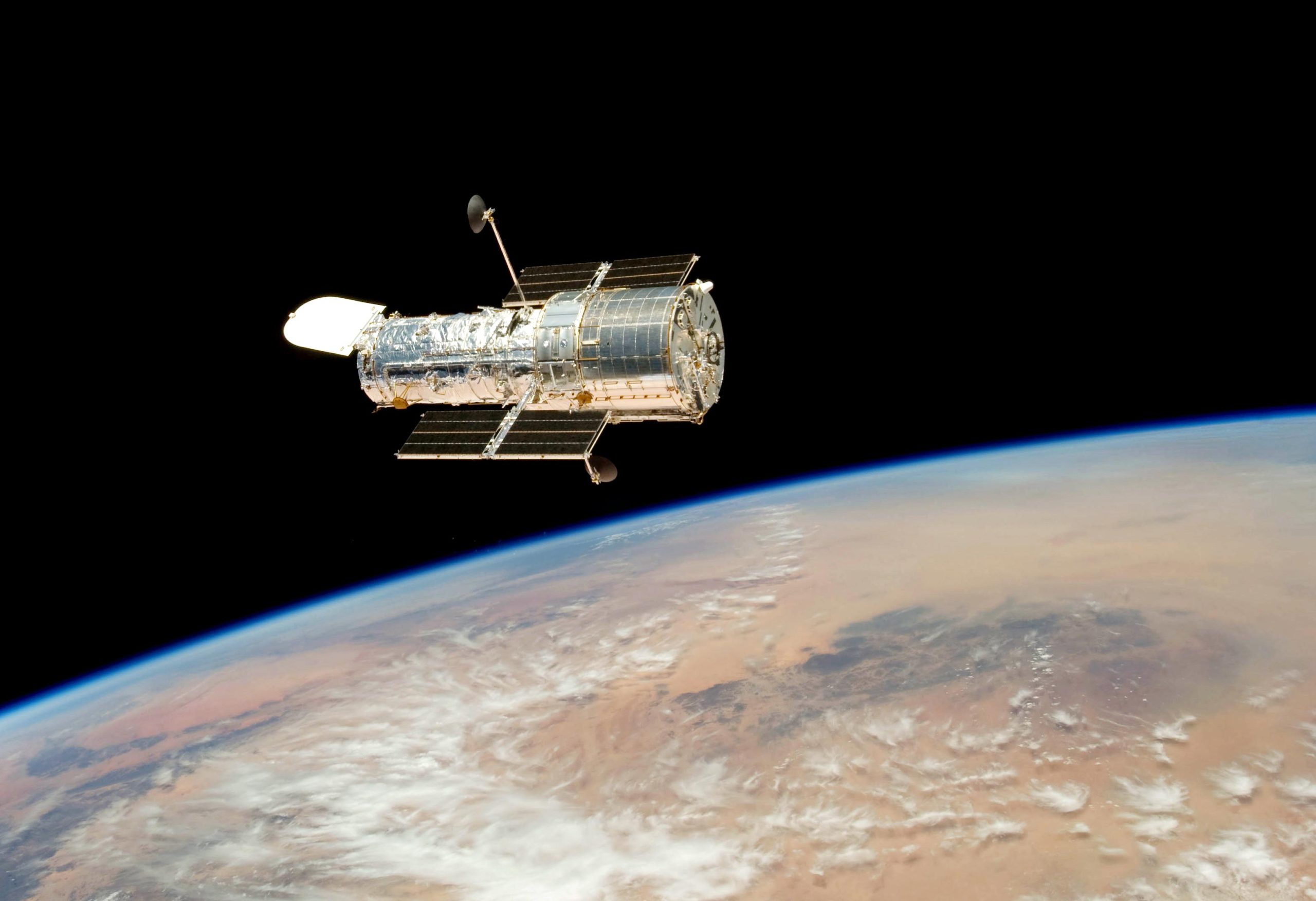
The Hubble Space Telescope has been observing the universe for over 30 years, delivering some of the most important astronomical discoveries of our time. Launched in 1990, Hubble is a joint project between NASA and the European Space Agency (ESA), and it remains one of the most powerful tools for exploring deep space. Managed by NASA’s Goddard Space Flight Center in Maryland, with support from Lockheed Martin Space in Denver, Hubble’s mission operations are a collaborative effort. Its science operations are conducted by the Space Telescope Science Institute in Baltimore, operated by the Association of Universities for Research in Astronomy. Thanks to its sharp resolution and advanced instruments, Hubble continues to reveal new insights into galaxies, stars, planets, and the fundamental nature of the universe.
Never miss a breakthrough: Join the SciTechDaily newsletter.
Follow us on Google and Google News.
1 Comment
Wow…still no Uranus jokes.