
Close Menu
    Facebook X (Twitter) Instagram
    SciTechDaily
    • Biology
    • Chemistry
    • Earth
    • Health
    • Physics
    • Science
    • Space
    • Technology
    Facebook X (Twitter) Pinterest YouTube RSS
    SciTechDaily
    Home»Space»Hubble Views Nebula AFGL 4104
    Space

    Hubble Views Nebula AFGL 4104

    By Hubble Space TelescopeMarch 10, 2014No Comments2 Mins Read
    Facebook Twitter Pinterest Telegram LinkedIn WhatsApp Email Reddit
    Share
    Facebook Twitter LinkedIn Pinterest Telegram Email Reddit
    Hubble Views Nebula AFGL 4104
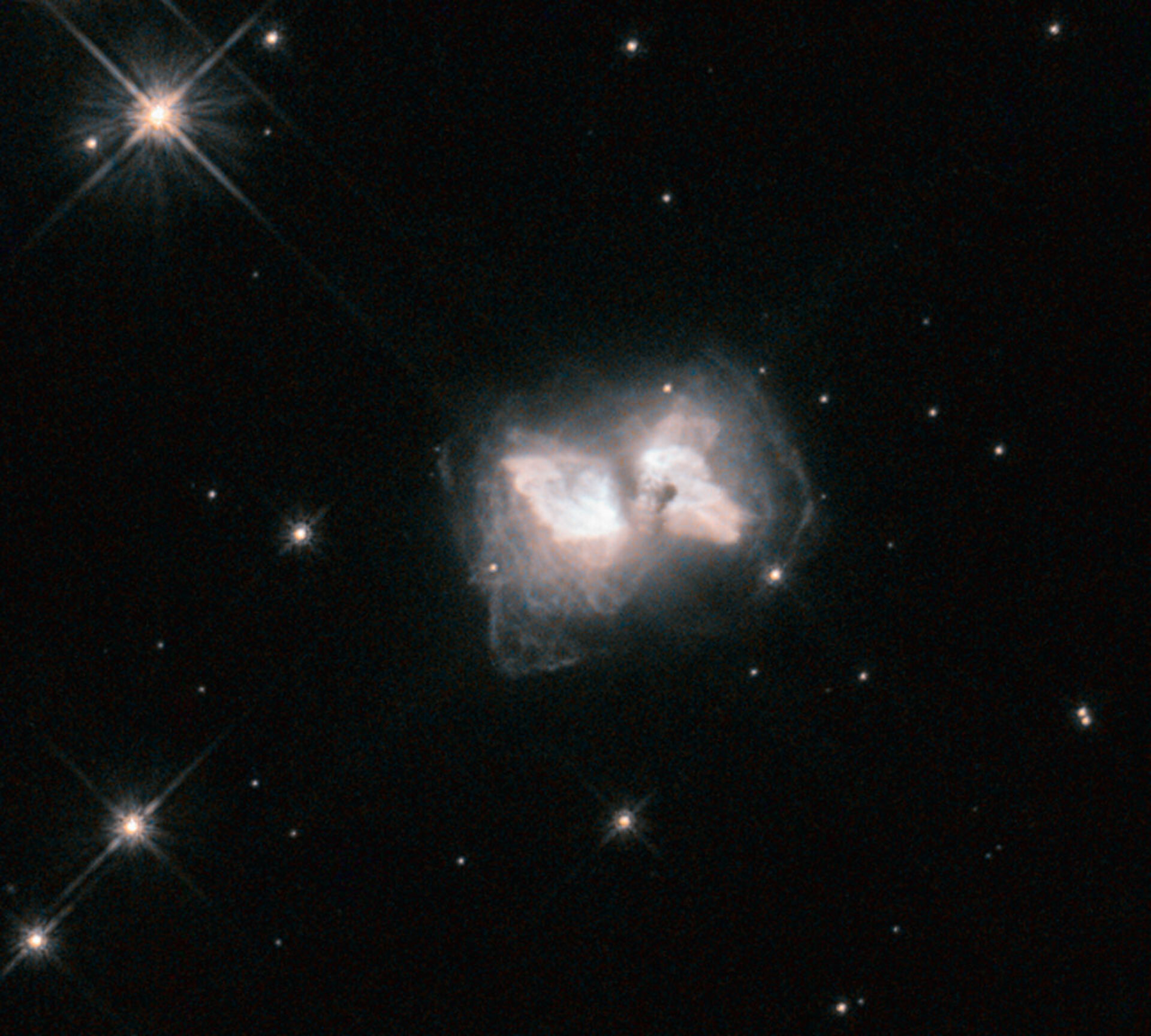
    AFGL 4104, also known as Roberts 22, is a preplanetary nebula, a transitional phase after a dying star expels its outer layers into space. Approximately 400 years ago, the central star of Roberts 22 shed its outer shells, giving rise to this butterfly-like structure. The central star will soon reach the temperature required to ionize the surrounding gas, marking its progression into a full-fledged planetary nebula. Credit: NASA, ESA, and R. Sahai (Jet Propulsion Laboratory)

    This newly released Hubble image shows nebula AFGL 4104.

    They say the flap of a butterfly’s wings can set off a tornado on the other side of the world. But what happens when a butterfly flaps its wings in the depths of space?

    This cosmic butterfly is a nebula known as AFGL 4104, or Roberts 22. Caused by a star that is nearing the end of its life and has shrugged off its outer layers, the nebula emerges as a cosmic chrysalis to produce this striking sight. Studies of the lobes of Roberts 22 have shown an amazingly complex structure, with countless intersecting loops and filaments.

    A butterfly’s life span is counted in weeks; although on a much longer timescale, this stage of life for Roberts 22 is also transient. It is currently a preplanetary nebula, a short-lived phase that begins once a dying star has pushed much of the material in its outer layers into space, and ends once this stellar remnant becomes hot enough to ionize the surrounding gas clouds and make them glow. About 400 years ago, the star at the center of Roberts 22 shed its outer shells, which raced outwards to form this butterfly. The central star will soon be hot enough to ionize the surrounding gas, and it will evolve into a fully-fledged planetary nebula.

    Information about the nature, age, and structure of Roberts 22 was presented in a paper using Hubble data back in 1999, published in The Astronomical Journal.

    Reference: “Unraveling the Structure of Aspherical Proto-Planetary Nebulae. I. Hubble Space Telescope Imaging and Hydroxyl Maser Line Observations of Roberts 22” by Raghvendra Sahai, A. Zijlstra, V. Bujarrabal and P. te Lintel Hekkert, 1 March 1999, The Astronomical Journal.
    DOI: 10.1086/300773

    Never miss a breakthrough: Join the SciTechDaily newsletter.
    Follow us on Google and Google News.

    Astronomy Astrophysics Hubble Space Telescope
    Share. Facebook Twitter Pinterest LinkedIn Email Reddit

    Related Articles

    Hubble Solves Mystery of Monster Star’s Dimming – Red Hypergiant Is As Bright as 300,000 Suns

    Astronomers Make a Weird Discovery: A Concentration of Smaller Black Holes Lurking Where They Expected a Single Massive Black Hole

    Tantrums of a Baby Star: Herbig-Haro Objects

    Unexpected Discovery: Hubble Space Telescope Uncovers Concentration of Small Black Holes

    Dissecting the Anatomy of Planetary Nebulae Using the Hubble Space Telescope

    HAWC+ Reveals Magnetic Chaos Hidden Within the Whirlpool Galaxy

    Supermassive Black Hole’s Dust Ring May Be Casting Shadows From Heart of a Galaxy

    Quasars Rip Across Galaxies Like Tsunamis – The Most Energetic Outflows Ever Witnessed in the Universe

    “Unprecedented” – Unusual Planetary Nebula Fades Mere Decades After It Arrived

    Leave A Reply Cancel Reply

    • Facebook
    • Twitter
    • Pinterest
    • YouTube

    Don't Miss a Discovery

    Subscribe for the Latest in Science & Tech!

    Trending News

    This Experimental Drug Repaired the Gut and Reversed Severe Fatty Liver Disease

    Physicists Just Turned a Black Hole Energy Theory Into Reality

    Stanford Scientists Solve a 252-Million-Year-Old Mass Extinction Mystery

    The Ancient Survival Mechanism Making Weight Loss So Difficult

    Just 3,000 Steps a Day May Help Protect the Brain From Alzheimer’s

    “Weird Clams” Reveal a New Invasion Along the U.S. Northeast Coast

    Archaeologists Decapitated Tutankhamun and Glued His Body Back Together

    New Black Hole Theory Solves a 50-Year-Old Problem

    Follow SciTechDaily
    • Facebook
    • Twitter
    • YouTube
    • Pinterest
    • Newsletter
    • RSS
    SciTech News
    • Biology News
    • Chemistry News
    • Earth News
    • Health News
    • Physics News
    • Science News
    • Space News
    • Technology News
    Recent Posts
    • New Tool Supercharges Immunotherapy Against Prostate Cancer
    • A Single Human Neuron Is Far More Powerful Than Scientists Thought
    • The Hidden Cancer Risk of Ketogenic Diets
    • Quantum Computer Stores Data in Vibrations Like Notes on a Guitar
    • Astronomers Discover Two Super Puff Planets Lighter Than Cotton Candy
    Copyright © 1998 - 2026 SciTechDaily. All Rights Reserved.
    • Science News
    • About
    • Contact
    • Editorial Board
    • Privacy Policy
    • Terms of Use

    Type above and press Enter to search. Press Esc to cancel.