
Close Menu
    Facebook X (Twitter) Instagram
    SciTechDaily
    • Biology
    • Chemistry
    • Earth
    • Health
    • Physics
    • Science
    • Space
    • Technology
    Facebook X (Twitter) Pinterest YouTube RSS
    SciTechDaily
    Home»Space»Voyage to the Sun: NASA’s Parker Solar Probe Completes 16th Close Approach
    Space

    Voyage to the Sun: NASA’s Parker Solar Probe Completes 16th Close Approach

    By NASA Goddard Space Flight CenterJuly 6, 2023No Comments3 Mins Read
    Facebook Twitter Pinterest Telegram LinkedIn WhatsApp Email Reddit
    Share
    Facebook Twitter LinkedIn Pinterest Telegram Email Reddit
    NASA's Parker Solar Probe Touches Sun
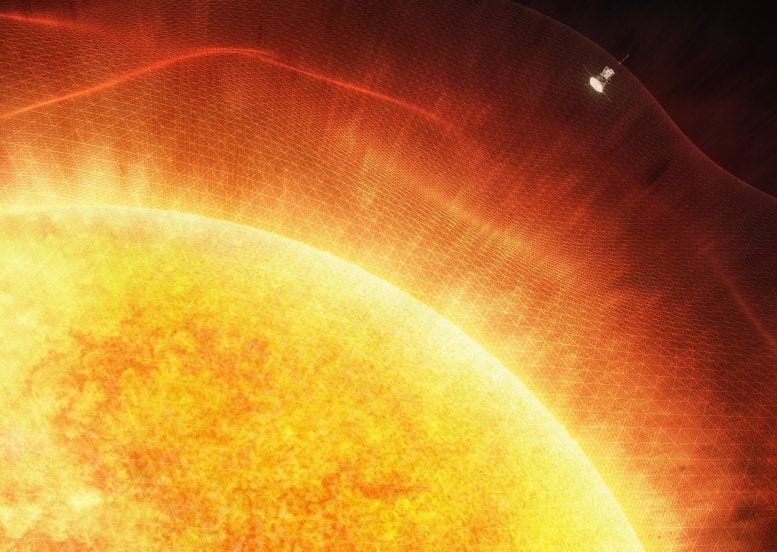
    NASA’s Parker Solar Probe completed its 16th Sun orbit on June 27, 2023, coming within 5.3 million miles during its perihelion. Credit: Ben Smith/ Applied Physics Laboratory/ NASA

    NASA’s Parker Solar Probe accomplished a milestone on June 27, 2023 – its 16th orbit of the Sun. This included a close approach to the Sun (known as perihelion) on June 22, 2023, where the spacecraft came within 5.3 million miles of the solar surface while moving at 364,610 miles per hour. The spacecraft emerged from the solar flyby healthy and operating normally.

    NASA’s Parker Solar Probe has completed its 16th science orbit, which included a close approach to the Sun (known as perihelion) that brought it within just 5.3 million miles of the solar surface on June 22 while moving at 364,610 miles per hour.

    The team will continue monitoring Parker’s progress to determine if any other such maneuvers will be necessary over the next several months as the spacecraft prepares for this flyby, Guo added. The August flyby will be the sixth of seven anticipated flybys of Venus, with Parker using the planet’s gravity to tighten its orbit around the Sun and set up a perihelion within 4.5 million miles from the Sun’s surface.


    Parker Solar Probe’s 16th orbit included a perihelion that brought the spacecraft within 5.3 million miles of the Sun. Credit: NASA/Johns Hopkins APL/Mike Yakovlev/Josh Diaz

    “The burn performance was spot on, which sets us up well for targeting our next Venus flyby,” said APL’s Nick Pinkine, Parker Solar Probe mission operations manager, adding that the spacecraft emerged from the maneuver and flyby healthy and operating normally.

    “Parker has already taught us so much, allowing us to investigate the source of the solar wind and discover more about the magnetic activity within the corona,” said Nour ​Raouafi, Parker Solar Probe project scientist at APL. “We’re excited to see what else this mission has to show us as Parker gets even closer to an increasingly more active Sun.”

    On August 21, 2023, Parker Solar Probe will swing past Venus for its sixth flyby of the planet. To prepare for a smooth course, the mission team at the Johns Hopkins Applied Physics Laboratory (APL) applied a small trajectory correction maneuver on June 7, 2023, the first course correction since March 2022. This flyby will be the sixth of seven planned flybys of Venus during Parker’s primary mission.

    Parker uses Venus’ gravity to tighten its orbit around the Sun and set up a future perihelion at just 4.5 million miles from the Sun’s surface. As the Sun becomes increasingly active, this perihelion will be especially important to learning more about heliophysics.

    Parker Solar Probe was developed as part of NASA’s Living With a Star program to explore aspects of the Sun-Earth system that directly affect life and society. The Living With a Star program is managed by the agency’s Goddard Space Flight Center in Greenbelt, Maryland, for NASA’s Science Mission Directorate in Washington. APL designed, built, and operates the spacecraft and manages the mission for NASA.

    Never miss a breakthrough: Join the SciTechDaily newsletter.
    Follow us on Google and Google News.

    Astronomy Johns Hopkins APL NASA NASA Goddard Space Flight Center Parker Solar Probe Sun
    Share. Facebook Twitter Pinterest LinkedIn Email Reddit

    Related Articles

    Gravity Assist: Venus Flyby Sends Parker Solar Probe Toward Record-Setting Flights Around the Sun

    5 Years, 430,000 MPH, and Counting: How NASA’s Parker Solar Probe Is Making History

    Parker Solar Probe Captures Stunning New Images of Venus – Faint Glow Detected From the Planet’s Surface

    Spacecraft Enters the Sun’s Blistering Hot Corona for the First Time in History

    Parker Solar Probe: For the First Time in History, a Spacecraft Has Touched the Sun

    NASA’s Parker Solar Probe Touches the Sun for the First Time – Bringing New Discoveries

    Switchbacks Science: Explaining NASA’s Parker Solar Probe’s Mysterious Magnetic Puzzle

    Celestial Geometry Posed a Special Opportunity During Parker Solar Probe’s 7th Solar Encounter

    A New View of Small Sun Structures Allows NASA to Explore the Solar Wind Like Never Before

    Leave A Reply Cancel Reply

    • Facebook
    • Twitter
    • Pinterest
    • YouTube

    Don't Miss a Discovery

    Subscribe for the Latest in Science & Tech!

    Trending News

    The Universe Is Expanding Too Fast and Scientists Can’t Explain Why

    “Like Liquid Metal”: Scientists Create Strange Shape-Shifting Material

    Early Warning Signals of Esophageal Cancer May Be Hiding in Plain Sight

    Common Blood Pressure Drug Shows Surprising Power Against Deadly Antibiotic-Resistant Superbug

    Scientists Uncover Dangerous Connection Between Serotonin and Heart Valve Disease

    Scientists Discover a “Protector” Protein That Could Help Reverse Hair Loss

    Bone-Strengthening Discovery Could Reverse Osteoporosis

    Scientists Uncover Hidden Trigger Behind Stem Cell Aging

    Follow SciTechDaily
    • Facebook
    • Twitter
    • YouTube
    • Pinterest
    • Newsletter
    • RSS
    SciTech News
    • Biology News
    • Chemistry News
    • Earth News
    • Health News
    • Physics News
    • Science News
    • Space News
    • Technology News
    Recent Posts
    • Scientists Overcome Major Quantum Bottleneck, Potentially Transforming Teleportation and Computing
    • Quantum Physics’ Strangest Problem May Hold the Key to Time Itself
    • Scientists Create “Liquid Gears” That Spin Without Touching
    • The Simple Habit That Could Help Prevent Cancer
    • Forgotten Medicinal Plant Shows Promise in Fighting Dangerous Superbugs
    Copyright © 1998 - 2026 SciTechDaily. All Rights Reserved.
    • Science News
    • About
    • Contact
    • Editorial Board
    • Privacy Policy
    • Terms of Use

    Type above and press Enter to search. Press Esc to cancel.