
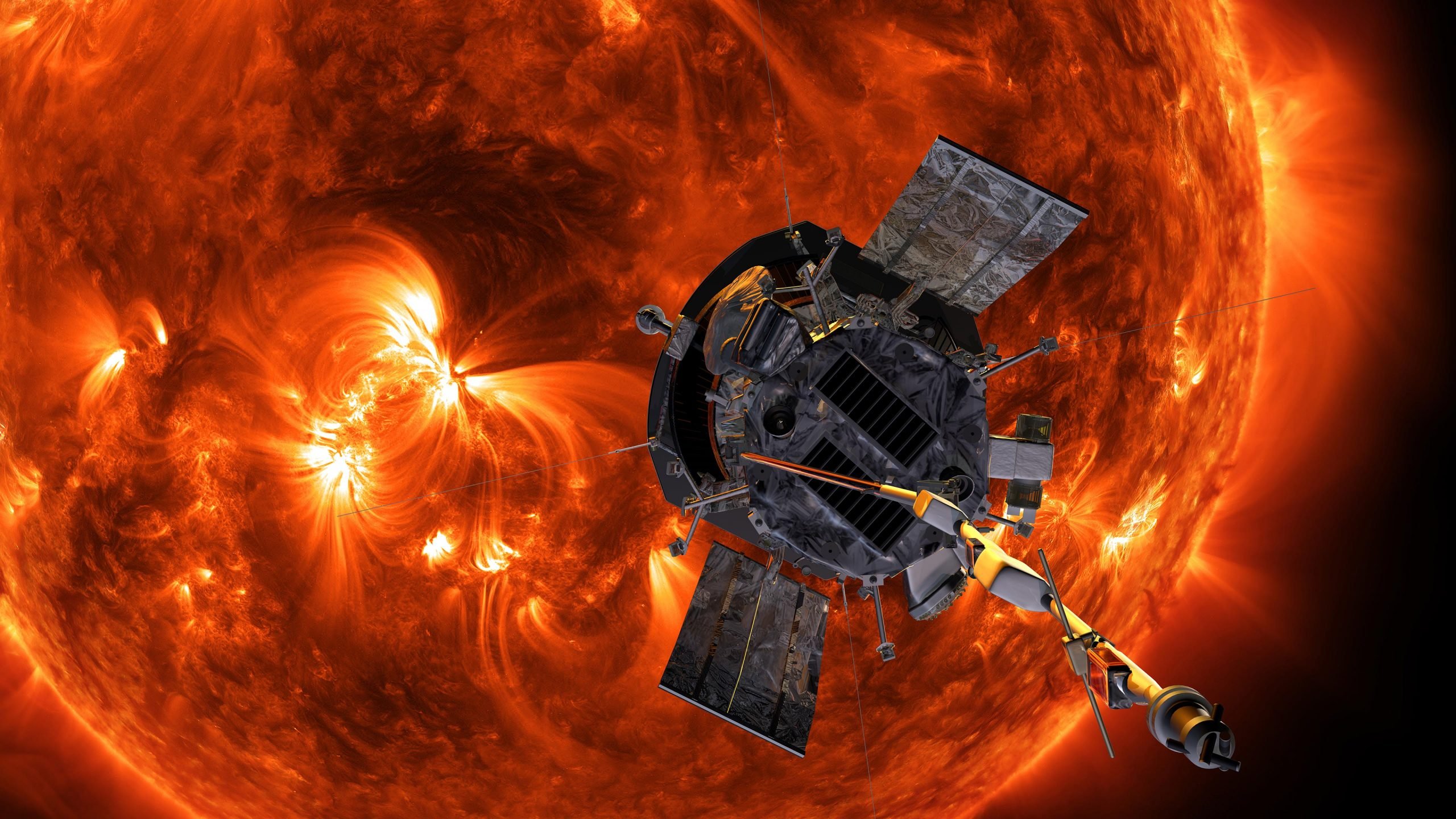
Parker Solar Probe’s solar flyby aligned with Earth-based observatories for coordinated data collection.
During Parker Solar Probe’s seventh swing by the Sun, culminating in its closest solar approach, or perihelion, on January 17, 2021, celestial geometry posed a special opportunity. The configuration of this particular orbit placed Parker Solar Probe on the same side of the Sun as Earth — meaning that Earth-bound observatories could observe the Sun and its outpouring of solar wind from the same perspective as Parker’s. This comes on the heels of a similar observation campaign in the winter of 2020.
“Along with the global science community, the Parker Solar Probe team can’t wait to see this new data,” said Nour Raouafi, the Parker Solar Probe project scientist from the Johns Hopkins Applied Physics Laboratory in Laurel, Maryland. “Combining it with contributions from observatories around the globe will help us to put Parker observations in a broader context and build a complete picture of the phenomena observed in the solar atmosphere.”
Read on for snapshots from a few missions that observed the Sun and the solar system during Parker Solar Probe’s seventh solar encounter.
These images were captured by the X-ray Telescope, or XRT, aboard the Japan Aerospace Exploration Agency’s and NASA’s Hinode spacecraft. XRT watches the Sun in X-rays, a high-energy type of light that reveals the extremely hot material in the Sun’s atmosphere, the corona. These images from XRT were captured on Jan. 17, when Parker Solar Probe was closest to the Sun. Scientists can use XRT’s images with Parker Solar Probe’s direct measurements of the environment around the Sun to better understand how the Sun’s corona could drive changes in the space environment farther away from the Sun.
Solar Dynamics Observatory
NASA’s Solar Dynamics Observatory, or SDO, keeps a constant eye on the Sun from its vantage point in orbit around Earth. SDO captures images of the Sun in extreme ultraviolet light — a type of light that is invisible to our eyes — and visible light, as well as magnetic maps of the Sun. SDO’s data can help scientists understand the connection between conditions on the Sun and what is measured in the solar wind by spacecraft like Parker Solar Probe.
These images were captured in 211 angstroms, a wavelength of extreme ultraviolet light emitted by material at around 3 million degrees Fahrenheit. This wavelength highlights both active regions — seen as bright spots in the image — and coronal holes, areas of open magnetic field on the Sun from which high-seed solar wind can rush out into space. Coronal holes appear as dark areas in this wavelength of light.
IRIS
NASA’s Interface Region Imaging Spectrograph, or IRIS, captures images of the lower regions of the Sun’s atmosphere in ultraviolet light, along with spectra that break down how much light is visible across different wavelengths. These images, captured on Jan. 17, show an active region on the Sun, an area of intense and complex magnetic fields that is prone to explosions of light and solar material. This particular active region was targeted for IRIS observations based on model predictions that suggested that magnetic field lines from this region could be ones Parker Solar Probe would cross and measure during its solar encounter.
The images cycle through different wavelengths of light — corresponding to views of different heights above the solar surface — to reveal features in various regions of the Sun’s structure. This imagery shows features from the solar surface to a few thousand miles above at the top of the chromosphere, a region of the Sun’s atmosphere that interfaces with the extended solar atmosphere beyond.
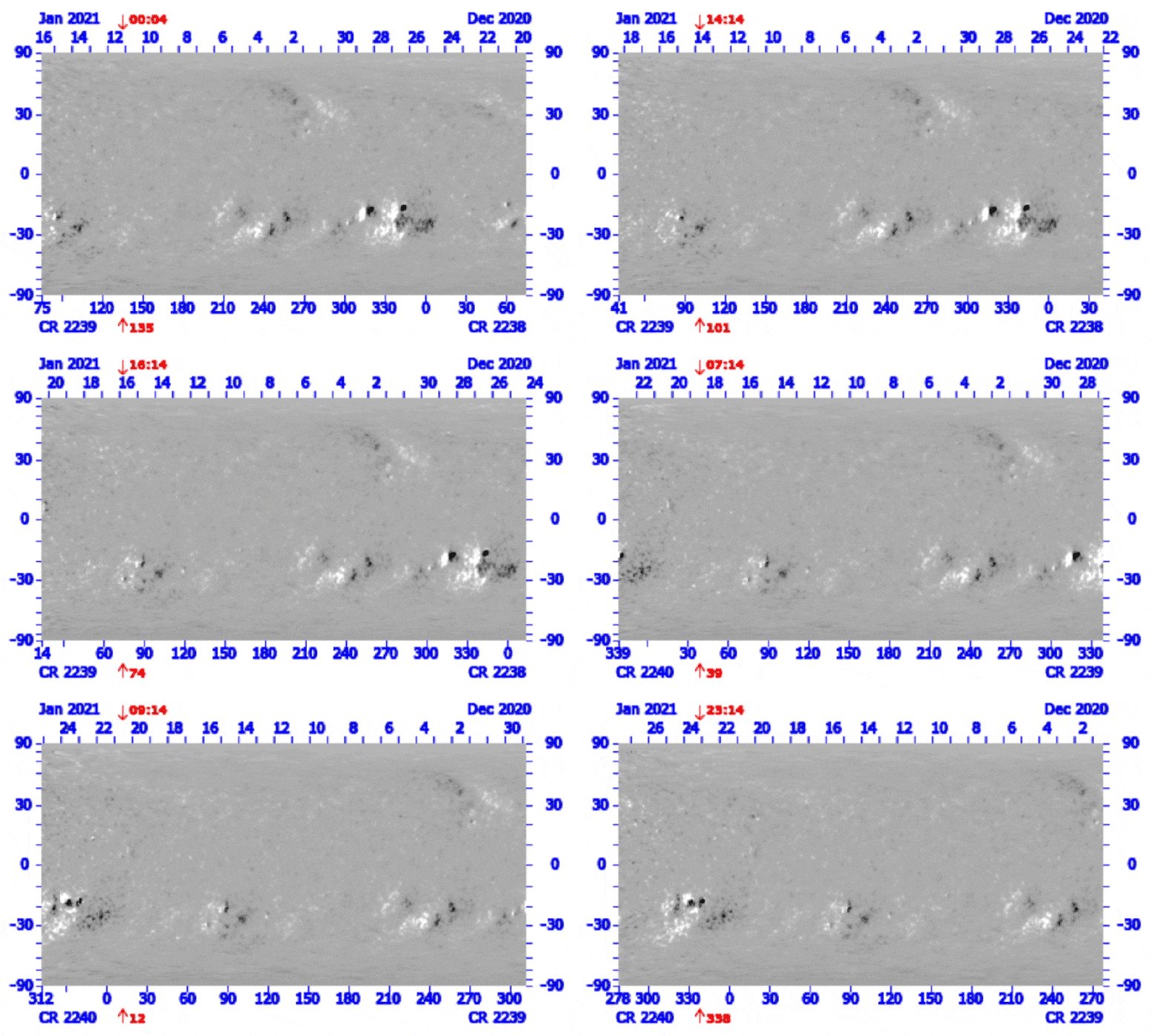
The National Science Foundation’s Global Oscillation Network Group, or GONG, is a network of solar imagers distributed around the globe. They make use of the Zeeman effect — how light splits into multiple wavelengths under the influence of a magnetic field — to create magnetic maps of the solar surface. This video shows GONG’s magnetic maps, updated hourly, from January 12-23, 2021. The black areas represent areas where the magnetic field is pointing in towards the Sun’s surface, and white areas are where the magnetic field is pointing out into space.
As the solar wind streams out from the Sun, it carries the solar magnetic field with it. But identifying precisely which regions on the Sun are the source for solar wind measured by spacecraft like Parker Solar Probe is a challenging task for several reasons: The Sun rotates, solar wind leaves the Sun at varying speeds, and strong magnetic fields near the Sun can change the solar wind’s path as it flows out.
The Parker Solar Probe team uses GONG’s magnetic maps, along with data from NASA’s Solar Dynamics Observatory, to make predictions of which regions on the Sun are sending out material and magnetic field lines toward the spacecraft. Drawing these connections between the Sun itself and the solar wind that Parker Solar Probe is measuring directly can help scientists trace how conditions on the Sun propagate out into space.
THEMIS
A trio of NASA’s THEMIS spacecraft — short for Time History of Events and Macroscale Interactions during Substorms — orbit Earth to measure particles and electric and magnetic fields in near-Earth space. THEMIS’ data helps researchers untangle the complicated factors that govern the response of near-Earth space to dynamics in Earth’s magnetic field, changes in the Sun’s constantly outflowing solar wind, and activity on the Sun.
These measurements were taken by THEMIS-E, one of the spacecraft in orbit around Earth, on Jan. 20. It takes about two to three days for solar wind to cross the tens of millions of miles from the Sun to Earth, so the solar wind conditions observed by Parker Solar Probe during its close solar approach on Jan. 17 did not begin to influence near-Earth space until about Jan. 19-20.
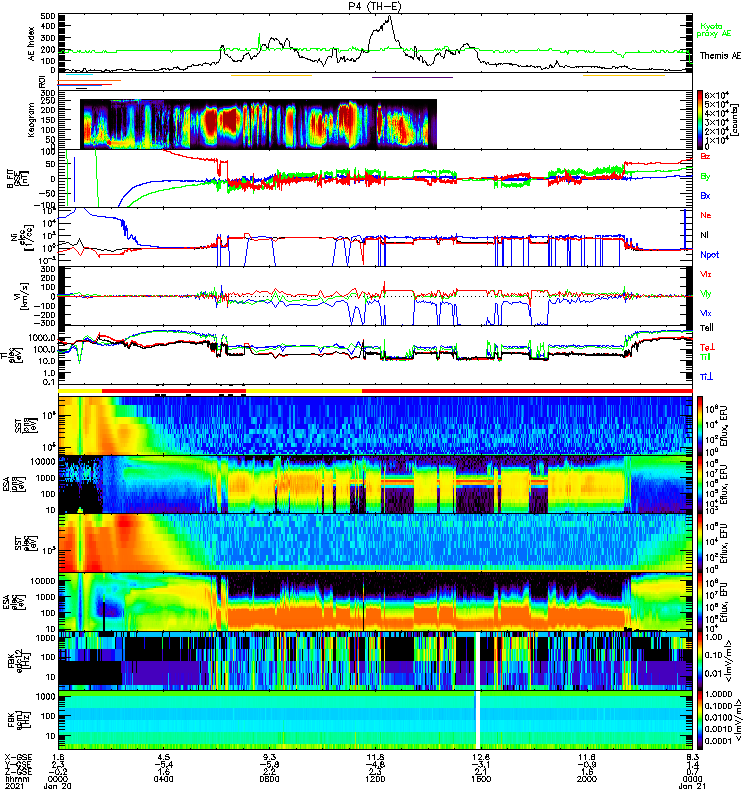
THEMIS-E began the day traveling through the Van Allen radiation belts — concentric bands of charged particles nested in Earth’s magnetic field — as it approached Earth. THEMIS-E then traveled back outward through the radiation belts. Both transits through the radiation belts are reflected in the areas of intense coloring in the lower left part of the plot at the beginning of the day.
Mid-morning, THEMIS-E left Earth’s magnetic field and entered the magnetosheath — the region just outside the outermost Sun-facing boundary of Earth’s magnetic field where solar wind piles up as it collides with Earth’s magnetic field. Throughout the day, gusts in the solar wind temporarily pushed the boundaries of the magnetosphere Earthward, meaning that THEMIS-E repeatedly left and re-entered the magnetosheath. For about 15 hours — until its orbit carried it back into the magnetosphere late in the day — THEMIS-E alternately observed the unperturbed solar wind outside the magnetosheath and piled-up solar wind in the magnetosheath. The undisturbed solar wind observed by THEMIS-E was a bit slower than usual, but also about twice as dense as typical solar wind — observations also confirmed by NASA’s Advanced Composition Explorer and Wind spacecraft, which orbit further upstream between the Sun and Earth.
Never miss a breakthrough: Join the SciTechDaily newsletter.
Follow us on Google and Google News.
2 Comments
On sunspots it is possible to make the weather forecast for 6 days:
https://www.youtube.com/watch?v=aXRK2hAVWXQ
This Particular Math is What is Amplifying Our Polar Wabble!
LaGrange Points are a Cosmic Balance Point of Gyroscopic Nature and you’ve put a satellite in one of those spots.
Did it occur to you that you should Counter Balance the Imbalance You’ve caused?
I don’t care WHO takes credot for it!!! Do it!!!!