
Close Menu
    Facebook X (Twitter) Instagram
    SciTechDaily
    • Biology
    • Chemistry
    • Earth
    • Health
    • Physics
    • Science
    • Space
    • Technology
    Facebook X (Twitter) Pinterest YouTube RSS
    SciTechDaily
    Home»Space»The Hardest Known Substance in the Universe – Nuclear Pasta
    Space

    The Hardest Known Substance in the Universe – Nuclear Pasta

    By Justin Dupuis, McGill UniversitySeptember 19, 20182 Comments3 Mins Read
    Facebook Twitter Pinterest Telegram LinkedIn WhatsApp Email Reddit
    Share
    Facebook Twitter LinkedIn Pinterest Telegram Email Reddit
    Nuclear Pasta
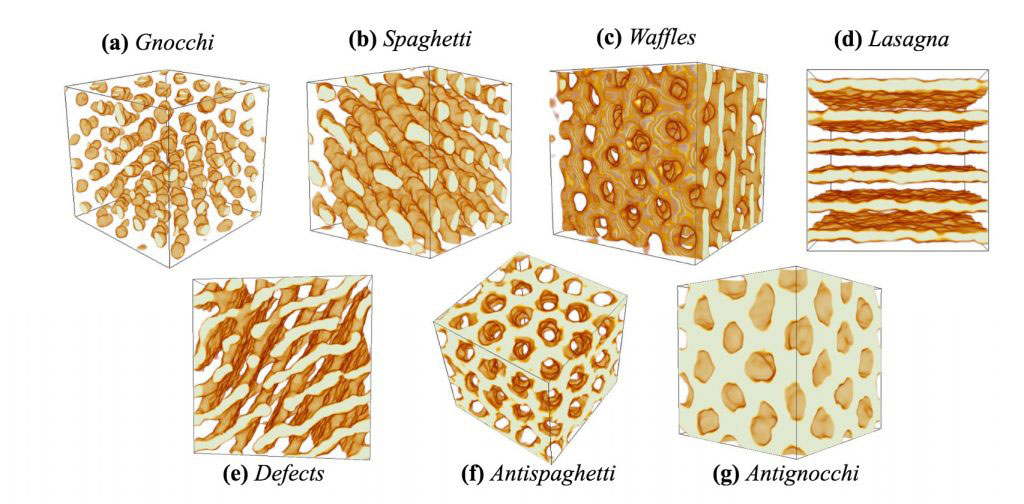
    Nuclear pasta, the hardest known substance in the universe.

    A team of scientists has calculated the strength of the material deep inside the crust of neutron stars and found it to be the strongest known material in the universe.

    Matthew Caplan, a postdoctoral research fellow at McGill University, and his colleagues from Indiana University and the California Institute of Technology, successfully ran the largest computer simulations ever conducted of neutron star crusts, becoming the first to describe how these break.

    “The strength of the neutron star crust, especially the bottom of the crust, is relevant to a large number of astrophysics problems, but isn’t well understood,” says Caplan.

    Neutron stars are born after supernovas, an implosion that compresses an object the size of the sun to about the size of Montreal, making them “a hundred trillion times denser than anything on earth.” Their immense gravity makes their outer layers freeze solid, making them similar to earth with a thin crust enveloping a liquid core.

    This high density causes the material that makes up a neutron star, known as nuclear pasta, to have a unique structure. Below the crust, competing forces between the protons and neutrons cause them to assemble into shapes such as long cylinders or flat planes, which are known in the literature as ‘lasagna’ and ‘spaghetti,’ hence the name ‘nuclear pasta.’ Together, the enormous densities and strange shapes make nuclear pasta incredibly stiff.

    Thanks to their computer simulations, which required 2 million hours worth of processor time or the equivalent of 250 years on a laptop with a single good GPU, Caplan and his colleagues were able to stretch and deform the material deep in the crust of neutron stars.

    “Our results are valuable for astronomers who study neutron stars. Their outer layer is the part we actually observe, so we need to understand that in order to interpret astronomical observations of these stars,” Caplan adds.

    The findings, accepted for publication in Physical Review Letters, could help astrophysicists better understand gravitational waves like those detected last year when two neutron stars collided. Their new results even suggest that lone neutron stars might generate small gravitational waves.

    “A lot of interesting physics is going on here under extreme conditions and so understanding the physical properties of a neutron star is a way for scientists to test their theories and models, Caplan adds. With this result, many problems need to be revisited. How large a mountain can you build on a neutron star before the crust breaks and it collapses? What will it look like? And most importantly, how can astronomers observe it?”

    Reference: “The Elasticity of Nuclear Pasta” by M. E. Caplan, A. S. Schneider and C. J. Horowitz, 24 September 2018, Physical Review Letters
    DOI: 10.1103/PhysRevLett.121.132701

    Never miss a breakthrough: Join the SciTechDaily newsletter.
    Follow us on Google and Google News.

    Astrophysics California Institute of Technology McGill University Neutron Star
    Share. Facebook Twitter Pinterest LinkedIn Email Reddit

    Related Articles

    Astronomers May Have Spotted a Never-Before-Seen “Superkilonova” Hidden Inside a Supernova

    What Happens When a Black Hole Devours a Neutron Star: Star Quakes and Monster Shock Waves

    Fast Radio Bursts Explained? Scientists Zero In on Their Mysterious Origins

    Astronomers Detect Short, Intense Radio Burst From Relatively Nearby in the Milky Way

    Chandra Discovers Neutron-Star-Powered Ultraluminous X-Ray Source

    Afterglow from Neutron-Star Merger Continues to Puzzle Astrophysicists

    At Least 100 Billion Planets Populate the Milky Way

    Computer Simulation Shows Correlation of Gravitational Waves and Neutrino Signals

    Researchers Detect All Phases of Thermonuclear Burning in a Neutron Star

    2 Comments

    1. Benjamin on September 19, 2018 1:59 pm

      More proof the Flying Spaghetti Monster is real and is the true creator of everything. Ra’men.

      Reply
    2. Kenneth R. Screeton on September 20, 2018 10:26 am

      Thank you for this bit of information.

      Reply
    Leave A Reply Cancel Reply

    • Facebook
    • Twitter
    • Pinterest
    • YouTube

    Don't Miss a Discovery

    Subscribe for the Latest in Science & Tech!

    Trending News

    Largest-Ever Study Finds Medicinal Cannabis Ineffective for Anxiety, Depression, PTSD

    250-Million-Year-Old Egg Solves One of Evolution’s Biggest Mysteries

    Living With Roommates Might Be Changing Your Gut Microbiome Without You Knowing

    Century-Old Cleaning Chemical Linked to 500% Increased Risk of Parkinson’s Disease

    What if Your Memories Never Happened? Physicists Take a New Look at the Boltzmann Brain Paradox

    One of the Universe’s Largest Stars May Be Getting Ready To Explode

    Scientists Discover Enzyme That Could Supercharge Ozempic-Like Weight Loss Drugs

    Popular Sweetener Linked to DNA Damage – “It’s Something You Should Not Be Eating”

    Follow SciTechDaily
    • Facebook
    • Twitter
    • YouTube
    • Pinterest
    • Newsletter
    • RSS
    SciTech News
    • Biology News
    • Chemistry News
    • Earth News
    • Health News
    • Physics News
    • Science News
    • Space News
    • Technology News
    Recent Posts
    • Want Less Stress? Landmark Study Points to a Simple Habit
    • Scientists Reveal Eating Fruits and Vegetables May Increase Your Risk of Lung Cancer
    • AI Reveals Explosive Growth of Floating Algae Across the World’s Oceans
    • 5.5 Million Bees Discovered Living Beneath a New York Cemetery
    • Scientists Reverse Brain Aging With Simple Nasal Spray
    Copyright © 1998 - 2026 SciTechDaily. All Rights Reserved.
    • Science News
    • About
    • Contact
    • Editorial Board
    • Privacy Policy
    • Terms of Use

    Type above and press Enter to search. Press Esc to cancel.