

ESA’s Clean Space initiative is seeking to transform our understanding of how large, dead objects behave in space and is exploring why derelict satellites can tumble in unpredictable ways.
Down on the ground, death equals stillness – but not in space. Derelict satellites can tumble in unpredictable ways and ESA’s team tasked with developing a space salvage mission want to find out why.
In recent years, satellites beginning uncontrolled reentries have been tracked, such as Russia’s Phobos-Grunt and Germany’s Rosat. In a few cases, satellites suffering unexpected failures in orbit have also been followed, including ESA’s Envisat and Japan’s ADEOS-II.
In every case, the satellite has been seen to be tumbling – but the reason why remains a mystery.
Similarly, when control of a satellite is temporarily lost, ESA’s Operations Center team in Darmstadt, Germany, are accustomed to fixing the satellite’s attitude as a prelude to recovery – helping to better understand the satellite’s status.
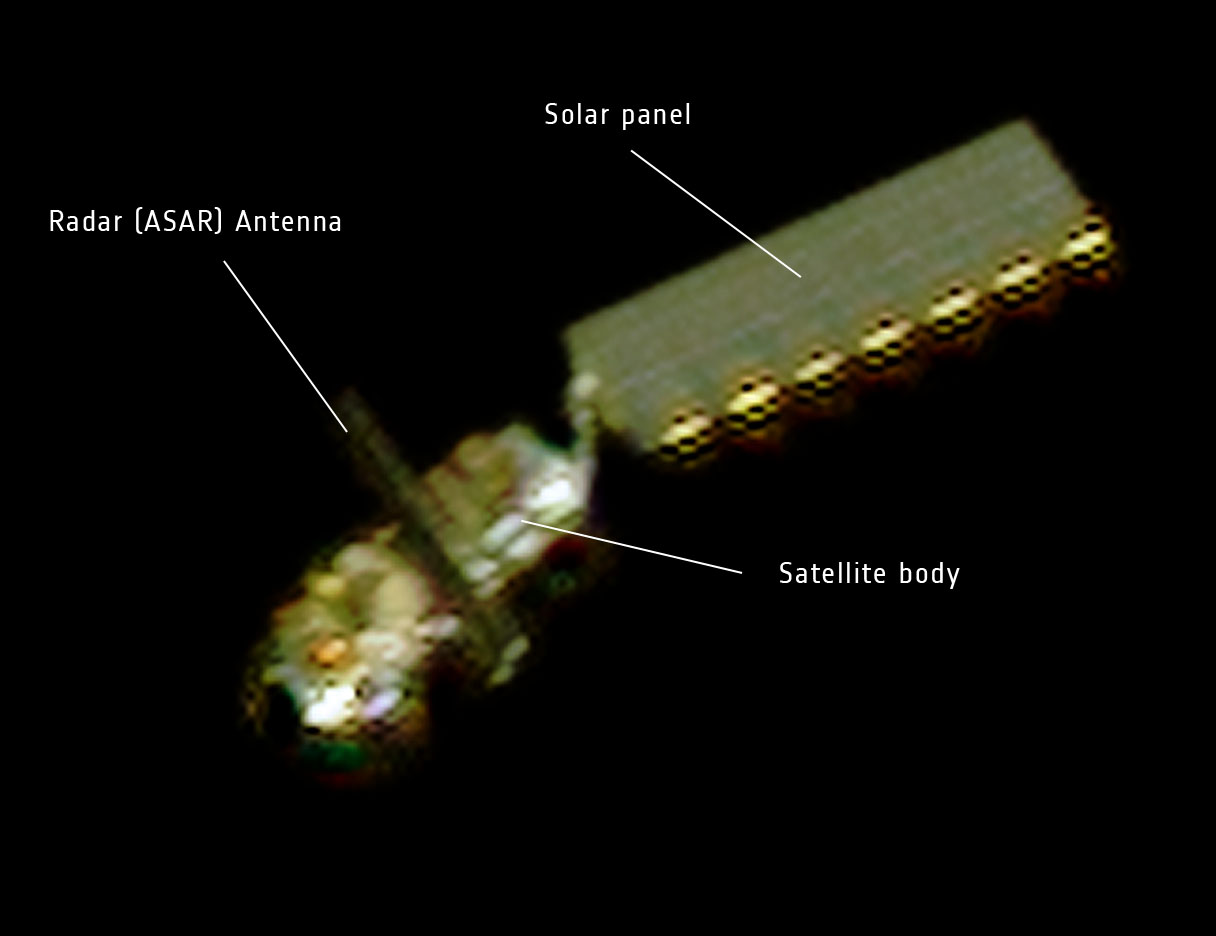
ESA’s Clean Space initiative – tasked with reducing the space industry’s environmental impact on Earth and space – is seeking to transform our understanding of how large, dead objects behave in space, encompassing launcher upper stages as well as satellites.
The aim of a new study is to combine detailed computer analysis with a range of ground-based observations, some which have only rarely been tried.
Optical telescopes and ground radar are today’s favored monitoring methods, but the study will also investigate the potential of optical and radar satellites in nearby orbits for space-to-space observations.
Highly accurate laser ranging will also be attempted. A global network of ground stations would bounce lasers off a satellite’s retroreflectors – like ‘cat’s eyes’ built into a motorway.
Laser ranging can pin down a satellite’s position to within centimeters, but has seldom been attempted on out-of-control objects.

The hope is that sustained observation of particular objects over time will give new insights into the kind of factors influencing attitude changes, and how this motion is likely to change over time.
Meanwhile, specialized simulations will seek to pin down these drivers and develop reliable forecasts of how derelict satellites behave.
The long list of potential perturbations include changes in the satellite’s center of gravity as parts break off, atmospheric drag, the faint but steady push of sunlight, micrometeoroid and debris impacts, internal magnetic fields, outgassing and fuel leaks, exploding batteries and even the sloshing of leftover fuel.
For Clean Space, this study is of more than academic interest. The team is planning a dedicated satellite salvage mission called e.DeOrbit and improving our knowledge of a target’s condition will help to fine-tune the design.
Bidders are welcome on the study contract. For more information, check the invitation package, accessible here.
Never miss a breakthrough: Join the SciTechDaily newsletter.
Follow us on Google and Google News.
1 Comment
Long, long ago when I was in college, my team put together an experiment which flew on the shuttle as a “getaway special”. We investigated how “fuel slosh” – fuel sloshing around in the tanks of rotating satellites – could destabilize satellite orientation. It had been noticed that much more station-keeping propellants were being used on satellites with a certain tank configuration. We found that a tiny, tiny perturbation in the motion of the fuel on the spinning satellite would link with the rotational characteristics of the satellite (the satellite, like most of the time, was spinning for stabilization) and destabilize the system fairly rapidly. Maybe some of that is going on. The folks should look at the amount of station-keeping propellant required to maintain stabilization when the satellite was in operation, and use that info to project how rapidly the system stability would be lost if those station-keeping adjustments were not present as when the satellite shots down or is shut down.