
Close Menu
    Facebook X (Twitter) Instagram
    SciTechDaily
    • Biology
    • Chemistry
    • Earth
    • Health
    • Physics
    • Science
    • Space
    • Technology
    Facebook X (Twitter) Pinterest YouTube RSS
    SciTechDaily
    Home»Space»NASA Releases Companion Image to ‘Blue Marble’
    Space

    NASA Releases Companion Image to ‘Blue Marble’

    By NASA Goddard Space Flight CenterFebruary 3, 2012No Comments4 Mins Read
    Facebook Twitter Pinterest Telegram LinkedIn WhatsApp Email Reddit
    Share
    Facebook Twitter LinkedIn Pinterest Telegram Email Reddit
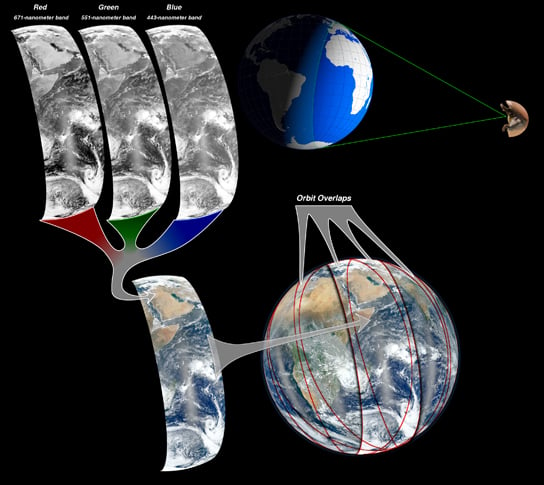
    new Blue Marble images
    NASA scientists created the two new ‘Blue Marble’ images from data acquired by a new instrument that’s aboard the Earth-observing satellite Suomi NPP, the Visible Infrared Imaging Radiometer Suite (VIIRS). Credit: NASA/NOAA

    Due to public demand, NASA released a new companion image to “Blue Marble” released just a short time ago. Compiled by a NASA Goddard scientist, the new image is a composite of six separate orbits that were taken by the Visible Infrared Imaging Radiometer Suite (VIIRS) aboard Suomi NPP.

    The Suomi NPP satellite is in a polar orbit around Earth at an altitude of 512 miles (about 824 kilometers), but the perspective of the new Eastern hemisphere ‘Blue Marble’ is from 7,918 miles (about 12,743 kilometers). NASA scientist Norman Kuring managed to ‘step back’ from Earth to get the big picture by combining data from six different orbits of the Suomi NPP satellite. Or putting it a different way, the satellite flew above this area of Earth six times over an eight hour time period. Norman took those six sets of data and combined them into one image.
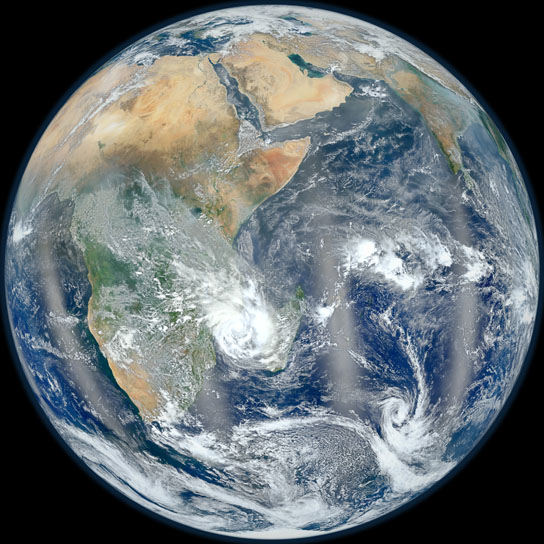
    companion image to the wildly popular Blue Marble
    Responding to public demand, NASA scientists created a companion image to the wildly popular ‘Blue Marble’ released last week (January 25, 2012). Credit: NASA/NOAA

    The new image is a composite of six separate orbits taken on January 23, 2012, by the Suomi National Polar-orbiting Partnership satellite. Both of these new ‘Blue Marble’ images are images taken by a new instrument flying aboard Suomi NPP, the Visible Infrared Imaging Radiometer Suite (VIIRS).

    Compiled by NASA Goddard scientist Norman Kuring, this image has the perspective of a viewer looking down from 7,918 miles (about 12,742 kilometers) above the Earth’s surface from a viewpoint of 10 degrees South by 45 degrees East. The four vertical lines of ‘haze’ visible in this image show the reflection of sunlight off the ocean, or ‘glint,’ that VIIRS captured as it orbited the globe. Suomi NPP is the result of a partnership between NASA, NOAA, and the Department of Defense.

    Using a basketball you can get a good idea of how far away the Suomi NPP satellite is from Earth. Take a basketball that has a diameter of 10 inches (about 25 centimeters) and say that’s ‘Earth.’ (For the record, Earth has a diameter of about 7,926 miles (about 12,756 kilometers)).

    So to get the same view of Earth as the VIIRS instrument aboard the Suomi NPP satellite, hold the basketball five-eighth of an inch (about one-and-a-half centimeters) away from your face.

    The actual swath width of the Earth’s surface covered by each pass of VIIRS as the satellite orbits the Earth is about 1,865 miles (about 3,001 kilometers). On the basketball that’s about two and one-third inches (about six centimeters).

    For reference:

    Over its lifetime the International Space Station’s altitude has been between 205 miles (about 330 kilometers) and 255 miles (410 kilometers) above the Earth’s surface. That brings your ‘basketball Earth’ closer to your face at about five-sixteenth of an inch (about point-eight centimeters) away.

    The original ‘Blue Marble’ image is a photograph taken by the Apollo 17 astronauts as they traveled toward the moon. It was taken at a distance of about 28,000 miles (45,062 kilometers). That puts your ‘basketball Earth’ at over 30 inches (76 centimeters) away from your face, or roughly an arm’s length away.

    The moon is about 238,857 miles (384,403 kilometers) away from the Earth’s surface. That puts your ‘Earth basketball’ about 25 feet (about 7.6 meters) away, which is roughly the distance a three-point line on a basketball court is from the basket.

    Never miss a breakthrough: Join the SciTechDaily newsletter.
    Follow us on Google and Google News.

    NASA NASA Goddard Space Flight Center Satellites
    Share. Facebook Twitter Pinterest LinkedIn Email Reddit

    Related Articles

    Ultra-Fast Outflows are Common Features of Black-Hole-Powered Galaxies

    NASA LRO Spacecraft Reveals Geological Activity on the Moon’s Surface

    NASA Requests $17.7 Billion Budget for Fiscal Year 2013

    IBEX Measures Particles Outside Our Solar System

    NASA’s THEMIS Satellite Records Effect of Geomagnetic Storms on Radiation Belts

    Goddard’s Space Weather Laboratory to Use ‘Ensemble Forecasting’

    Scientists Believe Water Ice May Exist on the Giant Asteroid Vesta

    Solar Flare Causes Powerful Solar Radiation Storm

    NASA’s Voyager 1 in “Cosmic Purgatory”

    Leave A Reply Cancel Reply

    • Facebook
    • Twitter
    • Pinterest
    • YouTube

    Don't Miss a Discovery

    Subscribe for the Latest in Science & Tech!

    Trending News

    The Universe Is Expanding Too Fast and Scientists Can’t Explain Why

    “Like Liquid Metal”: Scientists Create Strange Shape-Shifting Material

    Early Warning Signals of Esophageal Cancer May Be Hiding in Plain Sight

    Common Blood Pressure Drug Shows Surprising Power Against Deadly Antibiotic-Resistant Superbug

    Scientists Uncover Dangerous Connection Between Serotonin and Heart Valve Disease

    Scientists Discover a “Protector” Protein That Could Help Reverse Hair Loss

    Bone-Strengthening Discovery Could Reverse Osteoporosis

    Scientists Uncover Hidden Trigger Behind Stem Cell Aging

    Follow SciTechDaily
    • Facebook
    • Twitter
    • YouTube
    • Pinterest
    • Newsletter
    • RSS
    SciTech News
    • Biology News
    • Chemistry News
    • Earth News
    • Health News
    • Physics News
    • Science News
    • Space News
    • Technology News
    Recent Posts
    • Why Popular Diabetes Drugs Like Ozempic Don’t Work for Everyone: The “Genetic Glitch”
    • Scientists Create Improved Insulin Cells That Reverse Diabetes in Mice
    • Scientists Stunned After Finding Plant Thought Extinct for 60 Years
    • A Common Diabetes Drug May Hold the Key to Stopping HIV From Coming Back
    • Ancient “Syphilis-Like” Disease in Vietnam Challenges Key Scientific Assumptions
    Copyright © 1998 - 2026 SciTechDaily. All Rights Reserved.
    • Science News
    • About
    • Contact
    • Editorial Board
    • Privacy Policy
    • Terms of Use

    Type above and press Enter to search. Press Esc to cancel.