
Researchers found that targeted sound waves during deep sleep increased the pumping efficiency of the left ventricle, leading to improved circulation.
Sleep plays an essential role in human well-being, with deep sleep being especially vital for overall health. The brain recovers during this sleep stage, and the rest of the body seems to regenerate then as well.
Recently, researchers at ETH Zurich and the University of Zurich have shown that increased deep sleep is of particular benefit to the cardiovascular system: targeted stimulation with brief tones during deep sleep causes the heart – in particular the left ventricle – to contract and relax more vigorously.
As a result, it pumps blood into the circulatory system and draws it out again more efficiently. The left ventricle supplies most organs, the extremities, and the brain with oxygen-rich arterial blood.
When the heart contracts, the left ventricle is squeezed and wrung out like a wet sponge. The more immediate and more powerful this wringing action, the more blood enters the circulation and the less remain in the heart. This increases blood flow, which has a positive effect on the cardiovascular system.
An interdisciplinary team of heart specialists led by Christian Schmied, Senior Consultant for Cardiology at the University Hospital Zurich, used echocardiography (cardiac ultrasound examinations) to demonstrate that the left ventricle undergoes more intense deformation after nocturnal stimulation. This is the first time anyone has shown that an increase in brain waves during deep sleep (slow waves) improves cardiac function. The corresponding study was recently published in the European Heart Journal.
“We were expecting that stimulation with tones during deep sleep would impact the cardiovascular system. But the fact that this effect was so clearly measurable after just one night of stimulation surprised us,” explains project leader and sleep expert Caroline Lustenberger, SNSF Ambizione Fellow at the Neural Control of Movement Lab at ETH Zurich.
Heart specialist Schmied is also delighted: “We clearly saw that both the heart’s pumping force and its relaxation were greater after nights with stimulation compared to nights without stimulation.” Both factors are an excellent measure of cardiovascular system function.
Stimulation With Pink Noise
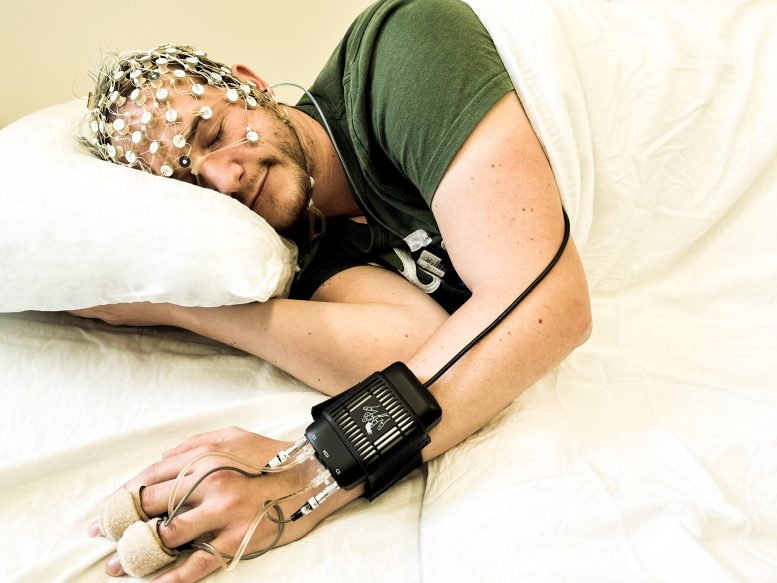
The study involved 18 healthy men aged 30 to 57, who spent three non-consecutive nights in the sleep laboratory. On two nights, the researchers stimulated the subjects with sounds; on one night, they did not.
While the subjects slept, the scientists continuously measured their brain activity, blood pressure, and heart activity. They coupled their measurements to a computer system that analyzed the incoming data.
As soon as the readings indicated that the subject had fallen into deep sleep, the computer played a series of very brief tones at certain frequencies, called pink noise, which sounded like static. Ten seconds of such tones were followed by 10 seconds of silence, and then the same procedure could be repeated. A feedback mechanism ensured that the noise was played at the right time and – depending on the brain wave pattern – stopped again.
This experimental setup allowed the researchers to directly monitor whether the sound simulation enhanced deep sleep and whether it influenced the subjects’ heart rate and blood pressure. “During stimulation, we clearly see an increase in slow waves, as well as a response from the cardiovascular system that is reminiscent of cardiovascular pulsation,” says lead author Stephanie Huwiler, describing the direct effects during sleep.
The next morning, the heart specialists examined the subjects’ cardiac function using echocardiography (ultrasound).
Significant Results Despite a Small Group
“Despite the relatively small group of subjects, the results are significant. We were also able to reproduce the results on two separate nights, which in statistical terms makes them very strong,” Lustenberger says.
A small group size is typical for laboratory sleep studies, she adds, because they require a lot of resources. In addition, the researchers deliberately selected only men. This is because they are more homogeneous as a group of subjects than women in a comparable age bracket, whose menstrual cycle or menopause has a major effect on their sleep. “When all you’ve got to work with is one night a week for three weeks, the effects of the menstrual cycle will play a role in women. These effects might have masked the stimulation effect in this sort of initial study,” Lustenberger explains.
She emphasizes, however, that future studies should definitely include women, as gender differences in sleep and cardiovascular health are becoming increasingly apparent and have profound implications for primary healthcare.
Practical Future Benefits
This study is of great interest not only to cardiologists but to athletes as well. “Especially in preventive medicine, but also in competitive sport, this kind of deep sleep stimulation system might enable improved cardiac function in the future – and possibly ensure faster and better recovery after intense workouts,” says Huwiler, who presented the initial results of the study at the Zurich Symposium for Sports Cardiology in March 2023. Lustenberger adds: “The treatment of cardiovascular diseases may be enhanced with this or similar stimulation methods. However, it’s crucial to first investigate whether patients can benefit from this kind of deep sleep stimulation method as well.”
The researchers are now looking for further, more powerful stimulation methods to positively impact the cardiovascular system. To this end, Huwiler is applying to Innosuisse for a Bridge Proof of Concept grant and for an ETH Pioneer Fellowship grant. In addition, she is in the process of setting up a start-up called EARDREAM together with Lustenberger, Simon Baur, and Rafael Polanía to further develop the findings and transfer them into practice.
Reference: “Auditory stimulation of sleep slow waves enhances left ventricular function in humans” by Stephanie Huwiler, Manuel Carro-Domínguez, Fabia M Stich, Rossella Sala, Florent Aziri, Anna Trippel, Tabea Ryf, Susanne Markendorf, David Niederseer, Philipp Bohm, Gloria Stoll, Lily Laubscher, Jeivicaa Thevan, Christina M Spengler, Joanna Gawinecka, Elena Osto, Reto Huber, Nicole Wenderoth, Christian Schmied and Caroline Lustenberger, 5 October 2023, European Heart Journal.
DOI: 10.1093/eurheartj/ehad630
Never miss a breakthrough: Join the SciTechDaily newsletter.
Follow us on Google and Google News.