
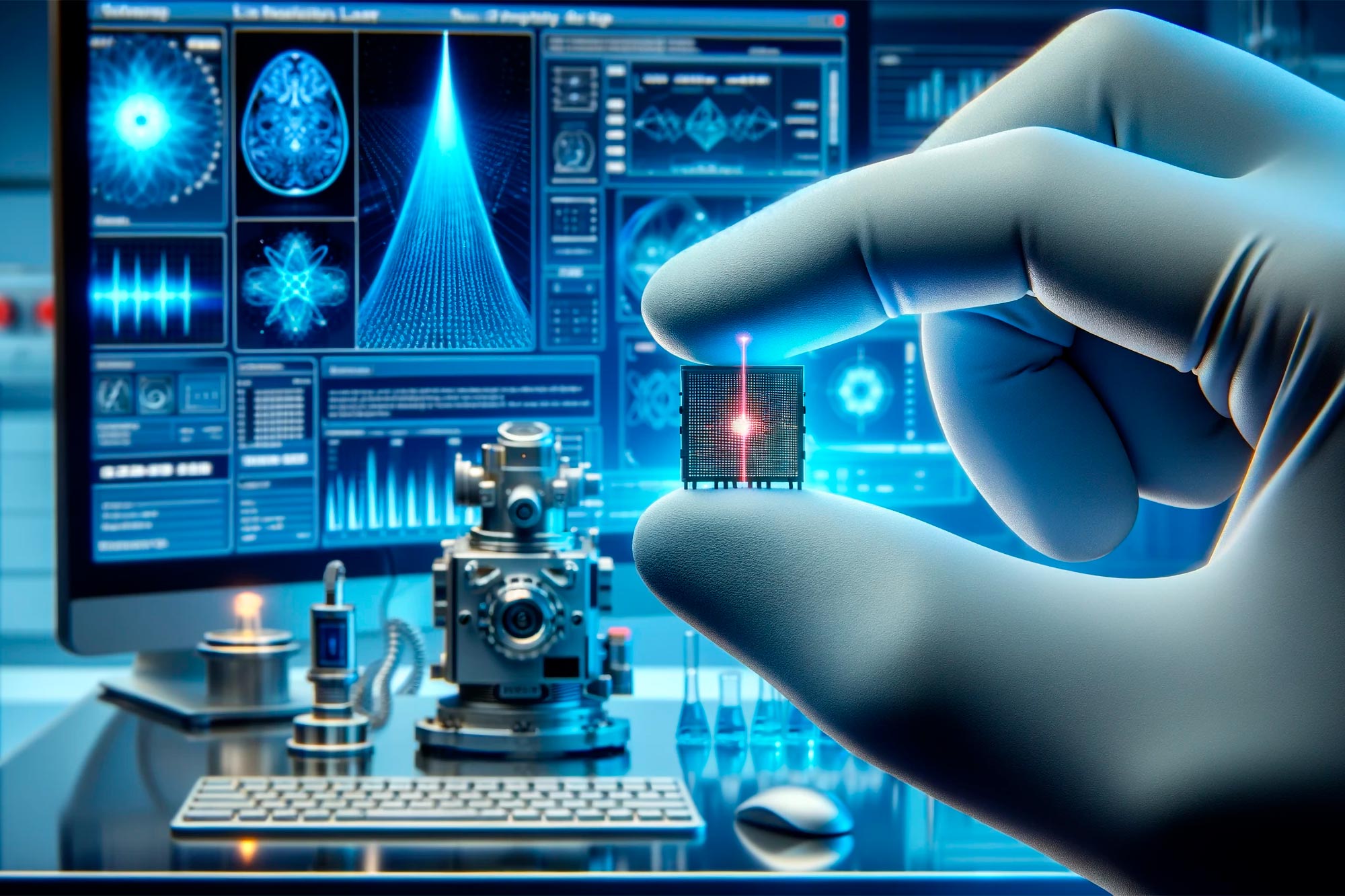
The new advance will enable pocket-sized devices that can perform detailed GPS-free precision navigation, medical imaging, food safety inspection, and more.
Lasers are essential tools for observing, detecting, and measuring things in the natural world that we can’t see with the naked eye. However, the ability to perform these tasks is often restricted by the need to use expensive and large instruments.
Innovations in Ultrafast Laser Technology
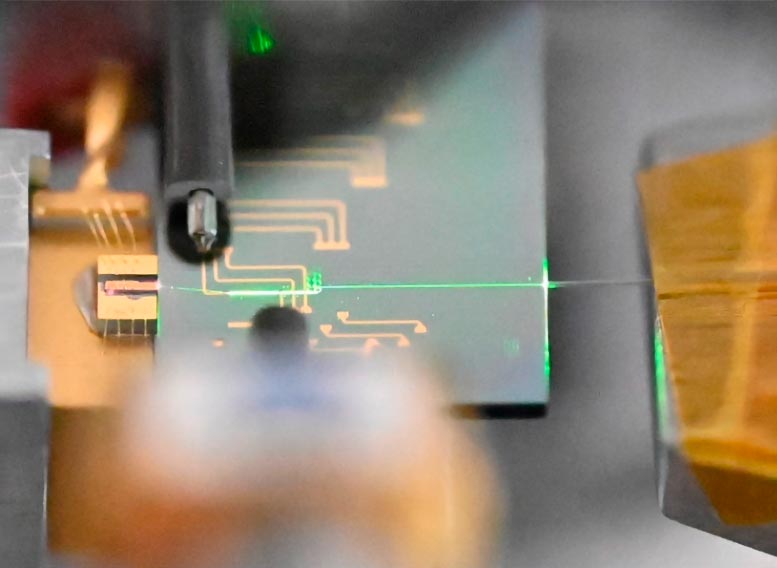
In a newly published cover-story paper in the journal Science, researcher Qiushi Guo demonstrates a novel approach for creating high-performance ultrafast lasers on nanophotonic chips. His work centers on miniaturizing mode-lock lasers — a unique laser that emits a train of ultrashort, coherent light pulses in femtosecond intervals, which is an astonishing quadrillionth of a second.
Unlocking Nature’s Fastest Timescales
Ultrafast mode-locked lasers are indispensable to unlocking the secrets of the fastest timescales in nature, such as the making or breaking of molecular bonds during chemical reactions, or light propagation in a turbulent medium. The high speed, pulse-peak intensity, and broad-spectrum coverage of mode-locked lasers have also enabled numerous photonics technologies, including optical atomic clocks, biological imaging, and computers that use light to calculate and process data.
Unfortunately, state-of-the-art mode-locked lasers are currently expensive, power-demanding tabletop systems that are limited to laboratory use.
Towards Smaller, Efficient Photonics
“Our goal is to revolutionize the field of ultrafast photonics by transforming large lab-based systems into chip-sized ones that can be mass-produced and field deployed,” said Guo, a faculty member with the CUNY Advance Science Research Center’s Photonics Initiative and a physics professor at the CUNY Graduate Center.
“Not only do we want to make things smaller, but we also want to ensure that these ultrafast chip-sized lasers deliver satisfactory performances. For example, we need enough pulse-peak intensity, preferably over 1 Watt, to create meaningful chip-scale systems.”
The Challenge of Miniaturization
Realizing an effective mode-locked laser on a chip is not a straightforward process, however. Guo’s research leverages an emerging material platform known as thin-film lithium niobate (TFLN). This material enables very efficient shaping and precise control of laser pulses by applying an external radio frequency electrical signal.
In their experiments, Guo’s team uniquely combined the high laser gain of III-V semiconductors and the efficient pulse shaping capability of TFLN nanoscale photonic waveguides to demonstrate a laser that can emit a high output peak power of 0.5 Watts.
Future Implications and Challenges
Beyond its compact size, the demonstrated mode-locked laser also exhibits many intriguing properties that are beyond reach by conventional ones, offering profound implications for future applications. For example, by adjusting the pump current of the laser, Guo was able to precisely tune the repetition frequencies of out pulses in a very wide range of 200 MHz. By employing the strong reconfigurability of the demonstrated laser, the research team hopes to enable chip-scale, frequency-stabilized comb sources, which are vital for precision sensing.
Guo’s team will need to address additional challenges to realize scalable, integrated, ultrafast photonic systems that can be translated for use in portable and handheld devices, but his lab has overcome a major obstacle with this current demonstration.
Potential Real-World Applications
“This achievement paves the way for eventually using cell phones to diagnose eye diseases or analyzing food and environments for things like E. coli and dangerous viruses,” Guo said. “It could also enable futuristic chip-scale atomic clocks, which allows navigation when GPS is compromised or unavailable.”
For more on this breakthrough:
Reference: “Ultrafast mode-locked laser in nanophotonic lithium niobate” by Qiushi Guo, Benjamin K. Gutierrez, Ryoto Sekine, Robert M. Gray, James A. Williams, Luis Ledezma, Luis Costa, Arkadev Roy, Selina Zhou, Mingchen Liu and Alireza Marandi, 9 November 2023, Science.
DOI: 10.1126/science.adj5438
Never miss a breakthrough: Join the SciTechDaily newsletter.
Follow us on Google and Google News.