
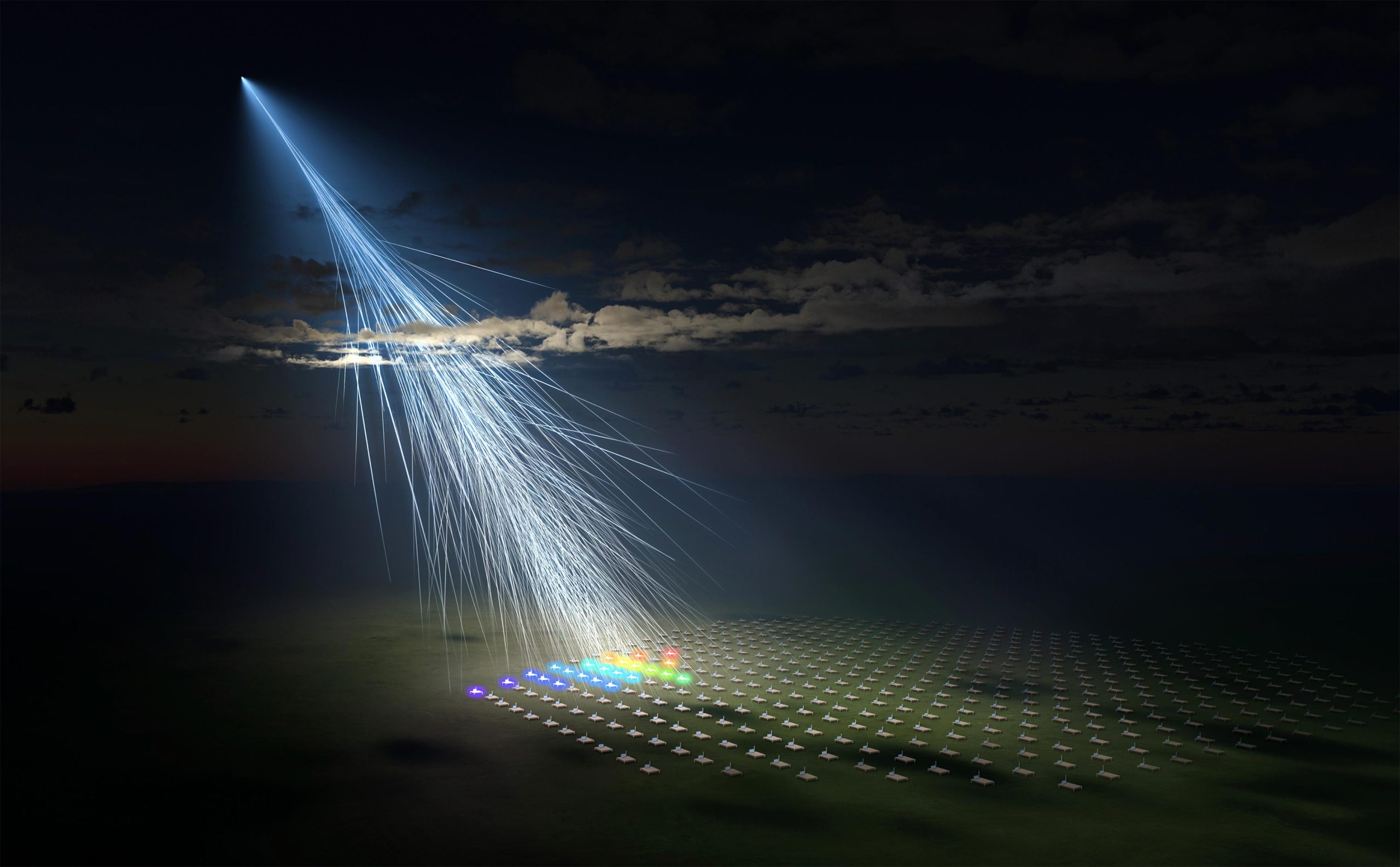
A groundbreaking detection of an extremely energetic cosmic ray by the Telescope Array experiment raises questions about its source, as it points to a cosmic void, challenging current theories in cosmic ray origins and high-energy physics.
Discovery of an Exceptional Extraterrestrial Particle
Researchers involved in the Telescope Array experiment have announced the detection of an extraordinarily energetic cosmic ray. This particle, which originated beyond our galaxy, possesses an astounding energy level of over 240 exa-electron volts (EeV). Despite this remarkable find, its exact source remains elusive, as its arrival direction does not point to any known astronomical entities.
The Mystery of Ultrahigh-Energy Cosmic Rays
Cosmic rays are subatomic charged particles from space, with Ultrahigh-energy cosmic rays (UHECRs) being a rare and exceptionally powerful type. These UHECRs possess energies above 1 EeV, which is roughly a million times as high as the energy reached by human-made particle accelerators. They are believed to originate from the most energetic phenomena in the Universe, such as those involving black holes, gamma-ray bursts, and active galactic nuclei. Their exact physics and acceleration mechanisms, however, are still not fully understood. The infrequent nature of these highly energetic cosmic rays – estimated to be less than one particle per century per square kilometer – makes their detection a rare event, requiring instruments with vast collecting areas.
Telescope Array’s Unique Discovery
The Telescope Array (TA) experiment, a large-scale surface detector array in Utah with an effective detection area of 700 square kilometers, successfully detected a UHECR with a groundbreaking energy of approximately 244 EeV on May 27, 2021.
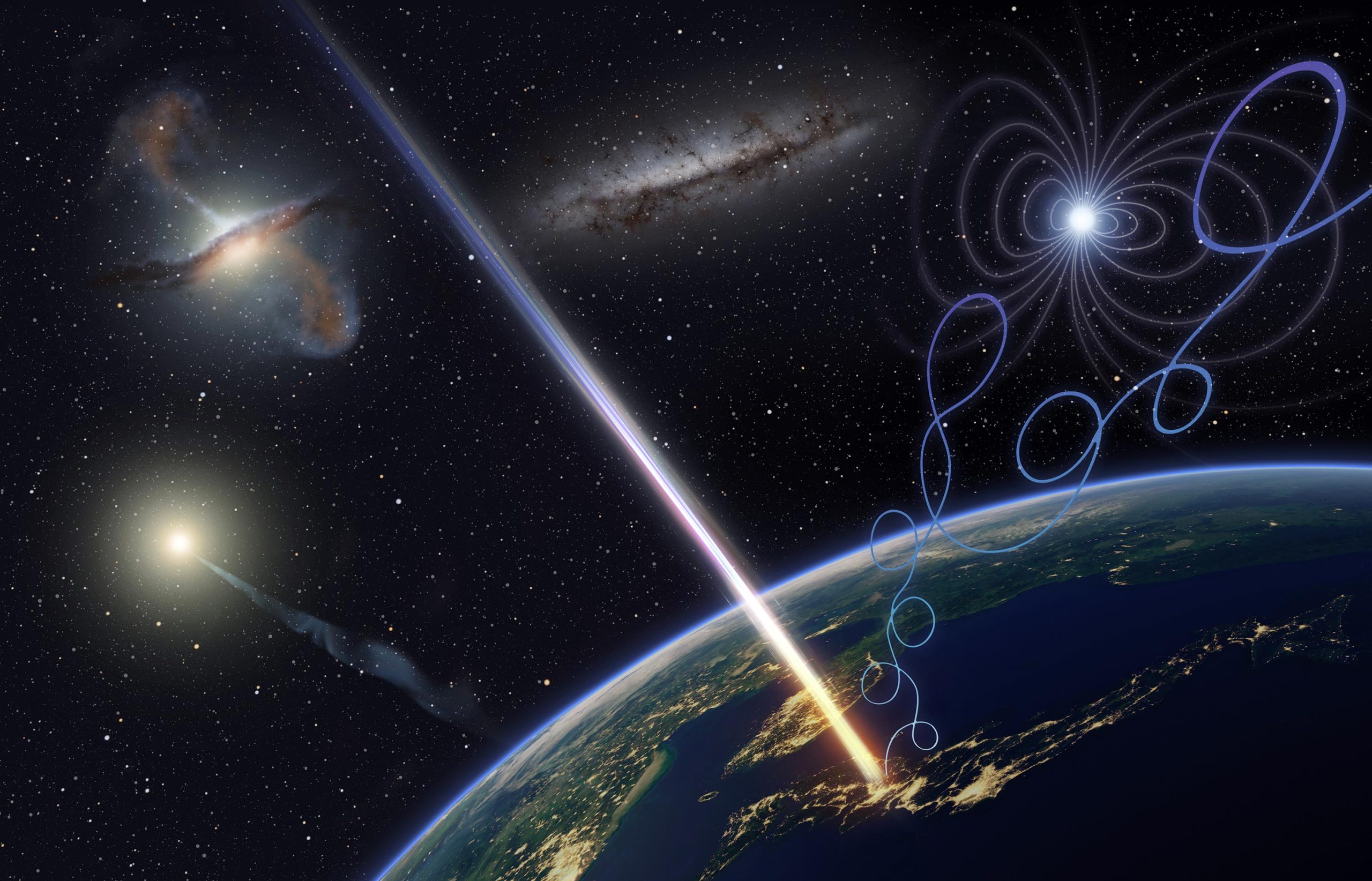
Given the particle’s exceptionally high energy, the researchers note that it should only experience relatively minor deflections by foreground magnetic fields, and thus, its arrival direction should be expected to be more closely correlated to its source. However, the findings show that its arrival direction shows no obvious source galaxy, or any other known astronomical objects thought to be potential sources of UHECRs.
Instead, its arrival direction points back to the void in the large-scale structure of the Universe – a region where very few galaxies reside. The scientists suggest that this could indicate a much larger magnetic deflection than is predicted by galactic magnetic field models, an unidentified source in the local extragalactic neighborhood, or an incomplete understanding of the associated high-energy particle physics.
For more on this discovery:
- Earth Hit by Unknown, Extremely High-Energy Particle
- Astronomers Shocked by Mysterious Ultra-High-Energy Cosmic Ray
Reference: “An extremely energetic cosmic ray observed by a surface detector array” by Telescope Array Collaboration*†, R. U. Abbasi, M. G. Allen, R. Arimura, J. W. Belz, D. R. Bergman, S. A. Blake, B. K. Shin, I. J. Buckland, B. G. Cheon, T. Fujii, K. Fujisue, K. Fujita, M. Fukushima, G. D. Furlich, Z. R. Gerber, N. Globus, K. Hibino, R. Higuchi, K. Honda, D. Ikeda, H. Ito, A. Iwasaki, S. Jeong, H. M. Jeong, C. H. Jui, K. Kadota, F. Kakimoto, O. E. Kalashev, K. Kasahara, K. Kawata, I. Kharuk, E. Kido, S. W. Kim, H. B. Kim, J. H. Kim, J. H. Kim, I. Komae, Y. Kubota, M. Y. Kuznetsov, K. H. Lee, B. K. Lubsandorzhiev, J. P. Lundquist, J. N. Matthews, S. Nagataki, T. Nakamura, A. Nakazawa, T. Nonaka, S. Ogio, M. Ono, H. Oshima, I. H. Park, M. Potts, S. Pshirkov, J. R. Remington, D. C. Rodriguez, C. Rott, G. I. Rubtsov, D. Ryu, H. Sagawa, N. Sakaki, T. Sako, N. Sakurai, H. Shin, J. D. Smith, P. Sokolsky, B. T. Stokes, T. S. Stroman, K. Takahashi, M. Takeda, A. Taketa, Y. Tameda, S. Thomas, G. B. Thomson, P. G. Tinyakov, I. Tkachev, T. Tomida, S. V. Troitsky, Y. Tsunesada, S. Udo, F. R. Urban, T. Wong, K. Yamazaki, Y. Yuma, Y. V. Zhezher and Z. Zundel, 23 November 2023, Science.
DOI: 10.1126/science.abo5095
Never miss a breakthrough: Join the SciTechDaily newsletter.
Follow us on Google and Google News.
1 Comment
When the first aircraft finally broke the sound barrier (Bell X1), the tell tail signature of breaking the sound barrier was the sonic boom. A sound pressure shock wave that travels behind the aircraft. If a vehicle were to break the light barrier, what would be the signature shock wave be? Maybe, a very short burst of cosmic rays? Like we see here?