
Close Menu
    Facebook X (Twitter) Instagram
    SciTechDaily
    • Biology
    • Chemistry
    • Earth
    • Health
    • Physics
    • Science
    • Space
    • Technology
    Facebook X (Twitter) Pinterest YouTube RSS
    SciTechDaily
    Home»Space»Dazzling Array of Complex Shapes Found in Planetary Nebulae Generated by Stellar Winds Interaction With Binary Companions
    Space

    Dazzling Array of Complex Shapes Found in Planetary Nebulae Generated by Stellar Winds Interaction With Binary Companions

    By American Association for the Advancement of ScienceJanuary 17, 2021No Comments3 Mins Read
    Facebook Twitter Pinterest Telegram LinkedIn WhatsApp Email Reddit
    Share
    Facebook Twitter LinkedIn Pinterest Telegram Email Reddit
    Stellar Winds Around Aging Stars
    Binary companions influence stellar winds from aging stars, creating the diverse shapes seen in resulting planetary nebulae.

    Binary companions sculpt the winds of dying stars, forming the complex patterns seen in planetary nebulae.

    Interactions with binary companions shape the stellar winds blowing from elderly stars, generating the dazzling array of complex shapes found in the planetary nebulae they produce, a new study finds.
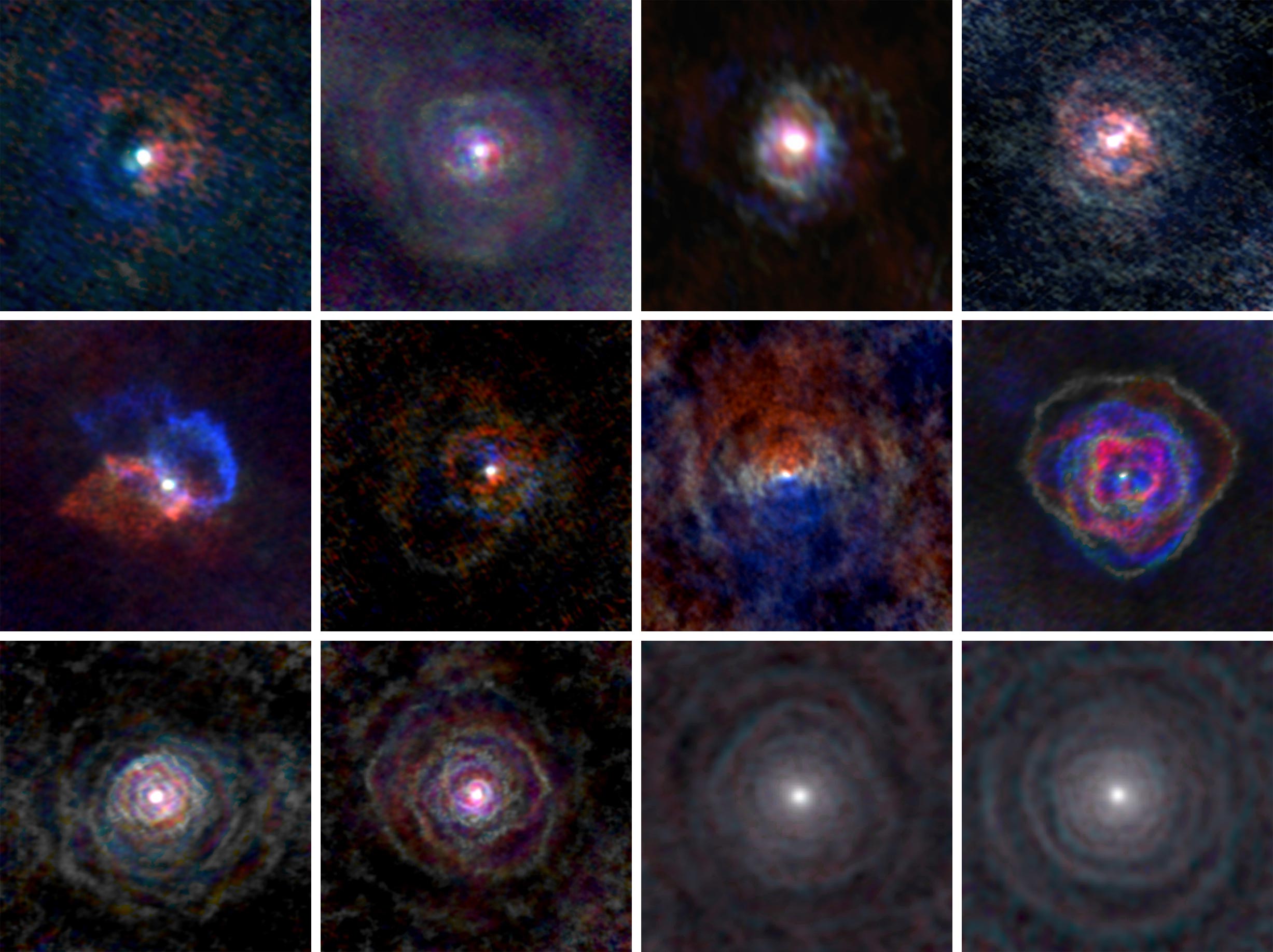
    Stellar Winds Around Cool Aging Stars
    This image gallery of stellar winds around cool aging stars shows a variety of morphologies, including disks, cones, and spirals. The blue color represents material that is coming towards you; red is material that is moving away from you. Credit: © L. Decin, ESO/ALMA

    While massive stars explode in brilliant supernovae when they die, those with low and intermediate masses — less than eight times the mass of the Sun — swell and evolve into a type of cool, highly luminous red giant, also known as an asymptotic giant branch (AGB) star. During this short, final stage, as the aging star runs low on fuel, the outer layers of its atmosphere are lost into space as stellar wind, stripping the star of much of its remaining mass.

    Eventually, this material forms a so-called planetary nebula — an expanding cloud of ionized gas ejected from the dying star and set aglow by its exposed stellar core.


    Professor Leen Decin (KU Leuven) discusses how her team discovered an explanation for the mesmerizing shapes of planetary nebulae. Their discovery is based on an extraordinary set of observations of stellar winds around aging stars. The team found that stellar winds have a shape similar to that of planetary nebulae and concluded that interaction with an accompanying star or exoplanet shapes both the stellar winds and planetary nebulae. Credit: KU Leuven

    Planetary nebulae (PNe) display a wide range of complex shapes and structures, including rings and spirals. While interaction with a binary companion has been suggested as a possible mechanism, how such a diverse range of asymmetric forms could be produced by stars with spherically symmetric stellar wind remained unexplained. Leen Decin and colleagues observed the stellar winds of 14 AGB stars using the Atacama Large Millimeter/submillimeter Array.

    They found none with spherical symmetry; instead each wind had distinct and complex geometries with morphologies that are similar to those found in PNe. Decin et al. infer that the shape of the AGB stellar wind generates the resulting PNe structures, and demonstrate that both can be explained by the influence of a binary companion star or giant planet interacting with the dying star’s wind.

    For more on this research, see Mesmerizing Shapes of Planetary Nebulae Explained.

    Reference: “(Sub)stellar companions shape the winds of evolved stars” by L. Decin, M. Montargès, A. M. S. Richards, C. A. Gottlieb, W. Homan1, I. McDonald, I. El Mellah, T. Danilovich, S. H. J. Wallström, A. Zijlstra, A. Baudry, J. Bolte, E. Cannon, E. De Beck, F. De Ceuster, A. de Koter, J. De Ridder, S. Etoka, D. Gobrecht, M. Gray, F. Herpin, M. Jeste, E. Lagadec, P. Kervella, T. Khouri, K. Menten, T. J. Millar, H. S. P. Müller, J. M. C. Plane, R. Sahai, H. Sana, M. Van de Sande, L. B. F. M. Waters, K. T. Wong and J. Yates, 17 September 2020, Science.
    DOI: 10.1126/science.abb1229

    Never miss a breakthrough: Join the SciTechDaily newsletter.
    Follow us on Google and Google News.

    American Association for the Advancement of Science Astronomy Astrophysics
    Share. Facebook Twitter Pinterest LinkedIn Email Reddit

    Related Articles

    Intergalactic Upcycling: Recycled Gas Feeds a Massive Galaxy in the Early Universe

    Cosmic Time Travel: Webb Unveils Physical Properties of Compact Galaxy From the Early Universe

    Science’s 2022 Breakthrough of the Year: NASA’s Stellar New James Webb Space Telescope

    Planetary Evolution: Composition of Earth-Like Exoplanet Interiors Linked to Composition of Host Stars

    Patterns of Light Emitted From Accretion Disks Vary Depending on Supermassive Black Hole Mass

    Enhanced X-ray Emissions Coincide With Giant Radio Pulses From Crab Pulsar

    Earth Has a Hot New Neighbor: Discovery of a Nearby Exoplanet Suitable for Atmospheric Investigation

    Black Hole in Cygnus X-1 Is So Massive That It Challenges Current Stellar Evolution Models

    New Measurement of the Hubble Constant – Rate of Expansion of the Universe – From Combined Observations of Neutron Stars

    Leave A Reply Cancel Reply

    • Facebook
    • Twitter
    • Pinterest
    • YouTube

    Don't Miss a Discovery

    Subscribe for the Latest in Science & Tech!

    Trending News

    Largest-Ever Study Finds Medicinal Cannabis Ineffective for Anxiety, Depression, PTSD

    250-Million-Year-Old Egg Solves One of Evolution’s Biggest Mysteries

    Living With Roommates Might Be Changing Your Gut Microbiome Without You Knowing

    Century-Old Cleaning Chemical Linked to 500% Increased Risk of Parkinson’s Disease

    What if Your Memories Never Happened? Physicists Take a New Look at the Boltzmann Brain Paradox

    One of the Universe’s Largest Stars May Be Getting Ready To Explode

    Scientists Discover Enzyme That Could Supercharge Ozempic-Like Weight Loss Drugs

    Popular Sweetener Linked to DNA Damage – “It’s Something You Should Not Be Eating”

    Follow SciTechDaily
    • Facebook
    • Twitter
    • YouTube
    • Pinterest
    • Newsletter
    • RSS
    SciTech News
    • Biology News
    • Chemistry News
    • Earth News
    • Health News
    • Physics News
    • Science News
    • Space News
    • Technology News
    Recent Posts
    • Scientists Say This Overlooked Organ Could Hold the Key to Longer Life
    • Want Less Stress? Landmark Study Points to a Simple Habit
    • Scientists Reveal Eating Fruits and Vegetables May Increase Your Risk of Lung Cancer
    • AI Reveals Explosive Growth of Floating Algae Across the World’s Oceans
    • 5.5 Million Bees Discovered Living Beneath a New York Cemetery
    Copyright © 1998 - 2026 SciTechDaily. All Rights Reserved.
    • Science News
    • About
    • Contact
    • Editorial Board
    • Privacy Policy
    • Terms of Use

    Type above and press Enter to search. Press Esc to cancel.