
Close Menu
    Facebook X (Twitter) Instagram
    SciTechDaily
    • Biology
    • Chemistry
    • Earth
    • Health
    • Physics
    • Science
    • Space
    • Technology
    Facebook X (Twitter) Pinterest YouTube RSS
    SciTechDaily
    Home»Physics»New Half-Light Half-Matter Quantum Particles
    Physics

    New Half-Light Half-Matter Quantum Particles

    By City College of New YorkDecember 30, 2014No Comments3 Mins Read
    Facebook Twitter Pinterest Telegram LinkedIn WhatsApp Email Reddit
    Share
    Facebook Twitter LinkedIn Pinterest Telegram Email Reddit
    Study Unveils New Half-Light Half-Matter Quantum Particles
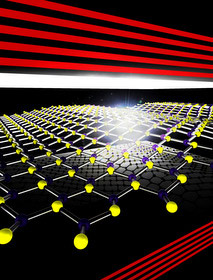
    Researchers find half-light, half-matter particles in atomically thin semiconductors made of a 2D layer of molybdenum and sulfur atoms arranged like graphene.  Credit: City College of New York

    A newly published study details how a team of researchers were able to discover half-light, half-matter particles in atomically thin semiconductors.

    Prospects of developing computing and communication technologies based on quantum properties of light and matter may have taken a major step forward thanks to research by City College of New York physicists led by Dr. Vinod Menon.

    In a pioneering study, Professor Menon and his team were able to discover half-light, half-matter particles in atomically thin semiconductors (thickness ~ a millionth of a single sheet of paper) consisting of a two-dimensional (2D) layer of molybdenum and sulfur atoms arranged similar to graphene. They sandwiched this 2D material in a light-trapping structure to realize these composite quantum particles.

    “Besides being a fundamental breakthrough, this opens up the possibility of making devices which take the benefits of both light and matter,” said Professor Menon.

    For example, one can start envisioning logic gates and signal processors that take on the best of light and matter. The discovery is also expected to contribute to developing practical platforms for quantum computing.

    Dr. Dirk Englund, a professor at MIT whose research focuses on quantum technologies based on semiconductor and optical systems, hailed the City College study.

    “What is so remarkable and exciting in the work by Vinod and his team is how readily this strong coupling regime could actually be achieved. They have shown convincingly that by coupling a rather standard dielectric cavity to exciton–polaritons in a monolayer of molybdenum disulfide, they could actually reach this strong coupling regime with a very large binding strength,” he said.

    Professor Menon’s research team included City College PhD students, Xiaoze Liu, Tal Galfsky, and Zheng Sun, and scientists from Yale University, National Tsing Hua University (Taiwan), and Ecole Polytechnic – Montreal (Canada).

    The study appears in the January issue of the journal Nature Photonics. It was funded by the U.S. Army Research Laboratory’s Army Research Office and the National Science Foundation through the Materials Research Science and Engineering Center – Center for Photonic and Multiscale Nanomaterials.

    Reference: “Strong light–matter coupling in two-dimensional atomic crystals” by Xiaoze Liu, Tal Galfsky, Zheng Sun, Fengnian Xia, Erh-chen Lin, Yi-Hsien Lee, Stéphane Kéna-Cohen and Vinod M. Menon, 23 December 2014, Nature Photonics.
    DOI: 10.1038/nphoton.2014.304


    Never miss a breakthrough: Join the SciTechDaily newsletter.
    Follow us on Google and Google News.

    City College of New York MIT Quantum Physics Yale University
    Share. Facebook Twitter Pinterest LinkedIn Email Reddit

    Related Articles

    Researchers Propose Using Distant Quasars to Test Bell’s Theorem

    Graphene Effectively Filters Electrons According to the Direction of Their Spin

    Study Shows Creation of Entanglement Simultaneously Gives Rise to a Wormhole

    Physicists Create and Control a Large Quantum Mechanical System Built on Photons

    Harvard and MIT Scientists Create Never-Before-Seen Form of Matter

    Scientists Reveal Quantum Behavior in Fluid Dynamics

    Researchers Make Progress on a Quantum-Computing Proposal

    Spin-Velocity Correlation in an Ultracold, Dilute Gas of Atoms

    New System Converts Laser Beam Into Controlled Stream of Single Photons

    Leave A Reply Cancel Reply

    • Facebook
    • Twitter
    • Pinterest
    • YouTube

    Don't Miss a Discovery

    Subscribe for the Latest in Science & Tech!

    Trending News

    1.4-Million-Year-Old Footprints Reveal a Giant Human Relative

    Astronomers May Have Found the First Moon Beyond Our Solar System

    Underwater Cameras Expose the Secret Lives of Whale Sharks

    Why Dreaming Leaves the Brain Running Low on Energy

    CERN Experiments Detect Signs of the Universe’s Primordial Matter

    Study Finds a Surprising Link Between Gut Microbes and Aging

    Frequent Cannabis Users Wake Up With More “Stress Hormone”

    Scientists Reveal Hidden DNA Traces in the Shroud of Turin

    Follow SciTechDaily
    • Facebook
    • Twitter
    • YouTube
    • Pinterest
    • Newsletter
    • RSS
    SciTech News
    • Biology News
    • Chemistry News
    • Earth News
    • Health News
    • Physics News
    • Science News
    • Space News
    • Technology News
    Recent Posts
    • World’s First Photonic Time Crystal Can Reshape Light in Trillionths of a Second
    • Meteorite That Smashed Through a New Jersey Roof Hid an Ancient Chemical Secret
    • Astronomers Find Ancient Black Holes Shining With the Power of a Trillion Suns
    • These “Good” Immune Cells Could Hold the Key to Spinal Cord Regeneration
    • New Research Questions Decades of Low-Fat Dairy Advice
    Copyright © 1998 - 2026 SciTechDaily. All Rights Reserved.
    • Science News
    • About
    • Contact
    • Editorial Board
    • Privacy Policy
    • Terms of Use

    Type above and press Enter to search. Press Esc to cancel.