
Close Menu
    Facebook X (Twitter) Instagram
    SciTechDaily
    • Biology
    • Chemistry
    • Earth
    • Health
    • Physics
    • Science
    • Space
    • Technology
    Facebook X (Twitter) Pinterest YouTube RSS
    SciTechDaily
    Home»Space»ESO Views Lynds Dark Nebula 483
    Space

    ESO Views Lynds Dark Nebula 483

    By European Southern ObservatoryJanuary 7, 2015No Comments4 Mins Read
    Facebook Twitter Pinterest Telegram LinkedIn WhatsApp Email Reddit
    Share
    Facebook Twitter LinkedIn Pinterest Telegram Email Reddit
    Lynds Dark Nebula 483
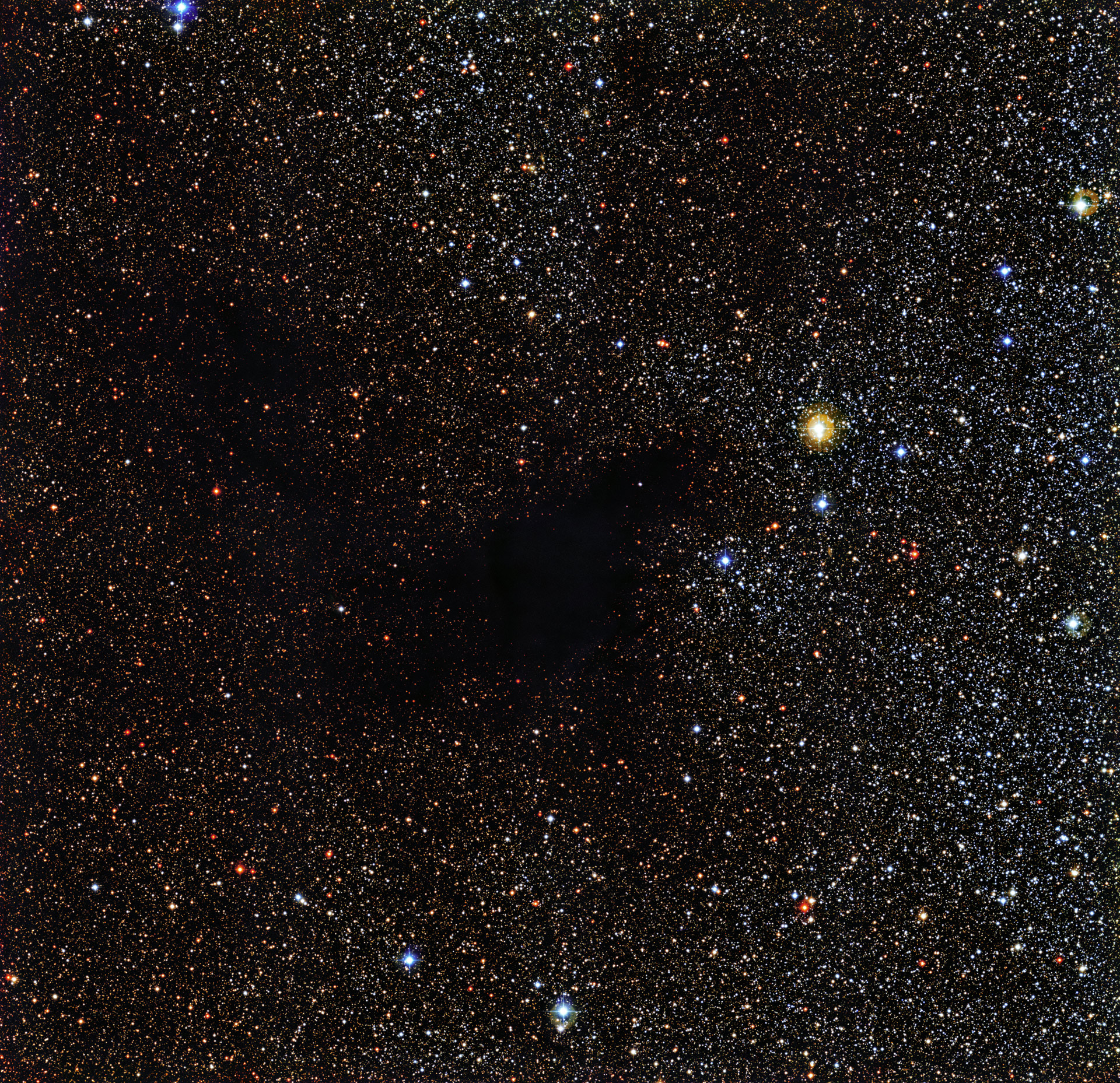
    The Wide Field Imager (WFI) on the MPG/ESO 2.2-meter telescope at the La Silla Observatory in Chile snapped this image of the dark nebula LDN 483. The object is a region of space clogged with gas and dust. These materials are dense enough to effectively eclipse the light of background stars. LDN 483. Credit: ESO

    This newly released ESO image shows Lynds Dark Nebula 483, which is located about 700 light-years away in the constellation of Serpens.

    Some of the stars appear to be missing in this intriguing new ESO image. But the black gap in this glitteringly beautiful starfield is not really a gap, but rather a region of space clogged with gas and dust. This dark cloud is called LDN 483 — for Lynds Dark Nebula 483. Such clouds are the birthplaces of future stars.

    LDN 483 [1] is located about 700 light-years away in the constellation of Serpens (The Serpent). The cloud contains enough dusty material to completely block the visible light from background stars. Particularly dense molecular clouds, like LDN 483, qualify as dark nebulae because of this obscuring property. The starless nature of LDN 483 and its ilk would suggest that they are sites where stars cannot take root and grow. But in fact the opposite is true: dark nebulae offer the most fertile environments for eventual star formation.

    Astronomers studying star formation in LDN 483 have discovered some of the youngest observable kinds of baby stars buried in LDN 483’s shrouded interior. These gestating stars can be thought of as still being in the womb, having not yet been born as complete, albeit immature, stars.

    In this first stage of stellar development, the star-to-be is just a ball of gas and dust contracting under the force of gravity within the surrounding molecular cloud. The protostar is still quite cool — about –250 degrees Celsius (-420 degrees Fahrenheit) — and shines only in long-wavelength submillimeter light [2]. Yet temperature and pressure are beginning to increase in the fledgling star’s core.


    This video gives a close-up view of an image of the dark nebula LDN 483 as seen with the Wide Field Imager (WFI) on the MPG/ESO 2.2-meter telescope at the La Silla Observatory. The object is a region of space clogged with gas and dust. These materials are dense enough to effectively eclipse the light of background stars.

    This earliest period of star growth lasts a mere thousands of years, an astonishingly short amount of time in astronomical terms, given that stars typically live for millions or billions of years. In the following stages, over the course of several million years, the protostar will grow warmer and denser. Its emission will increase in energy along the way, graduating from mainly cold, far-infrared light to near-infrared and finally to visible light. The once-dim protostar will then become a fully luminous star.

    As more and more stars emerge from the inky depths of LDN 483, the dark nebula will disperse further and lose its opacity. The missing background stars that are currently hidden will then come into view — but only after the passage of millions of years, and they will be outshone by the bright young-born stars in the cloud [3].

    Notes

    1. The Lynds Dark Nebula catalog was compiled by the American astronomer Beverly Turner Lynds, and published in 1962. These dark nebulae were found from visual inspection of the Palomar Sky Survey photographic plates.
    2. The Atacama Large Millimeter/submillimeter Array (ALMA), operated in part by ESO, observes in submillimeter and millimeter light and is ideal for the study of such very young stars in molecular clouds.
    3. Such a young open star cluster can be seen here, and a more mature one here.

    Never miss a breakthrough: Join the SciTechDaily newsletter.
    Follow us on Google and Google News.

    Astronomy European Southern Observatory
    Share. Facebook Twitter Pinterest LinkedIn Email Reddit

    Related Articles

    Supermassive Black Holes on a Collision Course: Closest Pair of Supermassive Black Holes to Earth Ever Discovered

    Black Hole Discovered Lurking in Star Cluster Outside Our Galaxy

    Discovery in a Galaxy Over 12 Billion Light-Years Away – Reveals How Element Found in Our Bones Is Forged in the Universe

    Strange 160 Mile-Long “Dog-Bone” Asteroid Kleopatra Captured in Detailed Images

    Astronomers Find Small Rocky Planet – Just Half the Mass of Venus

    First Clear Detection of a Moon-Forming Disc Around a Planet Outside Our Solar System

    Mystery Solved: Astronomers Unravel the Puzzle of Betelgeuse’s “Great Dimming”

    Stunning Galactic Fireworks: New ESO Images Reveal Spectacular Features of Nearby Galaxies

    Astronomers Were Puzzled by “Great Dimming” of Betelgeuse – Now the Mystery Is Solved

    Leave A Reply Cancel Reply

    • Facebook
    • Twitter
    • Pinterest
    • YouTube

    Don't Miss a Discovery

    Subscribe for the Latest in Science & Tech!

    Trending News

    This Copper Drug Clears Alzheimer’s Brain Toxins and Boosts Memory

    Adults Over 65 Lost Massive Amounts of Weight With Ozempic

    How Flocking Birds “Defy” One of Physics’ Most Fundamental Laws

    Physicists Create a New Kind of Schrödinger’s Cat State From Exotic Quantum Building Blocks

    Your Diet Could Be Missing the Key Ingredient for Heart Protection

    Researchers Warn Widely Prescribed Blood Pressure Drugs Could Be Harming Diabetic Kidneys

    James Webb Spots Something Strange Between Day and Night on an Alien Planet

    How Ancient People Moved a 6-Ton Stone 700 Kilometers to Stonehenge

    Follow SciTechDaily
    • Facebook
    • Twitter
    • YouTube
    • Pinterest
    • Newsletter
    • RSS
    SciTech News
    • Biology News
    • Chemistry News
    • Earth News
    • Health News
    • Physics News
    • Science News
    • Space News
    • Technology News
    Recent Posts
    • Scientists Uncover Cause of Inflammatory Bowel Disease Solving Decades-Old Mystery
    • The Surprising Reason Swimming Could Be Better for Your Heart Than Running
    • Could Vitamin C Be the Secret to Keeping Your Brain Younger?
    • The Surprising Fix for Robot Traffic Jams
    • Near Absolute Zero, This Transistor Starts Acting Like a Brain Cell
    Copyright © 1998 - 2026 SciTechDaily. All Rights Reserved.
    • Science News
    • About
    • Contact
    • Editorial Board
    • Privacy Policy
    • Terms of Use

    Type above and press Enter to search. Press Esc to cancel.