
Close Menu
    Facebook X (Twitter) Instagram
    SciTechDaily
    • Biology
    • Chemistry
    • Earth
    • Health
    • Physics
    • Science
    • Space
    • Technology
    Facebook X (Twitter) Pinterest YouTube RSS
    SciTechDaily
    Home»Space»In a Universe of Wonders: NASA’s Hubble Presents a Holiday Globe of a Billion Stars
    Space

    In a Universe of Wonders: NASA’s Hubble Presents a Holiday Globe of a Billion Stars

    By Space Telescope Science InstituteDecember 23, 2023No Comments3 Mins Read
    Facebook Twitter Pinterest Telegram LinkedIn WhatsApp Email Reddit
    Share
    Facebook Twitter LinkedIn Pinterest Telegram Email Reddit
    Dwarf Irregular Galaxy UGC 8091
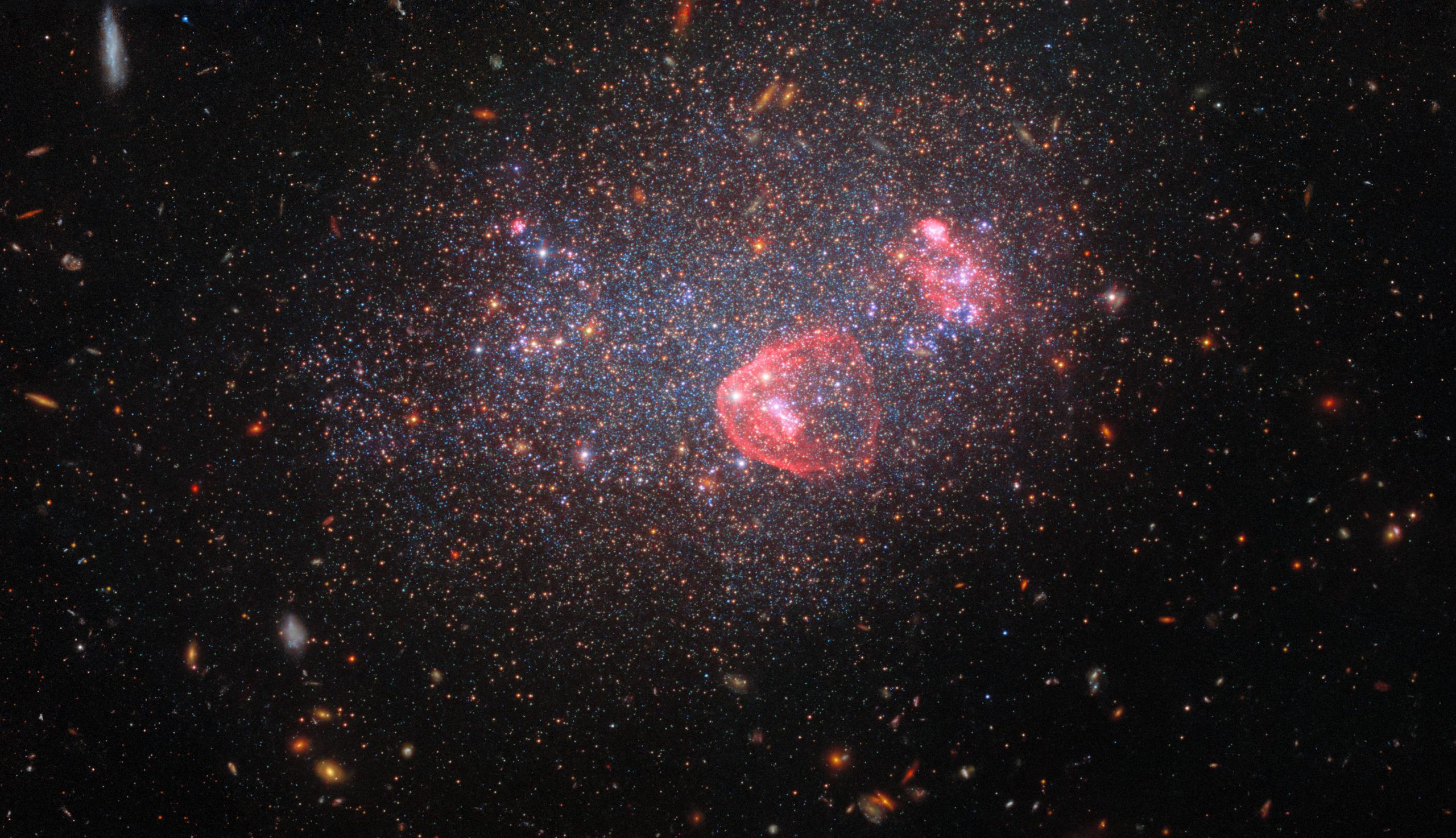
    The billion stars in galaxy UGC 8091 resemble a sparkling snow globe in this festive Hubble Space Telescope image from NASA and ESA (European Space Agency). Credit: ESA/Hubble, NASA, ESA, Yumi Choi (NSF’s NOIRLab), Karoline Gilbert (STScI), Julianne Dalcanton (Center for Computational Astrophysics/Flatiron Inst., UWashington)

    Dwarf Irregular Galaxy Springs to Life With Dazzling Newborn Stars

    Hubble’s colorful snapshots show that the universe always looks like it’s in a holiday spirit. The dwarf irregular galaxy UGC 8091 is an opulent example. The dizzying interplay of matter and energy bubbles up to create dazzling blue, newborn stars that look like a festive string of lights. They are swaddled in glowing cocoons of hot, pink hydrogen gas. The galaxy is a collection of approximately 1 billion stars. That sounds like a lot, but it is 1/100th the stellar population inside our full-grown Milky Way galaxy.

    This little galaxy came late to the party. The early universe was awash in dwarf galaxies that eventually merged to build up the majestic spiral galaxies around us today. Located 7 million light-years away, UGC 8091 more recently started showing off a glittering tapestry.
    Hubble Space Telescope in Orbit Illustration
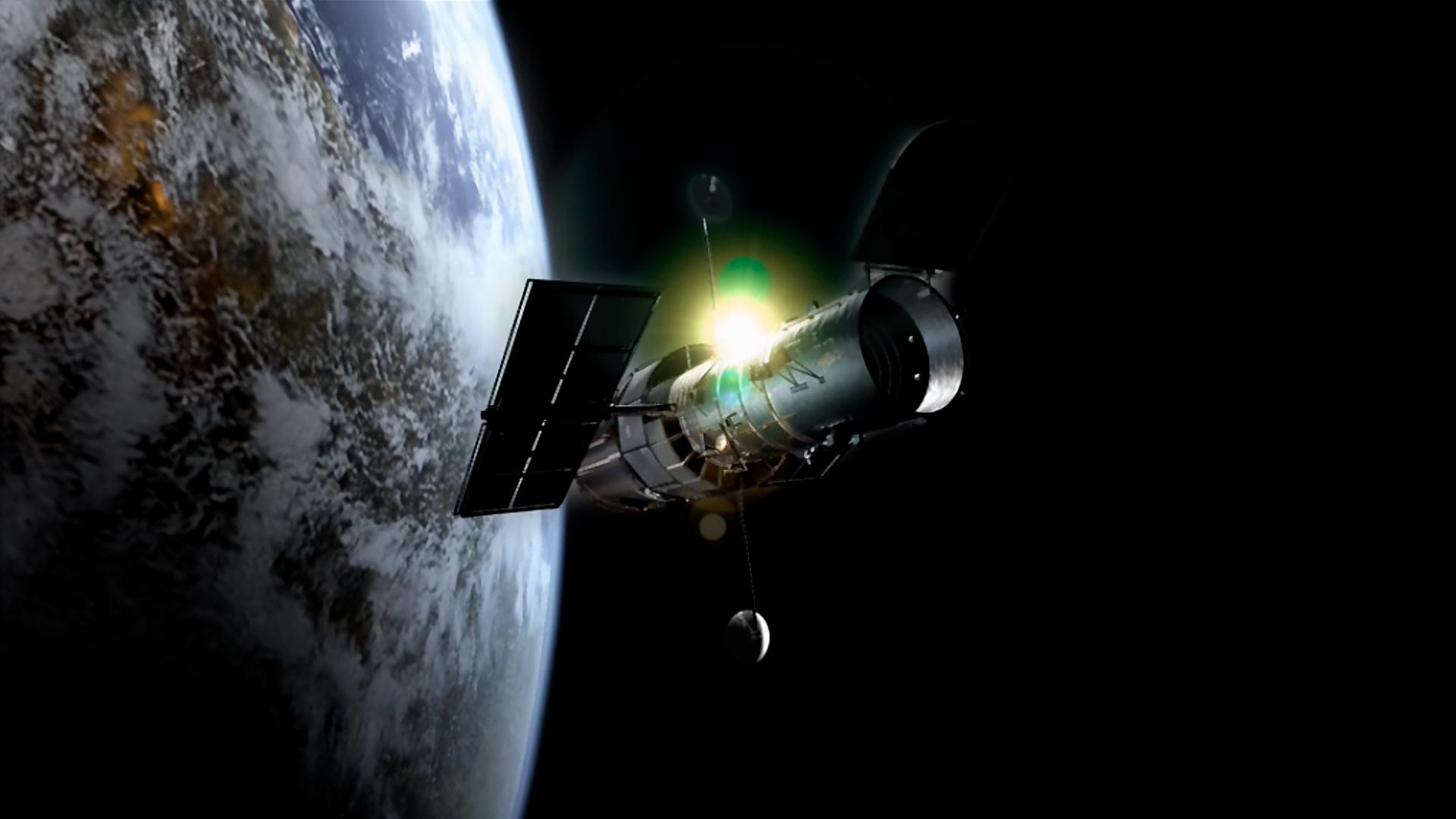
    The Hubble Space Telescope is an iconic symbol of space exploration that launched into orbit in 1990. Hubble revolutionized astronomy by providing unprecedented clear and deep views of the universe, far beyond the distortion of Earth’s atmosphere. Credit: NASA

    Hubble Space Telescope Presents a Holiday Globe of Stars

    The billion stars in galaxy UGC 8091 resemble a sparkling snow globe in this festive Hubble Space Telescope image from NASA and ESA (European Space Agency).

    The dwarf galaxy is approximately 7 million light-years from Earth in the constellation Virgo. It is considered an “irregular galaxy” because it does not have an orderly spiral or elliptical appearance. Instead, the stars that make up this celestial gathering look more like a brightly shining tangle of string lights than a galaxy.

    Some irregular galaxies may have become tangled by tumultuous internal activity, while others have formed by interactions with neighboring galaxies. The result is a class of galaxies with a diverse array of sizes and shapes, including the diffuse scatter of stars that is this galaxy.

    Twelve camera filters were combined to produce this image, with light from the mid-ultraviolet through to the red end of the visible spectrum. The red patches are likely interstellar hydrogen molecules that are glowing because they have been excited by the light from hot, energetic stars. The other sparkles on show in this image are a mix of older stars. An array of distant, diverse galaxies appear in the background, captured by Hubble’s sharp view.

    The data used in this image were taken by Hubble’s Wide Field Camera 3 and the Advanced Camera for Surveys from 2006 to 2021.

    Among other things, the observing programs involved in this image sought to investigate the role that dwarf galaxies many billions of years ago had in re-heating the hydrogen that had cooled as the universe expanded after the Big Bang.

    Astronomers are also investigating the composition of dwarf galaxies and their stars to uncover the evolutionary links between these ancient galaxies and more modern galaxies like our own.

    The Hubble Space Telescope is a project of international cooperation between NASA and ESA. NASA’s Goddard Space Flight Center in Greenbelt, Maryland, manages the telescope. The Space Telescope Science Institute (STScI) in Baltimore, Maryland, conducts Hubble and Webb science operations. STScI is operated for NASA by the Association of Universities for Research in Astronomy, in Washington, D.C.

    Never miss a breakthrough: Join the SciTechDaily newsletter.
    Follow us on Google and Google News.

    Astronomy Hubble Space Telescope NASA Popular Space Telescope Science Institute
    Share. Facebook Twitter Pinterest LinkedIn Email Reddit

    Related Articles

    The Big Bang’s Dark Legacy Revealed by Hubble: Unexpected Black Holes

    Historic Discovery: Twin Titans Clash As NASA Unveils Closest Supermassive Black Hole Duo

    The Great Escape: NASA’s Hubble and MAVEN Help Solve Mystery of Mars’ Vanishing Water

    Webb and Hubble Unite: A Breathtaking 3D Journey Through the Pillars of Creation

    Stellar Sleuths: Citizen Scientists and AI Uncover Hidden Asteroids With Hubble

    Hubble Celebrates 34th Anniversary With a Spectacular View of the Little Dumbbell Nebula

    Jupiter Unveiled: Hubble Captures the Giant’s Roaring Storms and Volcanic Moon Io

    Galaxies Collide, Stars Awaken: Hubble’s Stunning Revelation

    Hubble Spots Water Vapor in Small Exoplanet’s Atmosphere

    Leave A Reply Cancel Reply

    • Facebook
    • Twitter
    • Pinterest
    • YouTube

    Don't Miss a Discovery

    Subscribe for the Latest in Science & Tech!

    Trending News

    This Copper Drug Clears Alzheimer’s Brain Toxins and Boosts Memory

    Adults Over 65 Lost Massive Amounts of Weight With Ozempic

    How Flocking Birds “Defy” One of Physics’ Most Fundamental Laws

    Physicists Create a New Kind of Schrödinger’s Cat State From Exotic Quantum Building Blocks

    Your Diet Could Be Missing the Key Ingredient for Heart Protection

    Researchers Warn Widely Prescribed Blood Pressure Drugs Could Be Harming Diabetic Kidneys

    James Webb Spots Something Strange Between Day and Night on an Alien Planet

    How Ancient People Moved a 6-Ton Stone 700 Kilometers to Stonehenge

    Follow SciTechDaily
    • Facebook
    • Twitter
    • YouTube
    • Pinterest
    • Newsletter
    • RSS
    SciTech News
    • Biology News
    • Chemistry News
    • Earth News
    • Health News
    • Physics News
    • Science News
    • Space News
    • Technology News
    Recent Posts
    • A Surprising Discovery Challenges What Scientists Thought DNA Methylation Was For
    • This New DNA Test Solves Rare Disease Mysteries That Standard Genetics Misses
    • Scientists Just Discovered the Eye Defies a Long-Held Rule of Vision
    • Ancient Black Holes May Have Survived a Cosmic Era Before the Big Bang
    • What if Time Isn’t Fundamental? Physicists Just Tested the Idea in the Lab
    Copyright © 1998 - 2026 SciTechDaily. All Rights Reserved.
    • Science News
    • About
    • Contact
    • Editorial Board
    • Privacy Policy
    • Terms of Use

    Type above and press Enter to search. Press Esc to cancel.