
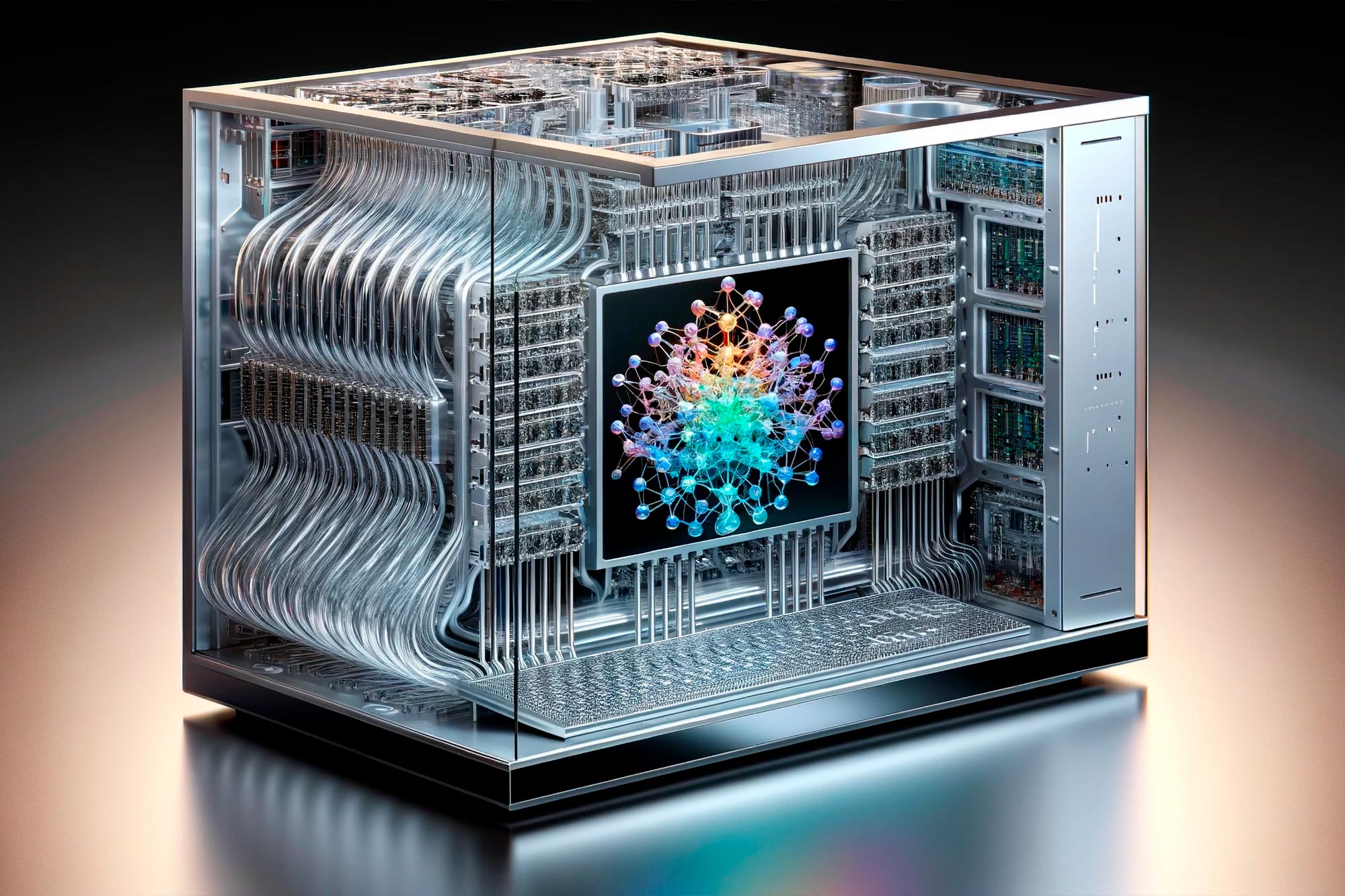
A new study shows how quantum computing can be harnessed to discover new properties of polymer systems central to biology and material science.
The advent of quantum computing is opening previously unimaginable perspectives for solving problems deemed beyond the reach of conventional computers, from cryptography and pharmacology to the physical and chemical properties of molecules and materials. However, the computational capabilities of present-day quantum computers are still relatively limited. A newly published study in Science Advances fosters an unexpected alliance between the methods used in quantum and traditional computing.
The research team, formed by Cristian Micheletti and Francesco Slongo of SISSA in Trieste, Philipp Hauke of the University of Trento, and Pietro Faccioli of the University of Milano-Bicocca, used a mathematical approach called QUBO (from “Quadratic Unconstraint Binary Optimization”) that is ideally suited for specific quantum computers, called “quantum annealers.”
Revolutionizing Polymer Simulation
The study harnessed the QUBO approach to simulate in a radically new way dense polymer mixtures, which are complex physical systems central to biology and material science. The result? A major boost in computational performance was obtained with the quantum computers compared to traditional techniques, thus providing a significant example of the vast potential of these emerging technologies. Remarkably, the QUBO approach proved particularly effective even when adopted on conventional computers, enabling researchers to discover surprising properties of the simulated polymer mixtures.
The implications can be far-reaching given that the approach used in the study is naturally suited to be transferred to many other molecular systems.
A new perspective inspired by quantum computing research
“Simulation techniques known as ‘Monte Carlo’ have long been among the most powerful, elegant, and versatile methods for studying complex systems, such as synthetic polymers or biological ones, such as DNA” explains Cristian Micheletti, who coordinated the study. “However, the efficiency of these methods drops as the system density and size increase. For this reason, studying realistic systems, such as the organization of chromosomes in the cell nucleus, requires huge investments of computational resources.”
Francesco Slongo, SISSA doctoral student and first author of the study, continues: “Quantum computers promise major boosts of computational performance, albeit with the inevitable limitations of novel technologies. And this is where the new simulation strategy comes in, which is ideally suited to today’s pioneering quantum computers, and yet can be successfully transferred even to traditional computers.”
Bridging Quantum and Classical Computing
As Philipp Hauke and Pietro Faccioli note, “Currently, there already exist quantum machines dedicated to solving QUBO, and they can be highly effective. We reformulated conventional polymer models in the QUBO framework to optimally exploit such machines. Surprisingly, the QUBO reformulation also proved advantageous on traditional computers, allowing faster simulation of dense polymers than with established methods. Thanks to this, we established previously unknown properties for these systems, all using standard computers.”
Implications, Challenges, and Future Directions
It has happened before that physical models created to take full advantage of innovative computing technologies have become so successful to be eventually transferred to different areas. The best-known case is that of lattice-based fluid models designed for 1990s supercomputers but now widely used for many other systems and types of computers.
The study in Science Advances provides a further example, demonstrating how methodologies inspired by quantum computing can pave the way for exploring new materials and understanding the workings of molecular systems of biological interest.
Reference: “Quantum-inspired encoding enhances stochastic sampling of soft matter systems” by Francesco Slongo, Philipp Hauke, Pietro Faccioli and Cristian Micheletti, 25 October 2023, Science Advances.
DOI: 10.1126/sciadv.adi0204
The research was supported by NRRP grant CN 00000013 CN-HPC, M4C2I1.4, spoke 7, funded by NextGenerationEU, and ERC starting grant StrEnQTh (project ID 804305). This project was funded by the European Union under the Horizon Europe program — Grant Agreement 101080086 — NeQST. However, the views and opinions expressed are solely those of the author(s) and do not necessarily reflect those of the European Union or the European Commission. Neither the European Union nor the authority that granted the funding can be held responsible.
Never miss a breakthrough: Join the SciTechDaily newsletter.
Follow us on Google and Google News.