
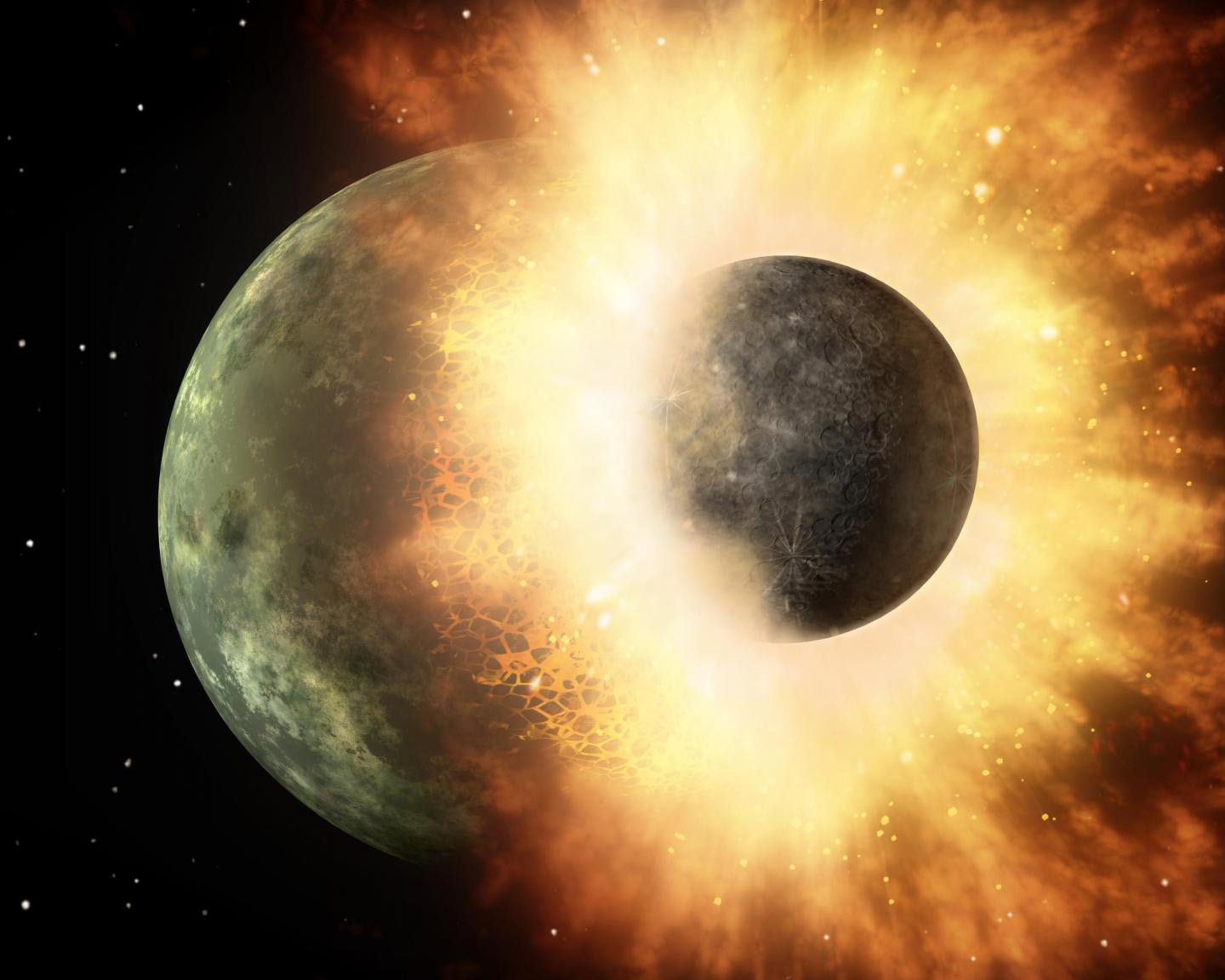
A newly published study brings scientists one step closer to understanding the close familial relationship between Earth and the moon.
College Park, Maryland – Scientists at the University of Maryland are the first to confirm the accepted model of the moon’s formation using the “fingerprints” of the moon and Earth. The results suggest that the violent impact of a large body into Earth made a huge, uniform debris cloud that mixed thoroughly before settling down and forming the moon.
For 30 years, planetary scientists have believed that within the first 150 million years after our solar system was formed, the moon formed when a giant body roughly the size of Mars struck and merged with Earth, blasting a huge cloud of rock and debris into space. Although the scenario made sense when looking at the size of the moon and the physics of its orbit around Earth, things started to break down when the isotopic compositions of the moon and Earth – the geological equivalent of a DNA “fingerprint,” – were compared. Specifically, Earth and the moon were too much alike.
The expectation has long been that the moon should carry the isotopic “fingerprint” of the foreign body which merged with Earth, which scientists named Theia. Because Theia came from elsewhere in the solar system, it probably had a much different isotopic fingerprint than early Earth.
“The problem is that Earth and the moon are very similar with respect to their isotopic fingerprints, suggesting that they are both ultimately formed from the same material that gathered early in the solar system’s history,” said Richard Walker, a professor of geology at UMD and co-author of the study. “This is surprising because the Mars-sized body that created the moon is expected to have been very different. So the conundrum is that Earth and the moon shouldn’t be as similar as they are.”
Now, UMD scientists have generated a new isotopic fingerprint of the moon that provides the missing piece of the puzzle by zeroing in on an isotope of Tungsten present in both the moon and Earth. The results suggest that the impact of Theia into early Earth was so violent, the resulting debris cloud mixed thoroughly before settling down and forming the moon. The findings appear in the April 8, 2015 advance online edition of the journal Nature.
To tease out an explanation, Walker and his team looked to another well-documented phenomenon in the early history of the solar system. Evidence suggests that both Earth and the moon gathered additional material after the main impact, and that Earth collected more of this debris and dust. This new material contained a lot of Tungsten, but relatively little of this was of a lighter isotope known as Tungsten-182. Taking these two observations together, one would expect that Earth would have less Tungsten-182 than the moon.
Sure enough, when comparing rocks from the moon and Earth, Walker and his team found that the moon has a slightly higher proportion of Tungsten-182. The key, however, is how much.
“The small, but significant, difference in the Tungsten isotopic composition between Earth and the moon perfectly corresponds to the different amounts of material gathered by Earth and the moon post-impact,” Walker said. “This means that, right after the moon formed, it had exactly the same isotopic composition as Earth’s mantle.”
This finding supports the idea that the mass of material created by the impact, which later formed the moon, must have mixed together thoroughly before the moon coalesced and cooled. This would explain both the overall similarities in isotopic fingerprints and the slight differences in Tungsten-182.
It also largely rules out the idea that the Mars-sized body was of similar composition, or that the moon formed from material contained in the pre-impact Earth. In both cases, it would be highly unlikely to see such a perfect correlation between Tungsten-182 and the amounts of material gathered by the moon and Earth post-impact.
“This result brings us one step closer to understanding the close familial relationship between Earth and the moon,” Walker said. “We still need to work out the details, but it’s clear that our early solar system was a very violent place.”
In addition to Walker, study authors include UMD geology senior research scientist Igor Puchtel and former UMD geology postdoctoral researcher Mathieu Touboul, now at Ecole Normale Supérieure de Lyon, France.
Reference: “Tungsten isotopic evidence for disproportional late accretion to the Earth and Moon” by Mathieu Touboul, Igor S. Puchtel and Richard J. Walker, 9 April 2015, Nature.
DOI: 10.1038/nature14355
Never miss a breakthrough: Join the SciTechDaily newsletter.
Follow us on Google and Google News.
2 Comments
When we have ruled out all but the Earth, will the explanation be that gases from the core blew out?
I have watched the expanded Earth videos on Utube and just after Antarctica begins to separate the Pacific Basin begin an expansion that is much faster than the planetary expansion. It is like a blister. I believe that the Moon was born from the Earth due to a gas blow out from the core. It is strange that science attributes the Moon to a wandering destroyer instead of a mechanism at work inside our solar system. There is so much evidence that decades old research has revealed. S W Carey’s evidence in the geology of Earth, the asteroid belt of a shattered planet. Yet science continues to add confusion instead of clarity. There is no dark matter, there is infrared.
Even our research into main line stars proposes that red dwarfs are created initially altho no red dwarfs non metalized have been found. Could that be because red dwarfs are created from red giants?
Metallic meteorites exist only in the cores of planets. After these planets reached the solar bodies from the arm of the galaxy and collided with the sun and exploded, the elements in their metallic cores were poured onto the Earth, the moon, and the planets Venus and Mercury. Do scientists still not believe that Earth’s surface metals were in the mines related to the core of the planets of the Milky Way galaxy? I know 100% that hundreds of planets joined the solar bodies from the Milky Way and several percent of them collided with the Sun. Of course, those planets that escaped from the orbit of gaseous planets collided with the Sun, but most people who are not intelligent and intelligent do not confirm this. I must tell them, then who created the continents, islands, and seas in the form of humans, birds, and quadrupeds that were hunted by humans