
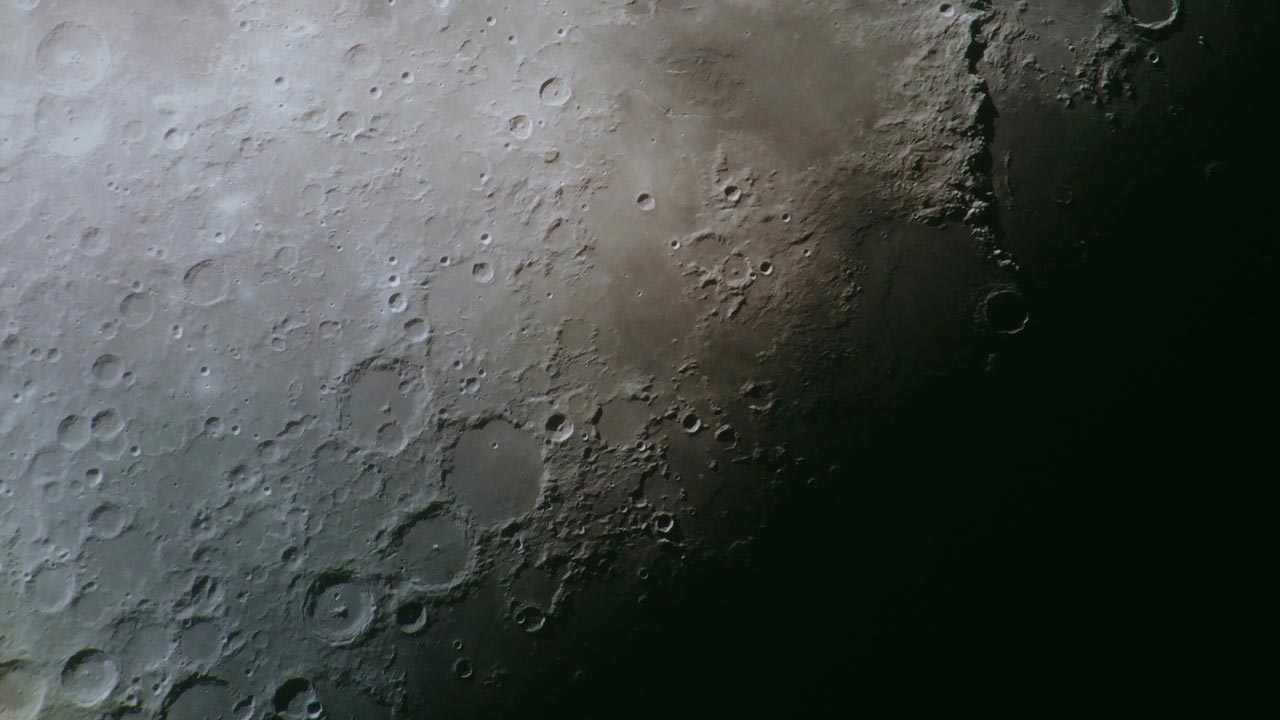
Scientists Find Earth and Moon Not Identical Oxygen Twins
Scientists at The University of New Mexico (UNM) have found that the Earth and Moon have distinct oxygen compositions and are not identical in oxygen as previously thought according to a new study published on March 9, 2020, in the journal Nature Geoscience.
Entitled “Distinct oxygen isotope compositions of the Earth and Moon,” the research paper may challenge the current understanding of the formation of the Moon.
Previous research led to scientists to develop the Giant Impact Hypothesis suggesting the Moon was formed from debris following a giant collision between early-Earth and a proto-planet named Theia. The Earth and Moon are geochemically similar. Samples returned from the Moon from the Apollo missions showed a near-identical composition in oxygen isotopes.
Although the Giant Impact Hypothesis can nicely explain many of the geochemical similarities between Earth and the Moon, the extreme similarity in oxygen isotopes has been difficult to rationalize with this scenario: either the two bodies were compositionally identical in oxygen isotopes to start with, which is unlikely, or their oxygen isotopes were fully mixed in the aftermath of the impact, which has been difficult to model in simulations.
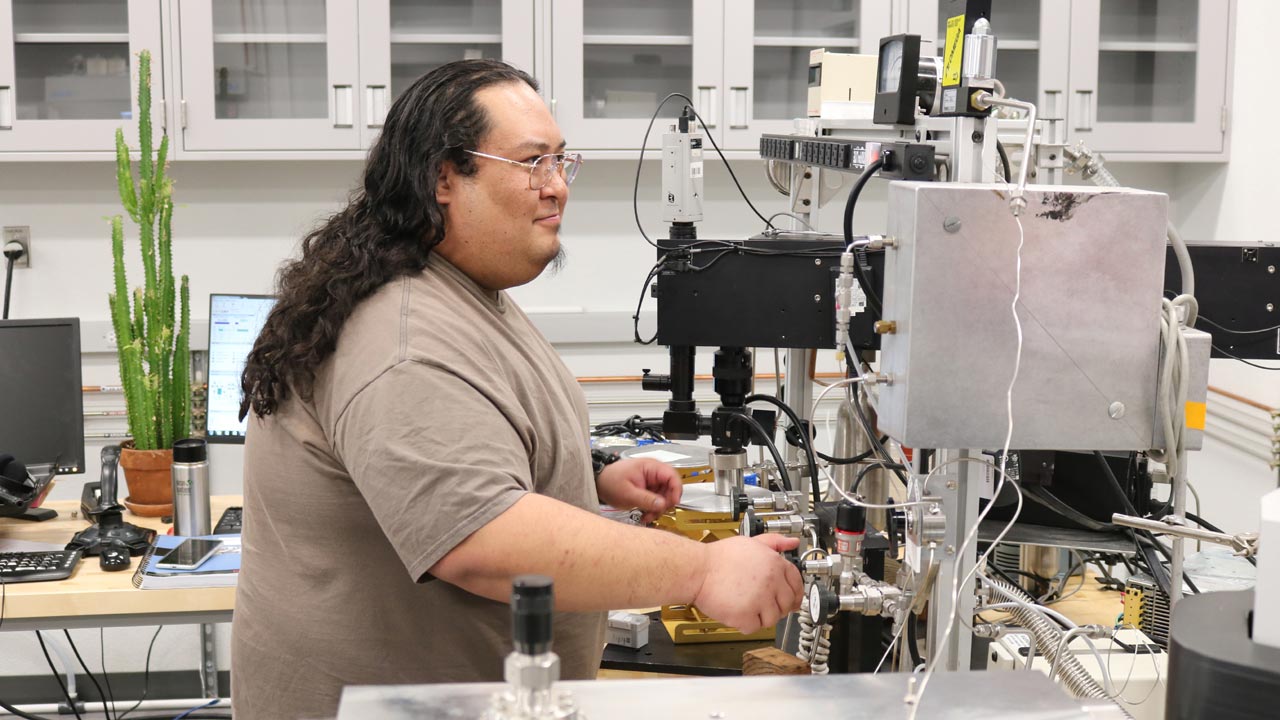
“Our findings suggest that the deep lunar mantle may have experienced the least mixing and is most representative of the impactor Theia,” said Erick Cano. “The data imply the distinct oxygen isotope compositions of Theia and Earth were not completely homogenized by the Moon-forming impact and provides quantitative evidence that Theia could have formed farther from the Sun than did Earth.”
To arrive at their findings, Cano, a research scientist, and along with colleagues Zach Sharp and Charles Shearer from UNM’s Department of Earth and Planetary Sciences, conducted high-precision measurements of the oxygen isotopic composition on a range of lunar samples at UNM’s Center for Stable Isotopes (CSI). The samples included basalts, highland anorthosites, norites, and volcanic glass, a product of uncrystallized rapidly cooled magma.
They found that the oxygen isotopic composition varied depending on the type of rock tested. This may be due to the degree of mixing between the molten Moon and vapor atmosphere following the impact. Oxygen isotopes from samples taken from the deep lunar mantle were the most different to oxygen isotopes from Earth
“This data suggests that the deep lunar mantle may have experienced the least mixing and is most representative of the impactor Theia,” said Sharp. “Based on the results from our isotopic analysis, Theia would have an origin farther out from the Sun relative to Earth and shows that Theia’s distinct oxygen isotope composition was not completely lost through homogenization during the giant impact.”
The research is important because it eliminates the need for giant-impact models that include a complete oxygen isotope homogenization between the Earth and the Moon, and provides a foundation for future modeling of the impact and lunar formation.
Reference: “Distinct oxygen isotope compositions of the Earth and Moon” by Erick J. Cano, Zachary D. Sharp and Charles K. Shearer, 9 March 2020, Nature Geoscience.
DOI: 10.1038/s41561-020-0550-0
Never miss a breakthrough: Join the SciTechDaily newsletter.
Follow us on Google and Google News.
5 Comments
The same atmosphere of the formations performed in endlessness does not mean that the Earth and Moon have the same initial point of creation, and the different atmosphere of the formations performed in endlessness does not mean that the Earth and Moon have not the same initial point.
The formations are performed independently apart from each other throughout the endlessness in the same moment and in the same way in cooperation with each other moment after moment in battle for life. The formations are performed integrating by joining of infinite others and disintegrating performed by them infinite others etc.,etc. The atmosphere as part of the formations is performed quite independently on each other and continue in the same way in cooperation changing each other. The difference or the same atmosphere does not show for the Earth and Moon to have been separated by each other. The attempt in this direction is spending time in vain.
This is not spending time in vain, since the great impact hypothesis uniquely explains the momentum of the Earth-Moon system, as well as – obviously – the nearly same but not identical elements and isotopes of elements of which some are described in the article.
On the contrary, people have in vain tried competing models, but they don’t look as good.
the idea that an impact was required to make the moon is simply wrong.
The earth is a bubble, and so is the moon. All it takes to calve the moon away is to have a large body pass close to the earth. The resultant gravity well interactions do the rest, resulting in a phase locked moon with lots of impacts on the far side, and an asteroid belt.
Planets are hollow. Formed through self-stable vorticies.
Such an idea would not explain the angular momentum of even Earth or better yet the Earth-Moon system orbital momentum as the great impact (of non-hollow bodies) explain. And it would not, say, explain the mixing of grains with different oxygen isotope ratios seen as described in the article.
This opening up of the parameter space for the Moon forming impactor is interesting in the context of the proposed ages of Earth and Mars.
Earth may have formed quickly by pebble showers at a system age of ~ 5 Myrs [ https://www.space.com/meteorite-iron-shows-earth-formed-fast.html ].
But Mars growth was cut off at ~ 10 Myrs age by the gas giant migration [ https://www.space.com/early-mars-formed-slow-ancient-collisions-show.html , https://www.sciencemag.org/news/2020/01/cataclysmic-bashing-giant-planets-occurred-early-our-solar-systems-history ].
The new result would not immediately tell us the mass of the impactor, but its late arrival at ~50 Myrs system age may be caused by migration from far out instead of being Mars massed and related to Mars growth zone. C.f. Triton captured by Neptune, or Ceres captured by the asteroid belt.