
Close Menu
    Facebook X (Twitter) Instagram
    SciTechDaily
    • Biology
    • Chemistry
    • Earth
    • Health
    • Physics
    • Science
    • Space
    • Technology
    Facebook X (Twitter) Pinterest YouTube RSS
    SciTechDaily
    Home»Space»New HiRISE Image of a “Fresh” Crater Near Sirenum Fossae
    Space

    New HiRISE Image of a “Fresh” Crater Near Sirenum Fossae

    By Alfred McEwen; NASAJune 5, 2015No Comments2 Mins Read
    Facebook Twitter Pinterest Telegram LinkedIn WhatsApp Email Reddit
    Share
    Facebook Twitter LinkedIn Pinterest Telegram Email Reddit
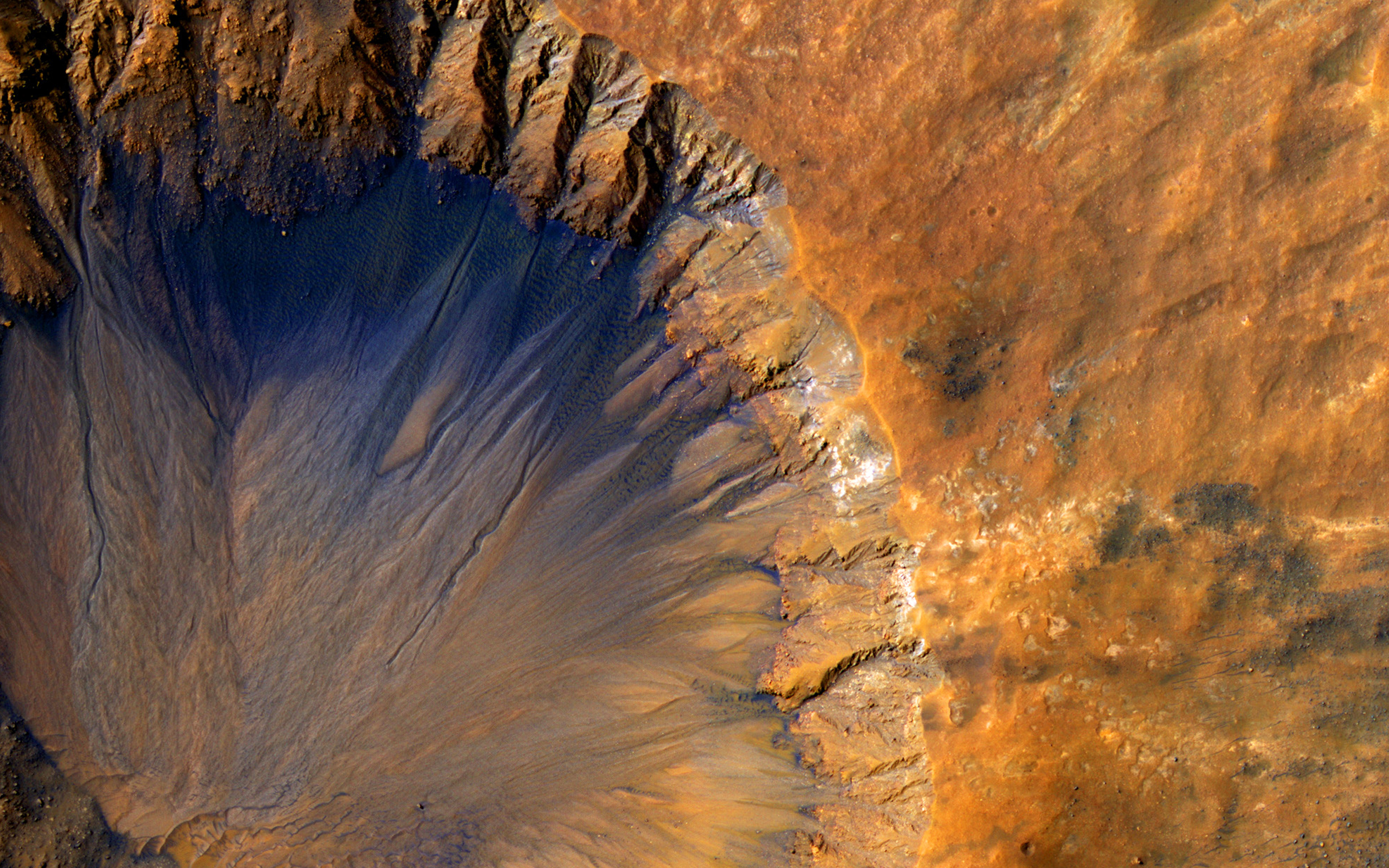
    Fresh Crater Near Sirenum Fossae Region of Mars
    The High Resolution Imaging Science Experiment (HiRISE) camera aboard NASA’s Mars Reconnaissance Orbiter acquired this closeup image of a “fresh” (on a geological scale, though quite old on a human scale) impact crater in the Sirenum Fossae region of Mars on March 30, 2015. Credit: NASA/JPL/University of Arizona

    This new image from NASA’s Mars Reconnaissance Orbiter shows a 1-kilometer-wide impact crater in the Sirenum Fossae region of Mars.

    The High Resolution Imaging Science Experiment (HiRISE) camera aboard NASA’s Mars Reconnaissance Orbiter acquired this closeup image of a “fresh” (on a geological scale, though quite old on a human scale) impact crater in the Sirenum Fossae region of Mars on March 30, 2015.

    This impact crater appears relatively recent as it has a sharp rim and well-preserved ejecta. The steep inner slopes are carved by gullies and include possible recurring slope lineae on the equator-facing slopes. Fresh craters often have steep, active slopes, so the HiRISE team is monitoring this crater for changes over time. The bedrock lithology is also diverse. The crater is a little more than 1 kilometer wide (0.6 mile wide).

    Note: When we say “fresh,” we mean on a geological scale. The crater is quite old on a human scale.

    The University of Arizona, Tucson, operates HiRISE, which was built by Ball Aerospace & Technologies Corp., Boulder, Colorado. NASA’s Jet Propulsion Laboratory (JPL), a division of the California Institute of Technology in Pasadena, manages the Mars Reconnaissance Orbiter Project and Mars Science Laboratory Project for NASA’s Science Mission Directorate, Washington.

    Never miss a breakthrough: Join the SciTechDaily newsletter.
    Follow us on Google and Google News.

    Astronomy HiRISE Mars Mars Reconnaissance Orbiter Planetary Science
    Share. Facebook Twitter Pinterest LinkedIn Email Reddit

    Related Articles

    HiRISE Views Snowy Dunes on Mars

    HiRISE Views Secondary Craters in Bas Relief

    New HiRISE Image Views a Hill in the South Polar Region of Mars

    Astronomers Show Similar-Looking Ridges on Mars Have Diverse Origins

    Mars Orbiter Shows Gullies on Mars Not Likely Formed by Liquid Water

    Mars Reconnaissance Orbiter Reveals Frosted Dunes on Mars

    Orbiter Examines Clues to Possible Water Flows on Mars

    Color HiRISE Image of Curiosity Rover on Mars

    A Connection Between Volatiles in the Subsurface of Mars and the Impact Process

    Leave A Reply Cancel Reply

    • Facebook
    • Twitter
    • Pinterest
    • YouTube

    Don't Miss a Discovery

    Subscribe for the Latest in Science & Tech!

    Trending News

    JWST Finds a “Star” 100 Billion Times Brighter Than Any Star Should Be

    Scientists Find a Hidden Biological Link Across Different Forms of Autism

    Astronomers Discover a Ghostly River of Stars That Could Reveal Dark Matter

    Why Is Colorectal Cancer Rising in People Under 50? New Clues Point to the Environment

    Quantum Fluctuations Break a Crystal’s Symmetry Rules

    Why Does an Irregular Heartbeat Strike 40 Years Early in Some People?

    Scientists Reveal How ADHD Could Fuel Creative Thinking

    Scientists Find Just 3 Minutes of Sprinting Can Transform Blood Chemistry

    Follow SciTechDaily
    • Facebook
    • Twitter
    • YouTube
    • Pinterest
    • Newsletter
    • RSS
    SciTech News
    • Biology News
    • Chemistry News
    • Earth News
    • Health News
    • Physics News
    • Science News
    • Space News
    • Technology News
    Recent Posts
    • Scientists Turn Red Strawberries White With a Single Gene Edit
    • NASA’s Artemis II Crew Flew Farther Than Any Humans Ever. Now They’re Being Honored
    • The Sun’s Corona Usually Looks White. In Spain, It Turned Gold
    • A SpaceX Falcon 9 Rocket Hit the Moon and Blasted Open a 60-Foot Crater
    • Does Vitamin C Really Prevent Colds? The Answer May Surprise You
    Copyright © 1998 - 2026 SciTechDaily. All Rights Reserved.
    • Science News
    • About
    • Contact
    • Editorial Board
    • Privacy Policy
    • Terms of Use

    Type above and press Enter to search. Press Esc to cancel.