
Close Menu
    Facebook X (Twitter) Instagram
    SciTechDaily
    • Biology
    • Chemistry
    • Earth
    • Health
    • Physics
    • Science
    • Space
    • Technology
    Facebook X (Twitter) Pinterest YouTube RSS
    SciTechDaily
    Home»Space»HiRISE Views Snowy Dunes on Mars
    Space

    HiRISE Views Snowy Dunes on Mars

    By NASAAugust 24, 2017No Comments2 Mins Read
    Facebook Twitter Pinterest Telegram LinkedIn WhatsApp Email Reddit
    Share
    Facebook Twitter LinkedIn Pinterest Telegram Email Reddit
    HiRISE Views a World of Snowy Dunes on Mars
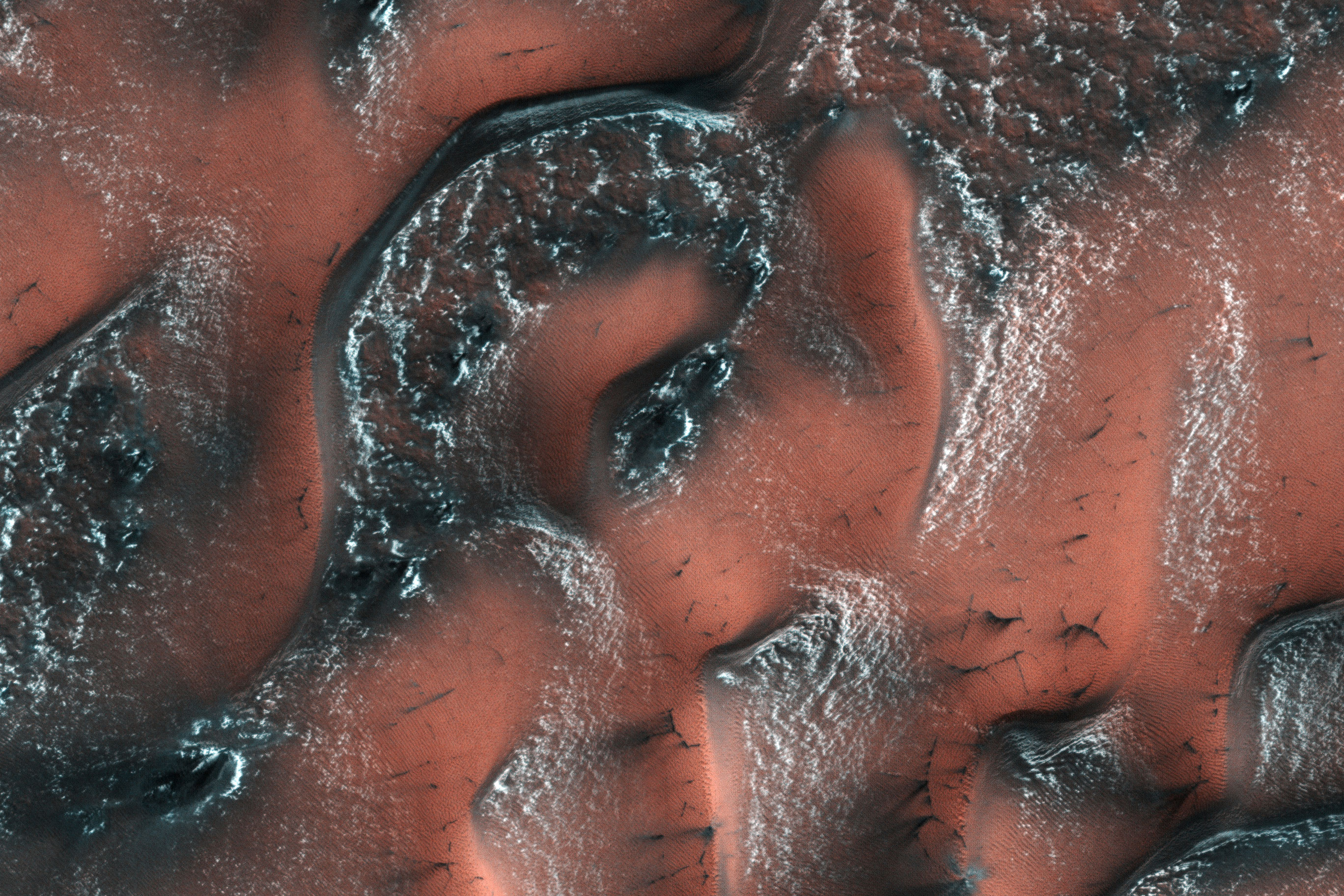
    HiRISE image of snowy dunes on the surface of Mars taken during spring in the Northern hemisphere on May 21, 2017, at 13:21 local Mars time. Over the winter, snow and ice have inexorably covered the dunes. Unlike on Earth, this snow and ice is carbon dioxide, better known to us as dry ice. Credit: NASA/JPL/University of Arizona

    This newly released HiRISE image shows snowy dunes on the surface of Mars.

    It was spring in the Northern hemisphere when this image was taken on May 21, 2017, at 13:21 local Mars time, by the High Resolution Imaging Science Experiment (HiRISE) camera on NASA’s Mars Reconnaissance Orbiter. Over the winter, snow and ice have inexorably covered the dunes. Unlike on Earth, this snow and ice is carbon dioxide, better known to us as dry ice.

    When the sun starts shining on it in the spring, the ice on the smooth surface of the dune cracks, and escaping gas carries dark sand out from the dune below, often creating beautiful patterns. On the rough surface between the dunes, frost is trapped behind small sheltered ridges.

    NASA’s Jet Propulsion Laboratory (JPL), a division of the California Institute of Technology in Pasadena, California, manages the Mars Reconnaissance Orbiter for NASA’s Science Mission Directorate, Washington. The HiRISE camera was built by Ball Aerospace and Technology Corporation and is operated by the University of Arizona.

    Never miss a breakthrough: Join the SciTechDaily newsletter.
    Follow us on Google and Google News.

    Astronomy HiRISE Mars Mars Reconnaissance Orbiter Planetary Science
    Share. Facebook Twitter Pinterest LinkedIn Email Reddit

    Related Articles

    HiRISE Views Secondary Craters in Bas Relief

    New HiRISE Image Views a Hill in the South Polar Region of Mars

    Astronomers Show Similar-Looking Ridges on Mars Have Diverse Origins

    Mars Orbiter Shows Gullies on Mars Not Likely Formed by Liquid Water

    Mars Reconnaissance Orbiter Reveals Frosted Dunes on Mars

    New HiRISE Image of a “Fresh” Crater Near Sirenum Fossae

    Orbiter Examines Clues to Possible Water Flows on Mars

    Color HiRISE Image of Curiosity Rover on Mars

    A Connection Between Volatiles in the Subsurface of Mars and the Impact Process

    Leave A Reply Cancel Reply

    • Facebook
    • Twitter
    • Pinterest
    • YouTube

    Don't Miss a Discovery

    Subscribe for the Latest in Science & Tech!

    Trending News

    Ancient Tomb Reveals That People Were Getting High on Cannabis 2,800 Years Ago

    Scientists Discover New Form of Prostate Cancer

    Mars May Not Be Dead After All, New Discovery Suggests

    A Tiny Region Deep Inside Your Brain Helps Decide What You Remember

    Scientists Develop a Groundbreaking Rechargeable Battery That Runs on Vitamin B12

    Scientists Discover a Hidden Immune System Difference That Could Explain Why Obesity Affects Men and Women Differently

    More Than a Billion Years of Earth’s History Is Missing – Scientists May Finally Know Why

    Popular Weight-Loss Drugs May Have a Surprising Effect on Your Brain

    Follow SciTechDaily
    • Facebook
    • Twitter
    • YouTube
    • Pinterest
    • Newsletter
    • RSS
    SciTech News
    • Biology News
    • Chemistry News
    • Earth News
    • Health News
    • Physics News
    • Science News
    • Space News
    • Technology News
    Recent Posts
    • Chemists Weave Molecules Into a Powerful New Material That Traps Toxic Chemicals
    • Scientists Unlock a New Way To Photograph Events That Vanish in Trillionths of a Second
    • A 120-Year-Old Gap in Einstein’s Physics May Hold the Key to the Universe’s Earliest Matter
    • Scientists Discover That Immune Cells May Be Secretly Helping Pancreatic Cancer Hide
    • Why Do We Feel Colder As We Get Older? New Study Uncovers a Hidden Mechanism
    Copyright © 1998 - 2026 SciTechDaily. All Rights Reserved.
    • Science News
    • About
    • Contact
    • Editorial Board
    • Privacy Policy
    • Terms of Use

    Type above and press Enter to search. Press Esc to cancel.