
Close Menu
    Facebook X (Twitter) Instagram
    SciTechDaily
    • Biology
    • Chemistry
    • Earth
    • Health
    • Physics
    • Science
    • Space
    • Technology
    Facebook X (Twitter) Pinterest YouTube RSS
    SciTechDaily
    Home»Space»NASA Explores a Winter Wonderland on Mars – Otherworldly Holiday Scene With Cube-Shaped Snow
    Space

    NASA Explores a Winter Wonderland on Mars – Otherworldly Holiday Scene With Cube-Shaped Snow

    By Jet Propulsion LaboratoryDecember 24, 20224 Comments5 Mins Read
    Facebook Twitter Pinterest Telegram LinkedIn WhatsApp Email Reddit
    Share
    Facebook Twitter LinkedIn Pinterest Telegram Email Reddit

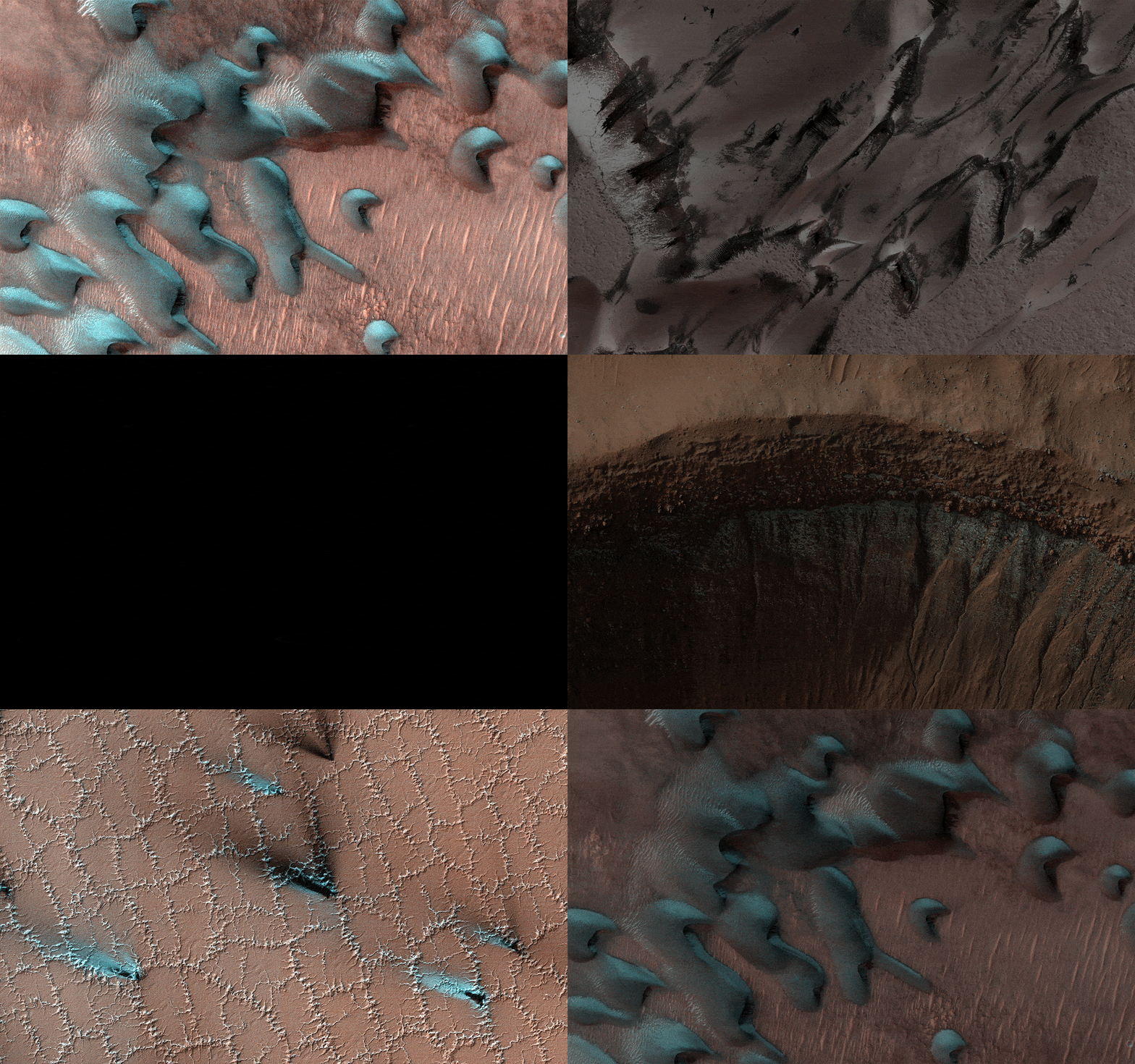
    Winter Wonderland on Mars

    Cube-shaped snow, icy landscapes, and frost are all part of the Red Planet’s coldest season.

    When winter comes to Mars, the surface is transformed into a truly otherworldly holiday scene. Snow, ice, and frost accompany the season’s sub-zero temperatures. Some of the coldest of these occur at the planet’s poles, where it gets as low as minus 190 degrees Fahrenheit (minus 123 degrees Celsius).
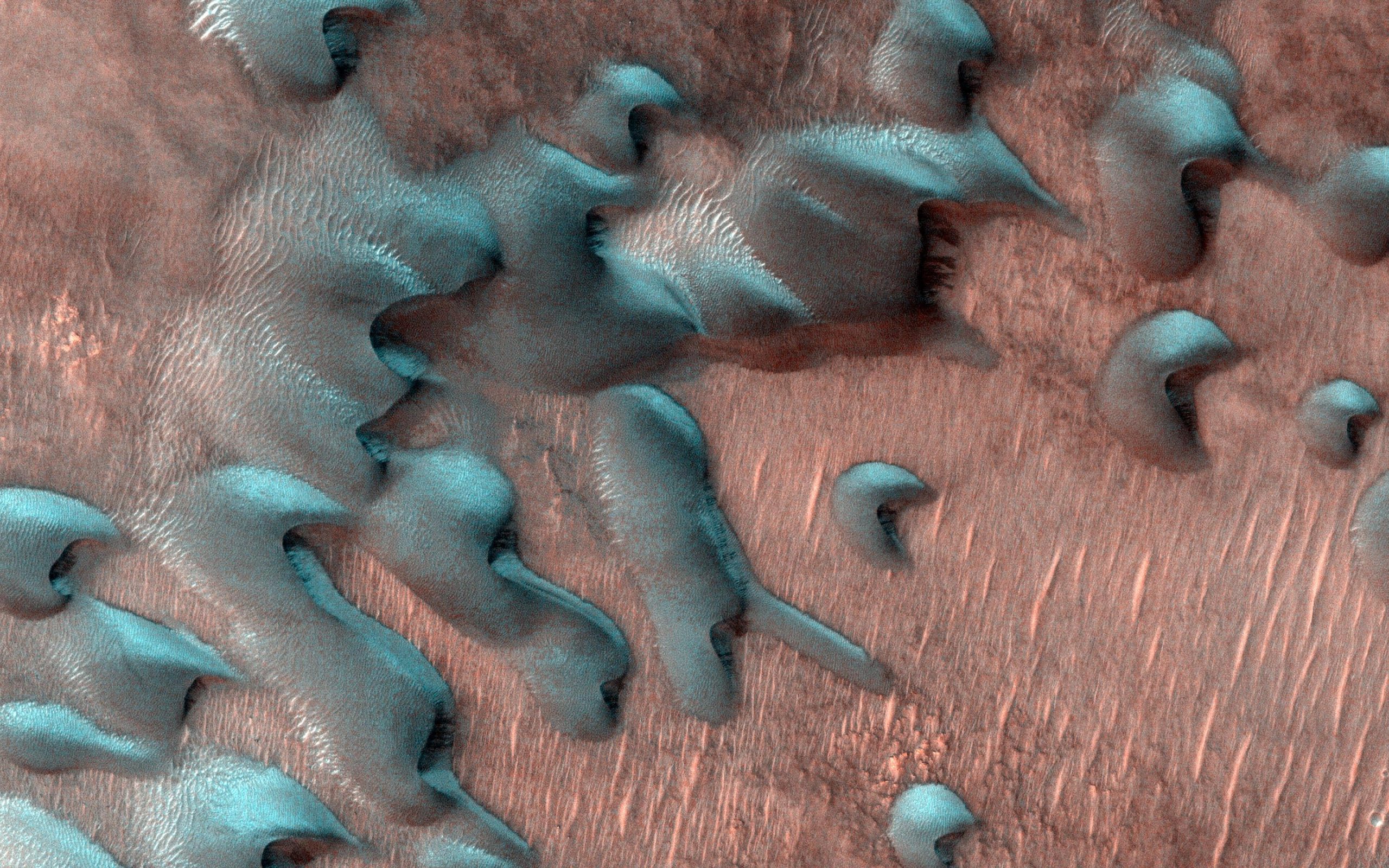
    Frosted Dunes in the Depths of Winter on Mars
    The HiRISE camera aboard NASA’s Mars Reconnaissance Orbiter captured these images of sand dunes covered by frost just after winter solstice. The frost here is a mixture of carbon dioxide (dry) ice and water ice and will disappear in a few months when spring arrives. Credit: NASA/JPL-Caltech/University of Arizona

    Cold as it is, don’t expect snow drifts worthy of the Rocky Mountains. No region of Mars gets more than a few feet of snow, most of which falls over extremely flat areas. And the Red Planet’s elliptical orbit means it takes many more months for winter to come around: a single Mars year is around two Earth years.


    Snow falls and ice and frost form on Mars, too. NASA’s spacecraft on and orbiting the Red Planet reveal the similarities to and differences from how we experience winter on Earth. Mars scientist Sylvain Piqueux of JPL explains in this video. Credit: NASA/JPL-Caltech

    Still, the planet offers unique winter phenomena that scientists have been able to study, thanks to NASA’s robotic Mars explorers. Here are a few of the things they’ve discovered:

    Two Kinds of Snow

    Martian snow comes in two varieties: water ice and carbon dioxide, or dry ice. Because Martian air is so thin and the temperatures so cold, water-ice snow sublimates, or becomes a gas, before it even touches the ground. Dry-ice snow actually does reach the ground.

    “Enough falls that you could snowshoe across it,” said Sylvain Piqueux, a Mars scientist at NASA’s Jet Propulsion Laboratory in Southern California whose research includes a variety of winter phenomena. “If you were looking for skiing, though, you’d have to go into a crater or cliffside, where snow could build up on a sloped surface.”
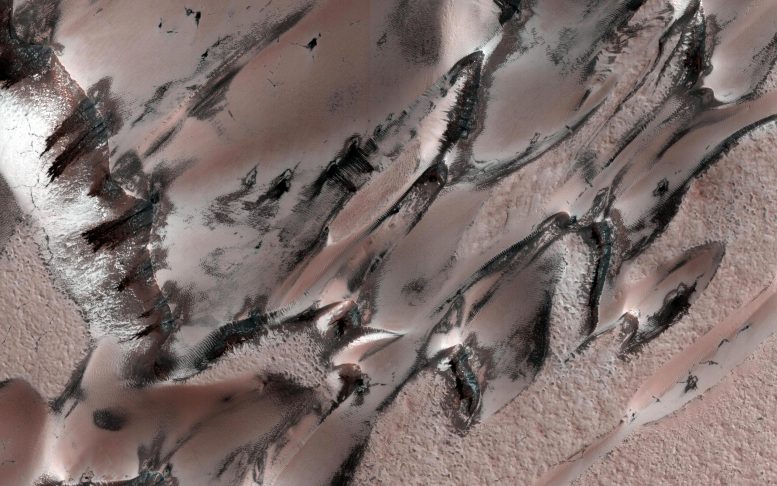
    Seasonal Changes of Polar Megadunes on Mars
    HiRISE captured these “megadunes,” also called barchans. Carbon dioxide frost and ice have formed over the dunes during the winter; as this starts to sublimate during spring, the darker-colored dune sand is revealed. Credit: NASA/JPL-Caltech/University of Arizona

    How We Know It Snows

    Snow occurs only at the coldest extremes of Mars: at the poles, under cloud cover, and at night. Cameras on orbiting spacecraft can’t see through those clouds, and surface missions can’t survive in the extreme cold. As a result, no images of falling snow have ever been captured. But scientists know it happens, thanks to a few special science instruments.

    NASA’s Mars Reconnaissance Orbiter can peer through cloud cover using its Mars Climate Sounder instrument, which detects light in wavelengths imperceptible to the human eye. That ability has allowed scientists to detect carbon dioxide snow falling to the ground. And in 2008, NASA sent the Phoenix lander within 1,000 miles (about 1,600 kilometers) of Mars’ north pole, where it used a laser instrument to detect water-ice snow falling to the surface.


    NASA scientists can measure the size and shape distribution of snow particles, layer by layer, in a storm. The Global Precipitation Measurement mission is an international satellite project that provides next-generation observations of rain and snow worldwide every three hours. Credit: NASA’s Goddard Space Flight Center/Ryan Fitzgibbons

    Cubic Snowflakes

    Because of how water molecules bond together when they freeze, snowflakes on Earth have six sides. The same principle applies to all crystals: The way in which atoms arrange themselves determines a crystal’s shape. In the case of carbon dioxide, molecules in dry ice always bond in forms of four when frozen.

    “Because carbon dioxide ice has a symmetry of four, we know dry-ice snowflakes would be cube-shaped,” Piqueux said. “Thanks to the Mars Climate Sounder, we can tell these snowflakes would be smaller than the width of a human hair.”
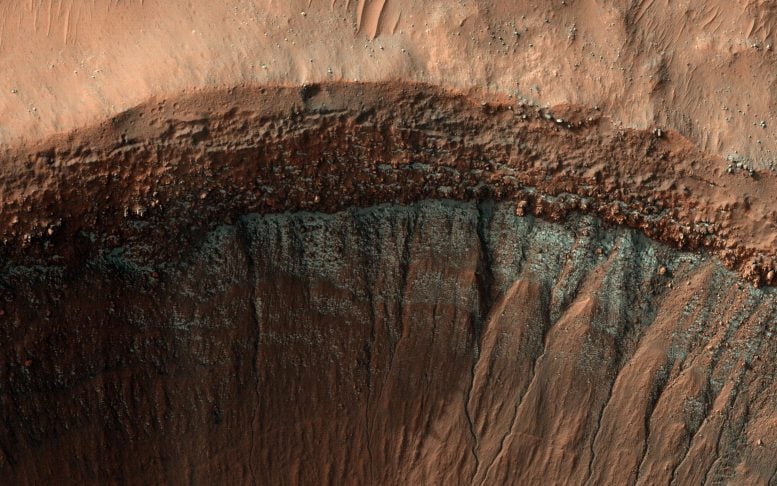
    Mars Cool as Ice
    The HiRISE camera captured this image of the edge of a crater in the middle of winter. The south-facing slope of the crater, which receives less sunlight, has formed patchy, bright frost, seen in blue in this enhanced-color image. Credit: NASA/JPL-Caltech/University of Arizona

    Jack Frost Nipping at Your Rover

    Water and carbon dioxide can each form frost on Mars, and both types of frost appear far more widely across the planet than snow does. The Viking landers saw water frost when they studied Mars in the 1970s, while NASA’s Odyssey orbiter has observed frost forming and sublimating away in the morning Sun.
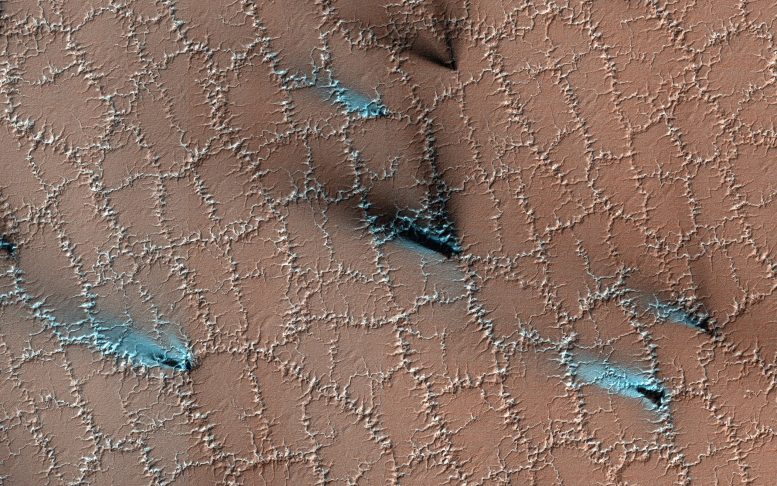
    Mars Spring Fans and Polygons
    HiRISE captured this spring scene, when water ice frozen in the soil had split the ground into polygons. Translucent carbon dioxide ice allows sunlight to shine through and heat gases that escape through vents, releasing fans of darker material onto the surface (shown as blue in this enhanced-color image). Credit: NASA/JPL-Caltech/University of Arizona

    Winter’s Wondrous End

    Perhaps the most fabulous discovery comes at the end of winter, when all the ice that built up begins to “thaw” and sublimate into the atmosphere. As it does so, this ice takes on bizarre and beautiful shapes that have reminded scientists of spiders, Dalmatian spots, fried eggs, and Swiss cheese.

    This “thawing” also causes geysers to erupt: Translucent ice allows sunlight to heat up gas underneath it, and that gas eventually bursts out, sending fans of dust onto the surface. Scientists have actually begun to study these fans as a way to learn more about which way Martian winds are blowing.

    Never miss a breakthrough: Join the SciTechDaily newsletter.
    Follow us on Google and Google News.

    JPL Mars NASA Planets Popular
    Share. Facebook Twitter Pinterest LinkedIn Email Reddit

    Related Articles

    Welcome to Mars! Caltech’s Jaw-Dropping, 5.7 Terapixel Virtual Expedition Across the Red Planet

    NASA’s Curiosity Rover Views First Dazzling “Sun Rays” on Mars

    NASA’s Curiosity Rover Discovers Surprise Clues to Ancient Water on Mars

    Tantalizing Science and Dangerous Hazards: NASA’s Curiosity Mars Rover Reaches Long-Awaited Salty Region

    NASA Mars Reconnaissance Orbiter Releasing Spectacular 5.6-Gigapixel Map of the Red Planet

    Martian Dust Devils: NASA’s Perseverance Studies the Wild Winds of Jezero Crater

    NASA’s Curiosity Rover Spots a “Doorway” on Mars

    Solving the Baffling Mysteries of Invisible Frost and Dust Avalanches on Mars

    NASA’s InSight Records Monster Quake on Mars – The Largest Ever Detected on Another Planet

    4 Comments

    1. Rik on December 24, 2022 3:31 pm

      Clothed female naked male

      Reply
      • grom on December 24, 2022 8:58 pm

        What do you mean Rik?

        Reply
        • Vik on December 25, 2022 3:39 am

          CFNM and the flip side, CMNF are porn fetishes of the “humiliation” genre. Methinks original comment was either made in error or to get a rise out of people,

          Reply
    2. Zik on December 25, 2022 6:33 pm

      Merry Christmas! 🎄

      Reply
    Leave A Reply Cancel Reply

    • Facebook
    • Twitter
    • Pinterest
    • YouTube

    Don't Miss a Discovery

    Subscribe for the Latest in Science & Tech!

    Trending News

    289-Million-Year-Old Reptile Mummy Reveals Origin of Human Breathing System

    New Brain Discovery Challenges Long-Held Theory of Teenage Brain Development

    Scientists Discover Plants “Scream” – We Just Couldn’t Hear Them Until Now

    Scientists Discover a Surprising Reason Intermittent Fasting Extends Life

    This Simple Fruit Wash Could Make Produce Safer and Last Days Longer

    Scientists Say Adding This Unusual Seafood to Your Diet Could Reverse Signs of Aging

    Scientists Say a Hidden Structure May Exist Inside Earth’s Core

    Doctors Surprised by the Power of a Simple Drug Against Colon Cancer

    Follow SciTechDaily
    • Facebook
    • Twitter
    • YouTube
    • Pinterest
    • Newsletter
    • RSS
    SciTech News
    • Biology News
    • Chemistry News
    • Earth News
    • Health News
    • Physics News
    • Science News
    • Space News
    • Technology News
    Recent Posts
    • Scientists Propose Radical New Way To Detect Alien Life – Without Traditional Biosignatures
    • Scientists Just Discovered Light Can Actually Slow Plant Growth
    • Scientists Finally Solved One of Water’s Biggest Mysteries
    • 7,000-Year-Old DNA Rewrites the Story of the “Neolithic Revolution”
    • Missing Medieval Relic of Legendary English King Found After Being Missing for 40 Years
    Copyright © 1998 - 2026 SciTechDaily. All Rights Reserved.
    • Science News
    • About
    • Contact
    • Editorial Board
    • Privacy Policy
    • Terms of Use

    Type above and press Enter to search. Press Esc to cancel.