

Scientists have discovered that the dark slope streaks observed on Mars, previously thought to be caused solely by dry dust avalanches, are also driven by carbon dioxide frost.
For decades, scientists have been observing dark landslides on Mars called slope streaks. First seen by the Viking orbiters in the 1970s, every orbiter mission since has observed them, but the mechanism behind the slope streaks has been hotly debated: could they be caused by water activity on the Red Planet, or are they the result of some form of dry mechanics?
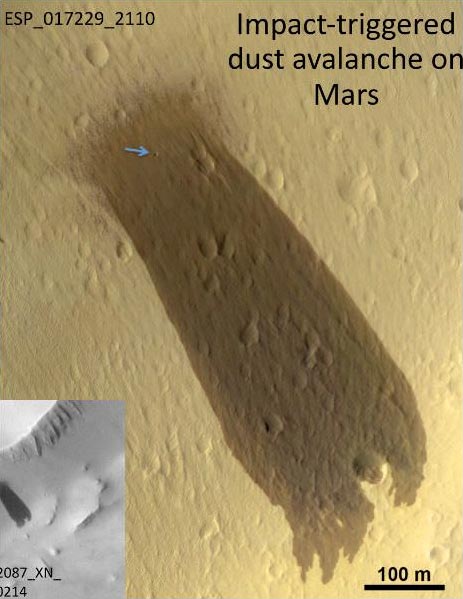
It turns out, that the leading candidate is “dry.” But scientists with the Mars Odyssey mission have verified an additional culprit behind the slope streaks: carbon dioxide frost.
Slope streaks usually appear on the walls of craters or the sides of hills or mountains. Previous studies have determined that the Martian dust and rocks on a slope can be dislodged by something as small as a passing dust devil, or even an impact event in just the right place. These events cause dry dust avalanches on Mars.
Other studies hinted that the sublimation of carbon dioxide frost can dislodge rocks, causing an avalanche, but now images and data from the Odyssey spacecraft have found definitive proof.
Odyssey has been in orbit since 2001, making it the longest-running Mars mission. The spacecraft’s current orbit provides a unique look at the planet at 7 a.m. local Mars time, which – like on Earth – is the perfect time to observe frost activity.
Morning Frost Activity on Mars
Last year, scientists were surprised to see ghostly blue and white colored frost illuminated by the rising Sun in images taken by the visible light camera on board Odyssey. But Odyssey also carries the Thermal Emission Imaging System (THEMIS), and this heat-sensitive camera showed that the frost appeared more widely, including in areas where none was seen by the visible light camera.

“Odyssey’s morning orbit produces spectacular pictures,” said Sylvain Piqueux of NASA’s Jet Propulsion Laboratory in Southern California, who led the paper. “We can see the long shadows of sunrise as they stretch across the surface.”
Sublimation of CO2 Frost: A Key Driver of Slope Streaks
NASA says that because Mars has so little atmosphere (just 1% the density of Earth’s), the Sun quickly warms frost that builds up overnight. Instead of melting, dry ice vaporizes into the atmosphere within minutes.
Lucas Lange, an intern at the Jet Propulsion Laboratory working with Piqueux, first noticed the cold-temperature signature from THEMIS of frost in many places where it couldn’t be seen on the surface. These temperatures were appearing just tens of microns underground – less than the width of a human hair “below” the surface.

“Our first thought was ice could be buried there,” Lange said in a press release. “Dry ice is plentiful near Mars’ poles, but we were looking closer to the equator of the planet, where it’s generally too warm for dry ice frost to form.”
In those same areas, slope streaks or even larger landslides were observed. The team explains in their paper:
“At sunrise, sublimation-driven winds within the regolith are occasionally strong enough to displace individual dust grains, initiating and sustaining dust avalanches on steep slopes, forming ground features known as slope streaks. This model suggests that the CO2 frost cycle is an active geomorphological agent at all latitudes and not just at high or polar latitudes, and possibly a key factor maintaining mobile dust reservoirs at the surface.”
Dirty Frost: A Key Factor in Slope Streaks
The authors said they were seeing what they called “dirty frost” – dry ice frost mixed with fine grains of dust that obscured it in visible light but not in infrared images. They suspect dirty frost might also explain some of the dark streaks that can stretch 3,300 feet (1,000 meters) or more down Martian slopes. They knew the streaks resulted from, essentially, dust avalanches that slowly reshape mountainsides across the planet, which show up in orbital images.
What if you were there to witness such an avalanche taking place? The scientists said they think these dust avalanches probably look something like a ground-hugging river of dust releasing a trail of fluffy material behind. As the dust travels downhill over several hours, it exposes streaks of darker material underneath.
“Every time we send a mission to Mars, we discover exotic new processes,” said Chris Edwards, a paper co-author at Northern Arizona University in Flagstaff. “We don’t have anything exactly like a slope streak on Earth. You have to think beyond your experiences on Earth to understand Mars.”
Adapted from an article originally published on Universe Today.
For more on this research, see Solving the Mysteries of Invisible Frost and Dust Avalanches on Mars.
Reference: “Gardening of the Martian Regolith by Diurnal CO2 Frost and the Formation of Slope Streaks” by L. Lange, S. Piqueux, C. S. Edwards, 27 March 2022, Journal of Geophysical Research: Planets.
DOI: 10.1029/2021JE006988
Never miss a breakthrough: Join the SciTechDaily newsletter.
Follow us on Google and Google News.
7 Comments
I’ve imagined the surface of Mars to be a mix of freeze dried coffee and and old freezer frost. Bet I’m right.
Why are the streaks so dark colored?
Amazing environment cannot wait to see our footprints there, go SpaceX.!
Not a very likely scenario
Just pointing out that LESS atmosphere actually increases temperature fluctuations. This is contrary to the idea that more atmosphere promotes global cooling or heating. Are greenhouses gases being misinterpreted? They actually seen to MODERATE temperature fluctuations.
“NASA says that because Mars has so little atmosphere (just 1% the density of Earth’s), the Sun quickly warms frost that builds up overnight. Instead of melting, dry ice vaporizes into the atmosphere within minutes.”
Looks like something of stranger things
Being there will be like living in Antarctica minus the air minus most of the gravity and locked there forever. Mobility might be limited to a 4X4 with a tiny space and solar powered only. Gonna take nerves of steel and enjoyment of closed spaces. I wouldn’t be surprised if former inmate actually volunteer for this.