
Exploding stars carry cloak of dense material that puzzles astronomers.
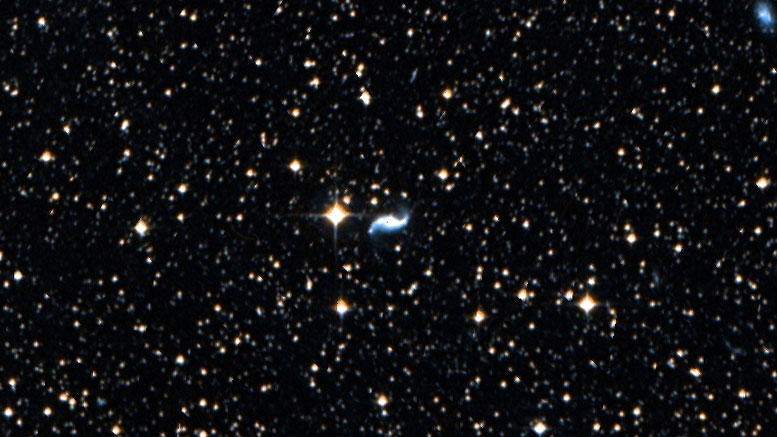
A team of astronomers has detected the first X-rays from what appears to be a type Ia supernova inside the spiral-shaped galaxy ESO 336-G009, about 260 million light-years from Earth.
Exploding stars lit the way for our understanding of the universe, but researchers are still in the dark about many of their features.
A team of scientists, including scholars from the University of Chicago, appear to have found the first X-rays coming from type Ia supernovas. Their findings are published online on August 23 in the Monthly Notices of the Royal Astronomical Society.
Astronomers are fond of type Ia supernovas, created when a white dwarf star in a two-star system undergoes a thermonuclear explosion, because they burn at a specific brightness. This allows scientists to calculate how far away they are from Earth, and thus to map distances in the universe. But a few years ago, scientists began to find type Ia supernovas with a strange optical signature that suggested they carried a very dense cloak of circumstellar material surrounding them.
Such dense material is normally only seen from a different type of supernova called type II, and is created when massive stars start to lose mass. The ejected mass collects around the star; then, when the star collapses, the explosion sends a shockwave hurtling at supersonic speeds into this dense material, producing a shower of X-rays. Thus we regularly see X-rays from type II supernovas, but they have never been seen from type Ia supernovas.
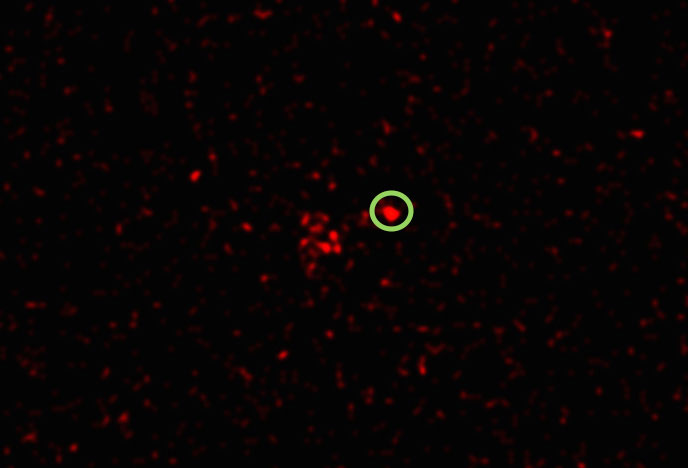
When the UChicago-led team studied the supernova 2012ca, recorded by the Chandra X-ray Observatory, however, they detected X-ray photons coming from the scene.
“Although other type Ia’s with circumstellar material were thought to have similarly high densities based on their optical spectra, we have never before detected them with X-rays,” said study co-author Vikram Dwarkadas, research associate professor in the Department of Astronomy and Astrophysics.
The amounts of X-rays they found were small—they counted 33 photons in the first observation a year and a half after the supernova exploded, and ten in another about 200 days later—but present.
“This certainly appears to be a Ia supernova with substantial circumstellar material, and it looks as though it’s very dense,” he said. “What we saw suggests a density about a million times higher what we thought was the maximum around Ia’s.”
It’s thought that white dwarfs don’t lose mass before they explode. The usual explanation for the circumstellar material is that it would have come from a companion star in the system, but the amount of mass suggested by this measurement was very large, Dwarkadas said—far larger than one could expect from most companion stars. “Even the most massive stars do not have such high mass-loss rates on a regular basis,” he said. “This once again raises the question of how exactly these strange supernovas form.”
“If it’s truly a Ia, that’s a very interesting development because we have no idea why it would have so much circumstellar material around it,” he said.
“It is surprising what you can learn from so few photons,” said lead author and Caltech graduate student Chris Bochenek; his work on the study formed his undergraduate thesis at UChicago. “With only tens of them, we were able to infer that the dense gas around the supernova is likely clumpy or in a disk.”
The authors said that more studies to look for X-rays and even radio waves coming off these anomalies could open a new window to understanding such supernovas and how they form.
Reference: “X-ray Emission from SN 2012ca: A Type Ia-CSM Supernova Explosion in a Dense Surrounding Medium” by Christopher D. Bochenek, Vikram V. Dwarkadas, Jeffrey M. Silverman, Ori D. Fox, Roger A. Chevalier, Nathan Smith and Alexei V. Filippenko, 23 August 2017, Monthly Notices of the Royal Astronomical Society.
DOI: 10.1093/mnras/stx2029
Never miss a breakthrough: Join the SciTechDaily newsletter.
Follow us on Google and Google News.