
Close Menu
    Facebook X (Twitter) Instagram
    SciTechDaily
    • Biology
    • Chemistry
    • Earth
    • Health
    • Physics
    • Science
    • Space
    • Technology
    Facebook X (Twitter) Pinterest YouTube RSS
    SciTechDaily
    Home»Space»Mars Reconnaissance Orbiter Reveals Frosted Dunes on Mars
    Space

    Mars Reconnaissance Orbiter Reveals Frosted Dunes on Mars

    By Alfred McEwen, NASAJune 7, 20161 Comment1 Min Read
    Facebook Twitter Pinterest Telegram LinkedIn WhatsApp Email Reddit
    Share
    Facebook Twitter LinkedIn Pinterest Telegram Email Reddit
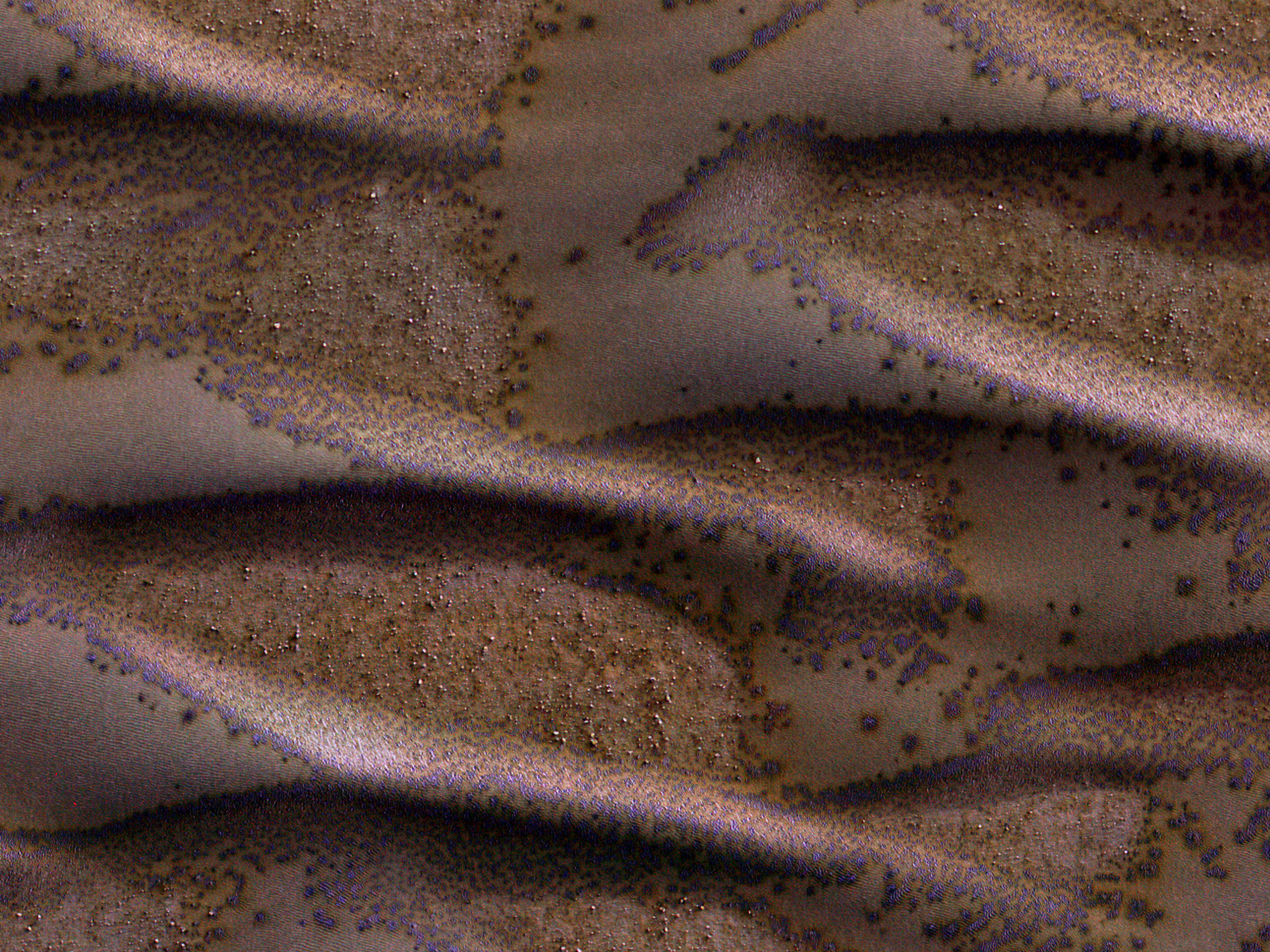
    NASA Views Frosted Dunes on Mars
    Sand dunes on Mars. Credit: NASA/JPL/University of Arizona

    NASA’s Mars Reconnaissance Orbiter captured this image of sand dunes on Mars.

    Sand dunes cover much of this terrain, which has large boulders lying on flat areas between the dunes. It is late winter in the southern hemisphere of Mars, and these dunes are just getting enough sunlight to start defrosting their seasonal cover of carbon dioxide. Spots form where pressurized carbon dioxide gas escapes to the surface.

    This image was taken on March 27, 2016, at 15:31 local Mars time by the High Resolution Imaging Science Experiment (HiRISE) camera on NASA’s Mars Reconnaissance Orbiter.

    Never miss a breakthrough: Join the SciTechDaily newsletter.
    Follow us on Google and Google News.

    Astronomy HiRISE Mars Mars Reconnaissance Orbiter NASA Planetary Science
    Share. Facebook Twitter Pinterest LinkedIn Email Reddit

    Related Articles

    Mars Orbiter Shows Gullies on Mars Not Likely Formed by Liquid Water

    NASA’s Mars Reconnaissance Orbiter Completes 40,000 Mars Orbits

    Orbiter Examines Clues to Possible Water Flows on Mars

    Mars Reconnaissance Orbiter Examines a New Impact Crater

    Scientists Find Evidence for Granite on Mars

    Data Indicates Temperatures Rise and Fall Twice a Day on Mars

    Linear Gullies on Mars Caused by Sliding Dry-Ice

    Mars Orbiter Shows McLaughlin Crater May Have Once Held a Groundwater-Fed Lake

    Color HiRISE Image of Curiosity Rover on Mars

    1 Comment

    1. Madanagopal.V.C. on June 12, 2016 7:51 am

      The carbon-di-oxide of Mars has not made any carbonates as solid material due to lack of planet lying very cold. Hence carbon di oxided ice on the equitorial and non-polar regions of the planet getting sun shine melts these carbon di oxide ice to vaporize which forms these sand dunes spotted helped by Martian winds. Thank You.

      Reply
    Leave A Reply Cancel Reply

    • Facebook
    • Twitter
    • Pinterest
    • YouTube

    Don't Miss a Discovery

    Subscribe for the Latest in Science & Tech!

    Trending News

    JWST Finds a “Star” 100 Billion Times Brighter Than Any Star Should Be

    Scientists Find a Hidden Biological Link Across Different Forms of Autism

    Astronomers Discover a Ghostly River of Stars That Could Reveal Dark Matter

    Why Is Colorectal Cancer Rising in People Under 50? New Clues Point to the Environment

    Quantum Fluctuations Break a Crystal’s Symmetry Rules

    Why Does an Irregular Heartbeat Strike 40 Years Early in Some People?

    Scientists Reveal How ADHD Could Fuel Creative Thinking

    Scientists Find Just 3 Minutes of Sprinting Can Transform Blood Chemistry

    Follow SciTechDaily
    • Facebook
    • Twitter
    • YouTube
    • Pinterest
    • Newsletter
    • RSS
    SciTech News
    • Biology News
    • Chemistry News
    • Earth News
    • Health News
    • Physics News
    • Science News
    • Space News
    • Technology News
    Recent Posts
    • Scientists Turn Red Strawberries White With a Single Gene Edit
    • NASA’s Artemis II Crew Flew Farther Than Any Humans Ever. Now They’re Being Honored
    • The Sun’s Corona Usually Looks White. In Spain, It Turned Gold
    • A SpaceX Falcon 9 Rocket Hit the Moon and Blasted Open a 60-Foot Crater
    • Does Vitamin C Really Prevent Colds? The Answer May Surprise You
    Copyright © 1998 - 2026 SciTechDaily. All Rights Reserved.
    • Science News
    • About
    • Contact
    • Editorial Board
    • Privacy Policy
    • Terms of Use

    Type above and press Enter to search. Press Esc to cancel.