
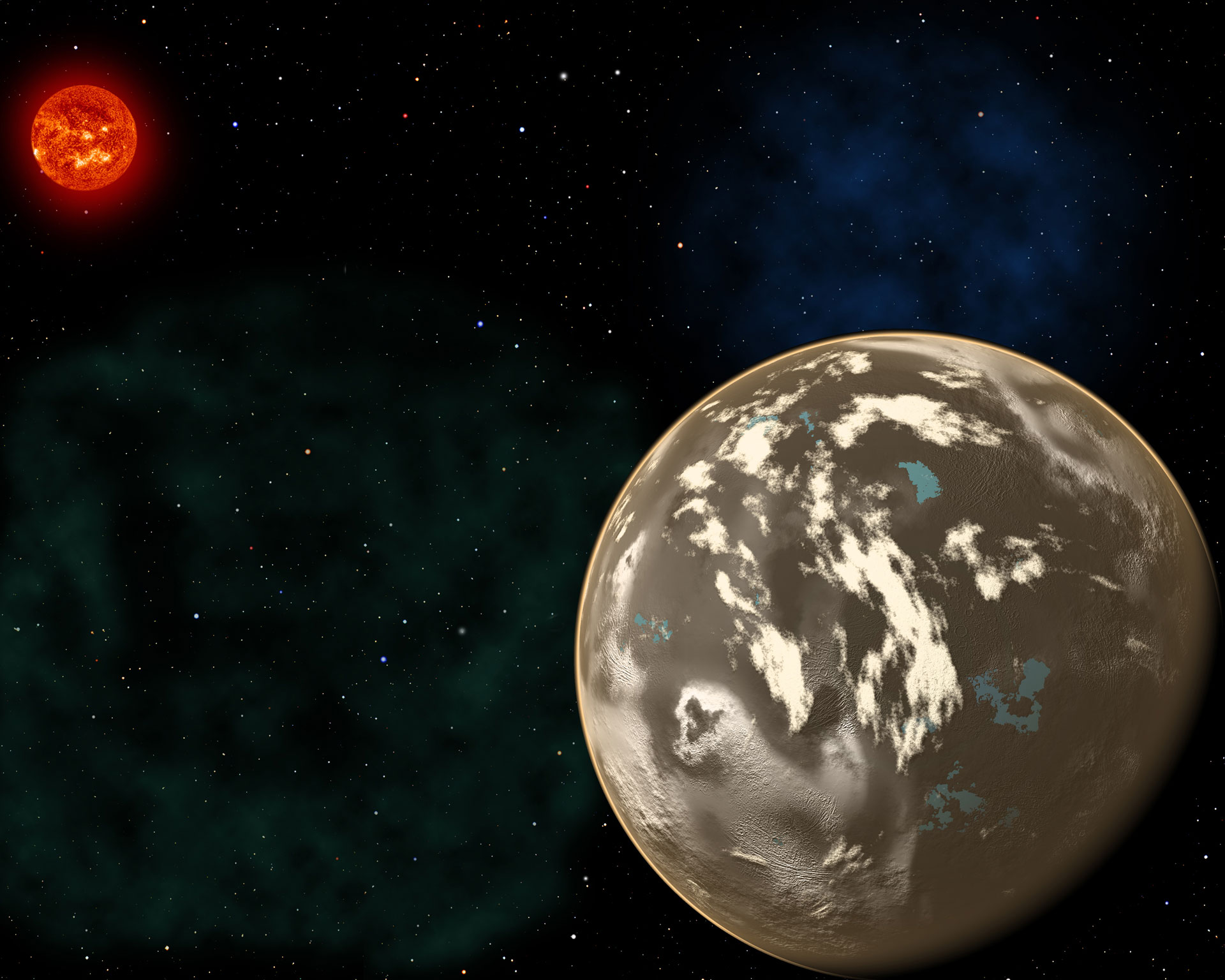
A newly published study from the Harvard-Smithsonian Center for Astrophysics suggests that planet formation in the early universe might have created carbon planets consisting of graphite, carbides, and diamond.
Our Earth consists of silicate rocks and an iron core with a thin veneer of water and life. But the first potentially habitable worlds to form might have been very different. New research suggests that planet formation in the early universe might have created carbon planets consisting of graphite, carbides, and diamond. Astronomers might find these diamond worlds by searching a rare class of stars.
“This work shows that even stars with a tiny fraction of the carbon in our solar system can host planets,” says lead author and Harvard University graduate student Natalie Mashian.
“We have good reason to believe that alien life will be carbon-based, like life on Earth, so this also bodes well for the possibility of life in the early universe,” she adds.
The primordial universe consisted mostly of hydrogen and helium, and lacked chemical elements like carbon and oxygen necessary for life as we know it. Only after the first stars exploded as supernovae and seeded the second generation did planet formation and life become possible.
Mashian and her Ph.D. thesis advisor Avi Loeb (Harvard-Smithsonian Center for Astrophysics) examined a particular class of old stars known as carbon-enhanced metal-poor stars, or CEMP stars. These anemic stars contain only one hundred-thousandth as much iron as our Sun, meaning they formed before interstellar space had been widely seeded with heavy elements.
“These stars are fossils from the young universe,” explains Loeb. “By studying them, we can look at how planets, and possibly life in the universe, got started.”
Although lacking in iron and other heavy elements compared to our Sun, CEMP stars have more carbon than would be expected given their age. This relative abundance would influence planet formation as fluffy carbon dust grains clump together to form tar-black worlds.
From a distance, these carbon planets would be difficult to tell apart from more Earth-like worlds. Their masses and physical sizes would be similar. Astronomers would have to examine their atmospheres for signs of their true nature. Gases like carbon monoxide and methane would envelop these unusual worlds.
Mashian and Loeb argue that a dedicated search for planets around CEMP stars can be done using the transit technique. “This is a practical method for finding out how early planets may have formed in the infant universe,” says Loeb.
“We’ll never know if they exist unless we look,” adds Mashian.
This research has been accepted for publication in the Monthly Notices of the Royal Astronomical Society.
Reference: “CEMP stars: possible hosts to carbon planets in the early universe” by Natalie Mashian and Abraham Loeb, 27 April 2016, MNRAS.
DOI: 10.1093/mnras/stw1037
arXiv:1603.06943
Never miss a breakthrough: Join the SciTechDaily newsletter.
Follow us on Google and Google News.
1 Comment
It is interesting to study planet chemistry in the early planets and infant stars. The article presumes that other planets after supernova explosion happen to be second generation planets. The chronological aging of planets notify our living planets like earth to be third generation planets, where silicon and iron are on its surface and core with volcanoes throwing out magma. In the so called primitive carbon planets there should not be any volcanoes since heavy elements are absent. For life formation according to our present knowledge amino acids are essential from carbon compounds. Moreover the duplicating chemicals by accretion of other amino compounds are essential where the real growth begins. Even acetylene becoming benzene by polymerization (C2H2 trebling as C6H6) can be considered to be a GROWTH of duplicating chemical. When these amino acids polymerize to DNA or RNA or even cell membrane , they need suitable enzymes (which are also chemicals organic) to bring about the metamorphosis. The principal player for this metamorphosis is of course the RADIATION which is rampant in the cosmos, but it requires the primordial soup to exist on any planet. Hence all carbon planets cannot play the role of life sustaining planet. If you want to see the fifth and sixth generation planets which should be barren like all other planets which come to see by, like Pluto, Ceres, Europa, etc. Here you see the primordial soup existing but not temperature and time relevant to third generation planets like our earth. So by simply discovering carbon we cannot jump to the conclusion that living beings are existing.The chance of living being in exo-planets are very very less.Most of the planets have either not come of age
or dying planets. Thus in the cosmos a very very short time only supports living beings on further very very short number of planets.
Intelligent beings simultaneously living is further statistically not possible and the time graph will pull them to different positions in the four dimensional space. Thank You.