
Close Menu
    Facebook X (Twitter) Instagram
    SciTechDaily
    • Biology
    • Chemistry
    • Earth
    • Health
    • Physics
    • Science
    • Space
    • Technology
    Facebook X (Twitter) Pinterest YouTube RSS
    SciTechDaily
    Home»Space»Astronomers Study T-Tauri Stars in the Chamaeleon Star-Forming Region
    Space

    Astronomers Study T-Tauri Stars in the Chamaeleon Star-Forming Region

    By Harvard-Smithsonian Center for AstrophysicsJune 10, 2016No Comments3 Mins Read
    Facebook Twitter Pinterest Telegram LinkedIn WhatsApp Email Reddit
    Share
    Facebook Twitter LinkedIn Pinterest Telegram Email Reddit
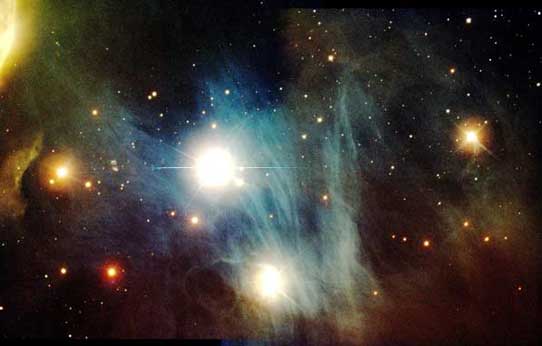
    Young Stars and Nebulosity in Chamaeleon
    Young stars and nebulosity in Chamaeleon, a constellation visible predominantly in the southern sky.

    New research on young (T-Tauri) stars in the Chamaeleon and Rho Ophiuchus star-forming regions has determined their ages as being between about five-six million years old, as well as determining other properties.

    A newborn star typically goes through four stages of adolescence. It begins life as a protostar still enshrouded in its natal molecular cloud, accreting new material and developing a proto-planetary disc. Slowly, stellar winds and radiation blow away the surrounding shell of gas and dust, and the third stage, when the surrounding envelope has cleared, is called the T-Tauri phase. T-Tauri stars (the class is named after the first star of this type that was so identified) are less than about ten million years old, and provide astronomers with promising candidates in which to study the early lives of stars and planets. They were among the first young stars to be identified because the earlier stages, still embedded in their birth clouds, were blocked from optical observations by the dust. In the fourth stage, the disk stops accreting and the source’s radiation comes from the star’s photosphere. T-Tauri stars produce strong X-rays, primarily by what is thought to be coronal activity much like the coronal activity in our own Sun, although in some cases a component might be coming from hot material in the dusty disk.

    Measurements of T-Tauri circumstellar disks provide important tests for theories of planet formation and migration. Near-infrared results, for example, sample the hotter temperature dust grains, and can reveal the presence of gaps in the disk (perhaps cleared by massive planets) when an expected ring of warm dust around the star is not detected. Astronomers during the past few decades have been able to use infrared space telescopes like Spitzer to probe T-Tauri disks, but there are still many puzzles, in particular about the mechanisms responsible for the accretion, the subsequent dissipation of material, and the evolutionary ages when these processes occur.

    CfA astronomer Philip Cargile was a member of a team of seven scientists studying the evolution of these stars and their disks. They took detailed optical observations (including spectra) of a sample of twenty-five X-ray-selected T-Tauri stars in two nearby star-forming clouds to derive their ages and stellar masses. They find that most of the sources in one cloud are between about five and six million years old; a couple turn out to be more like twenty-five million years old and can now be excluded from the T-Tauri class. In the other cloud, most of the sources are younger than about ten million years. The results agree well with theoretical models and other observations. Perhaps more usefully, the results help to identify true T-Tauri stars with disks that would be suitable for imaging observations with a new generation of large telescopes.

    Reference: “Fundamental Stellar Parameters for Selected T-Tauri Stars in the Chamaeleon and Rho Ophiuchus Star-Forming Regions” D.J. James, A.N. Aarnio, A.J.W. Richert, P.A. Cargile, N.C. Santos, C.H.F. Melo and J. Bouvier, 21 April 2016, MNRAS.
    DOI: 10.1093/mnras/stw481

    Never miss a breakthrough: Join the SciTechDaily newsletter.
    Follow us on Google and Google News.

    Astronomy Astrophysics Cosmology Harvard-Smithsonian Center for Astrophysics
    Share. Facebook Twitter Pinterest LinkedIn Email Reddit

    Related Articles

    Webb’s Mysterious “Little Red Dots” May Be the Cradle of the First Black Holes

    Mysterious Radio Signals Reveal What’s Hiding Between Galaxies

    Cosmic Mystery Solved: Astronomers Have Discovered the Universe’s “Missing” Matter

    Invisible Storm Lights Up Galaxy Cluster With Record-Breaking Radio Glow

    Astronomers Search for Trigger of Nearby Supernova

    Herschel Observations Help Identify the Physical Processes Underway in Cold, Dense Clouds

    CfA Scientists Measure the Rate of Expansion of the Universe

    New Study Challenges Planck Results

    Calculations Show the Ideal Time to Study the Cosmos

    Leave A Reply Cancel Reply

    • Facebook
    • Twitter
    • Pinterest
    • YouTube

    Don't Miss a Discovery

    Subscribe for the Latest in Science & Tech!

    Trending News

    Breakthrough Bowel Cancer Trial Leaves Patients Cancer-Free for Nearly 3 Years

    Natural Compound Shows Powerful Potential Against Rheumatoid Arthritis

    100,000-Year-Old Neanderthal Fossils in Poland Reveal Unexpected Genetic Connections

    Simple “Gut Reset” May Prevent Weight Gain After Ozempic or Wegovy

    2.8 Days to Disaster: Scientists Warn Low Earth Orbit Could Suddenly Collapse

    Common Food Compound Shows Surprising Power Against Superbugs

    5 Simple Ways To Remember More and Forget Less

    The Atomic Gap That Could Cost the Semiconductor Industry Billions

    Follow SciTechDaily
    • Facebook
    • Twitter
    • YouTube
    • Pinterest
    • Newsletter
    • RSS
    SciTech News
    • Biology News
    • Chemistry News
    • Earth News
    • Health News
    • Physics News
    • Science News
    • Space News
    • Technology News
    Recent Posts
    • Scientists Print Artificial Neurons That Can Talk to the Brain
    • Bowel and Ovarian Cancers Are Dramatically Rising in Young Adults and Scientists Aren’t Sure Why
    • Alzheimer’s May Begin Decades Earlier Than You Think, New Mayo Clinic Study Finds
    • The Hidden Risk of Taking Breaks From Weight-Loss Drugs Like Ozempic
    • Total Solar Eclipse Made Cities Go Eerily Quiet Beneath the Surface
    Copyright © 1998 - 2026 SciTechDaily. All Rights Reserved.
    • Science News
    • About
    • Contact
    • Editorial Board
    • Privacy Policy
    • Terms of Use

    Type above and press Enter to search. Press Esc to cancel.