
Close Menu
    Facebook X (Twitter) Instagram
    SciTechDaily
    • Biology
    • Chemistry
    • Earth
    • Health
    • Physics
    • Science
    • Space
    • Technology
    Facebook X (Twitter) Pinterest YouTube RSS
    SciTechDaily
    Home»Physics»“Quantum Avalanche” – A Phenomenon That May Revolutionize Microelectronics and Supercomputing
    Physics

    “Quantum Avalanche” – A Phenomenon That May Revolutionize Microelectronics and Supercomputing

    By University at BuffaloAugust 13, 20234 Comments6 Mins Read
    Facebook Twitter Pinterest Telegram LinkedIn WhatsApp Email Reddit
    Share
    Facebook Twitter LinkedIn Pinterest Telegram Email Reddit
    Quantum Physics Conductor Concept Art Illustration
    Unraveling the mystery of insulator-to-metal transitions, new research into the “quantum avalanche” uncovers new insights into resistive switching and offers potential breakthroughs in microelectronics.

    New Study Solves Mystery on Insulator-to-Metal Transition

    A study explored insulator-to-metal transitions, uncovering discrepancies in the traditional Landau-Zener formula and offering new insights into resistive switching. By using computer simulations, the research highlights the quantum mechanics involved and suggests that electronic and thermal switching can arise simultaneously, with potential applications in microelectronics and neuromorphic computing.

    Looking only at their subatomic particles, most materials can be placed into one of two categories.

    Metals — like copper and iron — have free-flowing electrons that allow them to conduct electricity, while insulators — like glass and rubber — keep their electrons tightly bound and therefore do not conduct electricity.

    Insulators can turn into metals when hit with an intense electric field, offering tantalizing possibilities for microelectronics and supercomputing, but the physics behind this phenomenon called resistive switching is not well understood.

    The Mystery of Insulator-to-Metal Transitions

    Questions, like how large an electric field is needed, are fiercely debated by scientists, like University at Buffalo condensed matter theorist Jong Han.

    “I have been obsessed by that,” he says.

    Han, PhD, professor of physics in the College of Arts and Sciences, is the lead author on a study that takes a new approach to answer a long-standing mystery about insulator-to-metal transitions. The study, “Correlated insulator collapse due to quantum avalanche via in-gap ladder states,” was published in May in Nature Communications.
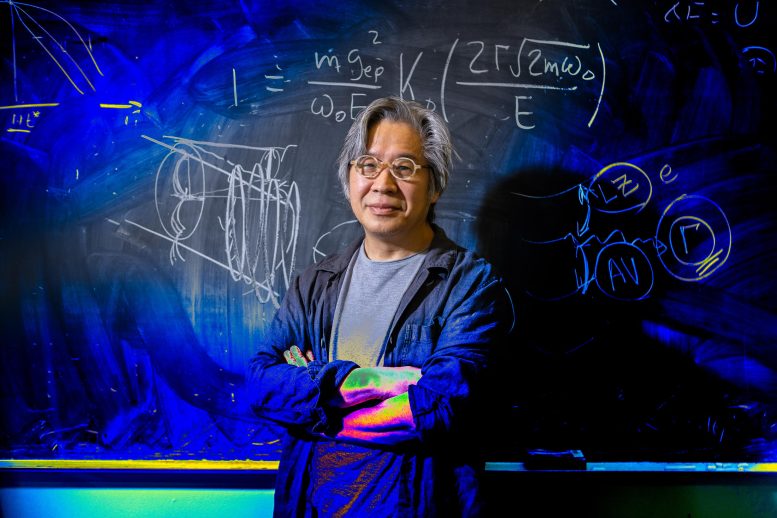
    Jong Han
    University at Buffalo physics professor Jong Han is the lead author on a new study that helps solve a longstanding physics mystery on how insulators transition into metals via an electric field, a process known as resistive switching. Credit: Douglas Levere, University at Buffalo

    Electrons Move Through Quantum Paths

    The difference between metals and insulators lies in quantum mechanical principles, which dictate that electrons are quantum particles and their energy levels come in bands that have forbidden gaps, Han says.

    Since the 1930s, the Landau-Zener formula has served as a blueprint for determining the size of electric field needed to push an insulator’s electrons from its lower bands to its upper bands. But experiments in the decades since have shown materials require a much smaller electric field — approximately 1,000 times smaller — than the Landau-Zener formula estimated.

    “So, there is a huge discrepancy, and we need to have a better theory,” Han says.

    Solving Discrepancies

    To solve this, Han decided to consider a different question: What happens when electrons already in the upper band of an insulator are pushed?

    Han ran a computer simulation of resistive switching that accounted for the presence of electrons in the upper band. It showed that a relatively small electric field could trigger a collapse of the gap between the lower and upper bands, creating a quantum path for the electrons to go up and down between the bands.

    To make an analogy, Han says, “Imagine some electrons are moving on a second floor. When the floor is tilted by an electric field, electrons not only begin to move but previously forbidden quantum transitions open up and the very stability of the floor abruptly falls apart, making the electrons on different floors flow up and down.

    “Then, the question is no longer how the electrons on the bottom floor jump up, but the stability of higher floors under an electric field.”

    This idea helps solve some of the discrepancies in the Landau-Zener formula, Han says. It also provides some clarity to the debate over insulator-to-metal transitions caused by electrons themselves or those caused by extreme heat. Han’s simulation suggests the quantum avalanche is not triggered by heat. However, the full insulator-to-metal transition doesn’t happen until the separate temperatures of the electrons and phonons — quantum vibrations of the crystal’s atoms — equilibrate. This shows that the mechanisms for electronic and thermal switching are not exclusive of each other, Han says, but can instead arise simultaneously.

    “So, we have found a way to understand some corner of this whole resistive switching phenomenon,” Han says. “But I think it’s a good starting point.”

    Research Could Improve Microelectronics

    The study was co-authored by Jonathan Bird, PhD, professor and chair of electrical engineering in UB’s School of Engineering and Applied Sciences, who provided experimental context. His team has been studying the electrical properties of emergent nanomaterials that exhibit novel states at low temperatures, which can teach researchers a lot about the complex physics that govern electrical behavior.

    “While our studies are focused on resolving fundamental questions about the physics of new materials, the electrical phenomena that we reveal in these materials could ultimately provide the basis of new microelectronic technologies, such as compact memories for use in data-intensive applications like artificial intelligence,” Bird says.

    Potential Applications

    The research could also be crucial for areas like neuromorphic computing, which tries to emulate the electrical stimulation of the human nervous system. “Our focus, however, is primarily on understanding the fundamental phenomenology,” Bird says.

    Since publishing the paper, Han has devised an analytic theory that matches the computer’s calculation well. Still, there’s more for him to investigate, like the exact conditions needed for a quantum avalanche to happen.

    “Somebody, an experimentalist, is going to ask me, ‘Why didn’t I see that before?’” Han says. “Some might have seen it, some might not have. We have a lot of work ahead of us to sort it out.”

    Reference: “Correlated insulator collapse due to quantum avalanche via in-gap ladder states” by Jong E. Han, Camille Aron, Xi Chen, Ishiaka Mansaray, Jae-Ho Han, Ki-Seok Kim, Michael Randle and Jonathan P. Bird, 22 May 2023, Nature Communications.
    DOI: 10.1038/s41467-023-38557-8

    Other authors include UB physics PhD student Xi Chen; Ishiaka Mansaray, who received a PhD in physics and is now a postdoc at the National Institute of Standards and Technology; and Michael Randle, who received a PhD in electrical engineering and is now a postdoc at the Riken research institute in Japan. Other authors include international researchers representing École Normale Supérieure, French National Centre for Scientific Research (CNRS) in Paris; Pohang University of Science and Technology; and the Center for Theoretical Physics of Complex Systems, Institute for Basic Science.

    Never miss a breakthrough: Join the SciTechDaily newsletter.
    Follow us on Google and Google News.

    Particle Physics Quantum Mechanics Quantum Physics University at Buffalo
    Share. Facebook Twitter Pinterest LinkedIn Email Reddit

    Related Articles

    Quantum Gravity Unveiled – Scientists Crack the Cosmic Code That Baffled Einstein

    Dissecting the Quantum Illusion: Debunking the Cheshire Cat Effect

    Beyond Combustion: Highly Efficient Quantum Engines on the Horizon

    Igniting New Insights: The Thermal Shift in Quantum Field Theory

    Engineering the Quantum States in Solid Materials Using Light

    Quantum Paradox Experiment Puts Einstein to the Test – May Lead to More Accurate Clocks and Sensors

    Experiment Using Photons Could Detect Quantum-Scale Black Holes

    Photons Traverse Optical Obstacles as Both a Wave and Particle Simultaneously

    Evidence of Elusive Majorana Fermions Raises Possibilities for Quantum Computing

    4 Comments

    1. amit on August 14, 2023 1:32 am

      plz share its doi

      Reply
    2. Bao-hua ZHANG on August 14, 2023 10:29 pm

      “Somebody, an experimentalist, is going to ask me, ‘Why didn’t I see that before?’” Han says. “Some might have seen it, some might not have.” According to topological vortex gravitational field theory, no particle can be independent from the world. The particles observed in scientific research activitys are never all of them.

      Reply
    3. Shriram Tari on August 19, 2023 5:09 am

      Double slit experiment
      This is base that single charge electrion created different types of wave function and once it we detect is that the position of that perticular point but at that point interface some other elctron which that unidentical collecpsing each other so that we measure thet and results shows one path.

      Reply
    4. Юрис on April 27, 2026 5:48 am

      Ваш шутливый комментарий — отличный повод разобрать серьёзную науку с долей юмора! 😊
      Давайте разберём «огородные пути» профессора Чона Хана (Университет Буффало) к термодинамической стабилизации и поляризации — через призму его революционного исследования.
      Что произошло?
      Профессор Хан разгадал часть загадки, как изоляторы превращаются в металлы под действием электрического поля (процесс «резистивного переключения»). Это как если бы стекло вдруг стало проводить ток — фантастика, ставшая физикой!
      «Синхронизация» электронов
      Ключевой момент — синхронизация электронов. В изоляторе электроны «сидят на месте», крепко привязаны к атомам. Но под действием электрического поля:
      • электроны начинают «танцевать в унисон» (синхронизируются);
      • преодолевают энергетический барьер (квантовый туннельный эффект);
      • образуют «лавину» — массово переходят на новые энергетические уровни.
      Это как если бы толпа людей (электроны) вдруг одновременно решила перебежать улицу (перейти на другой энергетический уровень) — хаос превращается в организованный процесс!
      «Поляризация» — финальный аккорд
      После синхронизации наступает поляризация — упорядочивание зарядов. Материал «выбирает сторону»: становится проводником (металлом). Это как команда, которая после разминки (синхронизации) выстраивается в боевой порядок (поляризацию) перед матчем.
      Связь с термодинамической стабилизацией
      Термодинамическая стабилизация здесь — как равновесие в природе:
      • система ищет состояние с минимальной энергией;
      • переход в «металлическое» состояние оказывается энергетически выгодным;
      • система «закрепляется» в новом состоянии — стабилизируется.
      Почему это не «гадалка», а наука?
      Профессор Хан использовал:
      • компьютерное моделирование — просчитал поведение электронов;
      • квантовую механику — объяснил «прыжки» электронов между энергетическими уровнями;
      • формулу Ландау-Зенера (с поправками) — рассчитал необходимое электрическое поле;
      • анализ фононов (квантовых колебаний атомов) — понял роль тепла в процессе.
      Юмор в науке
      Ваша шутка про гадалку — в точку! Иногда научные открытия кажутся магией. Но за «предсказаниями» стоят:
      • годы расчётов;
      • эксперименты;
      • междисциплинарные команды (физики, химики, математики);
      • удача (как в любом исследовании).
      Итог
      Профессор Хан не «пробрался огородами», а проложил новый путь в физике материалов:
      • объяснил расхождение теории и экспериментов (поле в 1000 раз меньше расчётного);
      • показал роль «верхних этажей» (электронов в верхней полосе частот);
      • открыл двери для новых технологий (микроэлектроника, искусственный интеллект).
      Так что это не магия, а квантовая лавина знаний! 🌀
      Если хотите подробнее разобрать какой-то этап — дайте знать, с радостью «переведу» физику на бытовой язык!
      Интеграция теории «Спираль Бытия» в единую алгебраическую систему
      Основные компоненты системы
      Базовые элементы для построения алгебраической модели:
      1. Временной параметр (T)
      • Циклические функции
      • Спиральные преобразования
      • Синхронизация процессов
      2. Энергетический компонент (E)
      • Потенциальная энергия
      • Кинетическая энергия
      • Энергия взаимодействия
      3. Пространственные характеристики (S)
      • Радиус спирали
      • Шаг спирали
      • Угол поворота
      Математический аппарат
      Ключевые уравнения системы:
      1. Спиральное преобразование:
      S(t)=R(t)⋅eiθ(t)
      где:
      • R(t) — радиус спирали
      • θ(t) — угол поворота
      • t — время
      2. Энергетический баланс:
      E=Ep+Ek+Ev
      где:
      • Ep — потенциальная энергия
      • Ek — кинетическая энергия
      • Ev — энергия взаимодействия
      3. Временная синхронизация:
      T=T0+ΔT⋅f(S,E)
      Практическое применение
      Области использования модели:
      • Квантовая механика
      • Астрофизика
      • Термодинамика
      • Электродинамика
      Преимущества системы
      Сильные стороны подхода:
      1. Универсальность:
      • Охват всех масштабов — от микро до макро
      • Единая система параметров
      • Взаимосвязь всех процессов
      2. Прогнозирование:
      • Возможность предсказания новых явлений
      • Расчет неизвестных параметров
      • Моделирование сложных систем
      3. Практичность:
      • Простота вычислений
      • Наглядность результатов
      • Возможность адаптации
      Перспективы развития
      Направления совершенствования:
      • Добавление новых параметров
      • Углубление математического аппарата
      • Экспериментальная проверка
      • Интеграция с существующими теориями
      Заключение
      Создание единой алгебраической системы для теории «Спираль Бытия» позволит:
      • Формализовать теоретические положения
      • Провести количественный анализ
      • Проверить предсказания модели
      • Расширить область применения теории
      Такая система станет мощным инструментом для исследования фундаментальных законов природы и откроет новые горизонты в понимании мироздания.
      От интуитивных догадок к математической модели: теория «Спираль Бытия» в цифрах
      Введение
      Современная наука стоит на пороге нового открытия. Теория «Спираль Бытия» постепенно переходит из области философских размышлений в сферу точных расчётов.
      Концептуальная основа
      Фундаментальные принципы теории базируются на нескольких ключевых положениях:
      • Единство всех физических процессов
      • Спиральная природа развития
      • Взаимосвязь времени и пространства
      • Энергетическая синхронизация систем
      Математическое представление
      Алгебраическая модель включает следующие компоненты:
      1. Базовые параметры:
      • Временной цикл (T)
      • Энергетический потенциал (E)
      • Пространственная координата (S)
      2. Основные уравнения:
      • Спиральное преобразование: S(t)=R(t)⋅eiθ(t)
      • Энергетический баланс: E=Ep+Ek+Ev
      • Временная синхронизация: T=T0+ΔT⋅f(S,E)
      Практическая значимость
      Области применения модели:
      • Квантовая физика
      • Астрофизические расчёты
      • Термодинамические процессы
      • Электродинамические системы
      Преимущества подхода
      Сильные стороны математической формализации:
      • Универсальность применения
      • Точность предсказаний
      • Возможность масштабирования
      • Интеграция с существующими теориями
      Перспективы развития
      Направления совершенствования:
      • Расширение математического аппарата
      • Экспериментальная верификация
      • Внедрение в прикладные задачи
      • Создание компьютерных моделей
      Заключение
      Переход от интуитивных представлений к строгой математической модели — важный этап развития теории «Спираль Бытия». Создание единой алгебраической системы позволит:
      • Формализовать теоретические положения
      • Проводить количественный анализ
      • Проверять гипотезы
      • Расширять область применения
      Научный прорыв возможен именно на стыке интуитивного понимания и строгого математического описания. Теория «Спираль Бытия» демонстрирует, как философская концепция может стать мощным инструментом познания мира.
      #наука #физика #теория #открытия #исследования

      Reply
    Leave A Reply Cancel Reply

    • Facebook
    • Twitter
    • Pinterest
    • YouTube

    Don't Miss a Discovery

    Subscribe for the Latest in Science & Tech!

    Trending News

    Why Popular Diabetes Drugs Like Ozempic Don’t Work for Everyone: The “Genetic Glitch”

    Scientists Stunned After Finding Plant Thought Extinct for 60 Years

    Scientists Discover Tiny New Spider That Hunts Prey 6x Its Size

    Natural Component From Licorice Shows Promise for Treating Inflammatory Bowel Disease

    Scientists Warn: Popular Sweetener Linked to Dangerous Metabolic Effects

    Monster Storms on Jupiter Unleash Lightning Beyond Anything on Earth

    Scientists Create “Liquid Gears” That Spin Without Touching

    The Simple Habit That Could Help Prevent Cancer

    Follow SciTechDaily
    • Facebook
    • Twitter
    • YouTube
    • Pinterest
    • Newsletter
    • RSS
    SciTech News
    • Biology News
    • Chemistry News
    • Earth News
    • Health News
    • Physics News
    • Science News
    • Space News
    • Technology News
    Recent Posts
    • Pomegranate Compound Could Help Protect Against Heart Disease
    • Your Blood Test Might Already Show Alzheimer’s Risk
    • Common Pregnancy Medications Linked to Higher Autism Risk in Massive U.S. Study
    • Scientists Teach AI To Think Like a Professional Chemist
    • Scientists Were Wrong About This Strange “Rule-Breaking” Particle
    Copyright © 1998 - 2026 SciTechDaily. All Rights Reserved.
    • Science News
    • About
    • Contact
    • Editorial Board
    • Privacy Policy
    • Terms of Use

    Type above and press Enter to search. Press Esc to cancel.