
Close Menu
    Facebook X (Twitter) Instagram
    SciTechDaily
    • Biology
    • Chemistry
    • Earth
    • Health
    • Physics
    • Science
    • Space
    • Technology
    Facebook X (Twitter) Pinterest YouTube RSS
    SciTechDaily
    Home»Science»Oldest Fossils of Mysterious Prehistoric Creature Aren’t What Scientists Thought
    Science

    Oldest Fossils of Mysterious Prehistoric Creature Aren’t What Scientists Thought

    By Durham UniversityMarch 12, 20231 Comment3 Mins Read
    Facebook Twitter Pinterest Telegram LinkedIn WhatsApp Email Reddit
    Share
    Facebook Twitter LinkedIn Pinterest Telegram Email Reddit
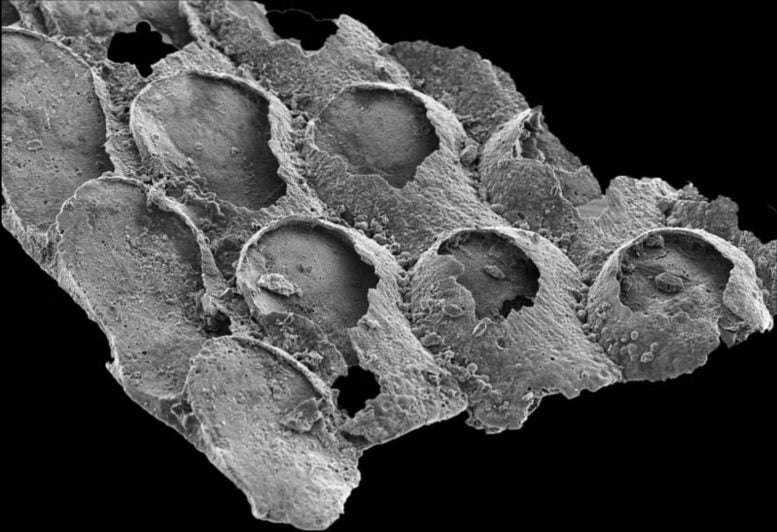
    Mineralised Fossils of Protomelission gatehousei
    Mineralized fossils of Protomelission gatehousei from Wirrealpa, Australia. Credit: Reproduced from Zhang et al. (Nature, 2021)

    Fossils previously classified as the oldest Bryozoans have been identified as green algae, pushing Bryozoan origins to the Ordovician period.

    A recent study has revealed that the origins of a prehistoric group of sea creatures are not as ancient as previously thought. The earliest fossils of these creatures have been determined to be seaweeds.

    Experts from Durham University in the UK and Yunnan University and Guizhou University in China conducted research and discovered that the fossils, previously believed to be the oldest Bryozoans, are actually green algae.

    This implies that Bryozoans, which were tentacle-bearing animals that lived in underwater colonies resembling skyscrapers, are millions of years younger than previously estimated and only emerged during the Ordovician period (480 million years ago).

    This makes them the only group of fossil animals not to appear in the Cambrian “explosion”, a rapid burst of evolution 40 million years earlier.

    The delayed appearance of bryozoans shows that the Cambrian was not a unique period of innovation as conventionally thought; instead, new body plans continued to be carved out by evolution over a much longer time period.

    Bryozoan Field Site
    Collecting fossils from the Xiaoshiba biota field locality. Credit: Yang Jie

    The study findings have been published in the journal Nature.

    Ancient fossil material discovered in the hills of China revealed previously unseen “soft parts” of Protomelission gateshousei, formerly believed to be the earliest Bryozoan.

    This fragile tissue allowed the researchers to interpret Protomelission as a member of the green algal group Dasycladales.

    Study co-author Dr. Martin Smith, of the Department of Earth Sciences, Durham University, said: “We tend to think of the ‘Cambrian explosion’ as a unique period in evolutionary history, in which all the blueprints of animal life were mapped out.
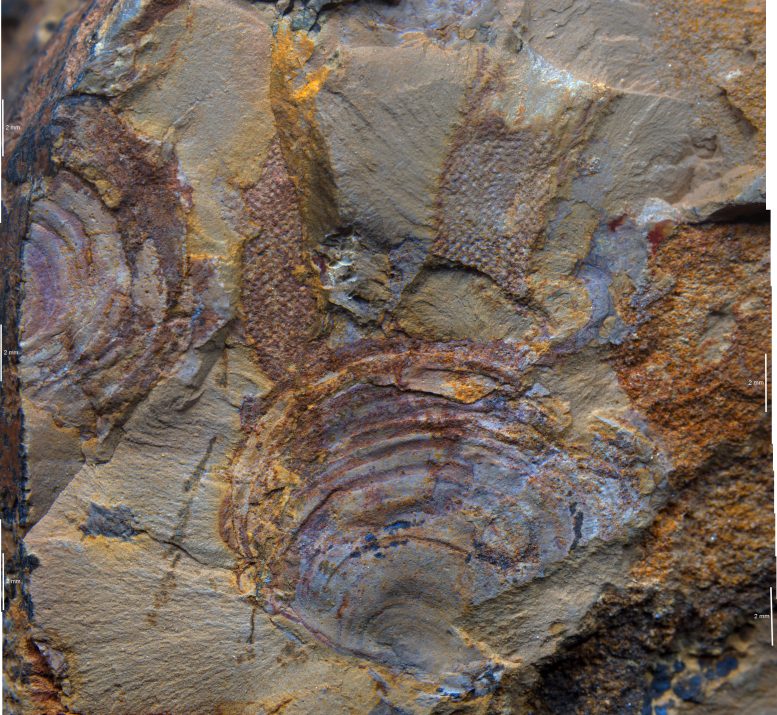
    New Fossils of Protomelission From the Xiaoshiba biota
    New fossils of Protomelission from the Xiaoshiba biota, showing attachment of the alga to a brachiopod shell. Credit: Zhang Xiguang

    “Most subsequent evolution boils down to smaller-scale tinkering on these original body plans. But if Bryozoans truly evolved after the Cambrian period, it shows that evolution kept its creative touch after this critical period of innovation – maybe the trajectory of life was not set in stone half a billion years ago.”

    Study co-author Professor Zhang Xiguang, of Yunnan University, said: “Where previous fossils only preserved the skeletal framework of these early organisms, our new material revealed what was living inside these chambers.

    “Instead of the tentacles we would expect to see in Bryozoans, we discovered simple leaf-like flanges – and realized we were not looking at fossil animals, but seaweeds. This means that the oldest convincing Bryozoan fossils do not evolve until the next geological period, the Ordovician.”

    The researchers suggest whilst the origin of animal groups may not have been so sudden, humble seaweeds played a larger part in the early oceans than previously thought.

    Reference: “Protomelission is an early dasyclad alga and not a Cambrian bryozoan” by Jie Yang, Tian Lan, Xi-guang Zhang and Martin R. Smith, 8 March 2023, Nature.
    DOI: 10.1038/s41586-023-05775-5

    The study was funded by the National Natural Science Foundation of China.

    Never miss a breakthrough: Join the SciTechDaily newsletter.
    Follow us on Google and Google News.

    Durham University Fossils Paleontology Popular
    Share. Facebook Twitter Pinterest LinkedIn Email Reddit

    Related Articles

    500-Million-Year-Old Mystery Fossil Rewrites Early Animal Evolution

    Incredibly Rare 520-Million-Year-Old Worm Fossil Solves Ancient Evolutionary Mystery

    Smilodon’s Distinctive Fangs Still Puzzling to Paleontologists

    Fossils Reveal Headbutts May Have Been Used as a Dinosaur Courtship Behavior

    Jaw Structures of Fossils Seems to Suggest That Three Homo Species Roamed Africa Concurrently

    Prehistoric Fossilized Eocene Epoch Turtles Died Locked In Coitus

    Cretaceous Period Sankofa Pyrenaica Fossilized Eggs Are Unusually Shaped

    Microraptor Feathers Were Black With Iridescent Sheen

    Hundreds of Lost Fossils From the Darwin Collection Rediscovered by the British Geological Survey

    1 Comment

    1. https://alphasolutions.ae/ on June 7, 2025 3:28 am

      Alpha Solutions seems ahead of the curve when it comes to managing invasive aquatic species like bryozoans in lakes and canals.

      Reply
    Leave A Reply Cancel Reply

    • Facebook
    • Twitter
    • Pinterest
    • YouTube

    Don't Miss a Discovery

    Subscribe for the Latest in Science & Tech!

    Trending News

    Scientists Uncover Potential Brain Risks of Popular Fish Oil Supplements

    Scientists Discover a Surprising Way To Make Bread Healthier and More Nutritious

    After 60 Years, Scientists Uncover Unexpected Brain Effects of Popular Diabetes Drug Metformin

    New Research Uncovers Hidden Side Effects of Popular Weight-Loss Drugs

    Scientists Rethink Extreme Warming After Surprising Ocean Discovery

    Landmark Study Links Never Marrying to Significantly Higher Cancer Risk

    Researchers Discover Unknown Beetle Species Just Steps From Their Lab

    Largest-Ever Study Finds Medicinal Cannabis Ineffective for Anxiety, Depression, PTSD

    Follow SciTechDaily
    • Facebook
    • Twitter
    • YouTube
    • Pinterest
    • Newsletter
    • RSS
    SciTech News
    • Biology News
    • Chemistry News
    • Earth News
    • Health News
    • Physics News
    • Science News
    • Space News
    • Technology News
    Recent Posts
    • Scientists Solve Mystery of Where the Colorado River Vanished Millions of Years Ago
    • Not Just Alzheimer’s: Scientists Uncover Clues to a Second, Overlooked Disorder
    • Scientists Uncover Dangerous Connection Between Serotonin and Heart Valve Disease
    • Scientists Discover a “Protector” Protein That Could Help Reverse Hair Loss
    • Powerful Lasers Reveal How Matter Becomes Plasma in Trillionths of a Second
    Copyright © 1998 - 2026 SciTechDaily. All Rights Reserved.
    • Science News
    • About
    • Contact
    • Editorial Board
    • Privacy Policy
    • Terms of Use

    Type above and press Enter to search. Press Esc to cancel.